South Africa’s unemployment disaster is worse than it looks


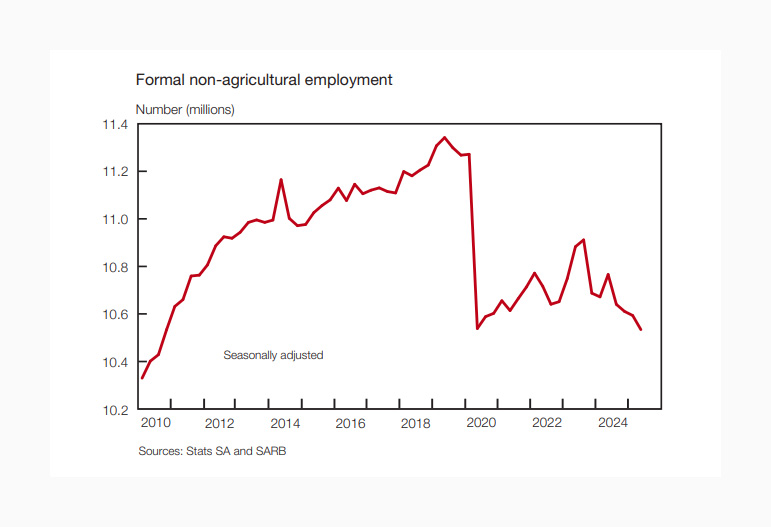
South Africa’s formal non-agricultural employment rate declined for the fourth consecutive quarter in Stats SA’s latest reading, bringing it to its lowest level since the fourth quarter of 2010.
The number of South Africans formally employed outside of agriculture is lower than the 10.54 million seen during the Covid-19 lockdowns.
This points to the country’s inability to kickstart an economic recovery following the pandemic and subsequent national lockdowns.
South Africa’s unemployment rate has only continued to rise as the country’s economy fails to absorb the estimated 600,000 individuals who enter the workforce every year.
This is despite the country’s strong job coefficient, whereby roughly 100,000 jobs are created for every percentage point of economic growth.
The Reserve Bank analysed South Africa’s unemployment crisis in its latest Quarterly Bulletin, focusing on the decline in formal sector employment and the inability to bounce back to pre-pandemic levels.
When analysing employment figures, the bank and economists tend to focus on non-agricultural jobs to strip out the temporary and seasonal nature of many jobs in the sector.
Analysing these figures gives a better picture of long-term trends in formal employment and retention rates. These figures can also be used as a means to analyse the health of the broader economy.
The Reserve Bank’s analysis of the latest Quarterly Employment Statistics Survey shows that formal non-agricultural employment declined for a fourth consecutive quarter, with 59,300 jobs lost across both the public and private sectors.
As a result, total formal non-agricultural employment fell to 10.53 million, which is lower than the dip seen in the midst of the Covid-19 pandemic.
The Reserve Bank noted this was the lowest figure since the fourth quarter of 2010, with the South African economy failing to provide formal employment at levels seen pre-pandemic.
Private sector employment decreased by 28,900 to 8.3 million in the second quarter of 2025.
This marked the fourth successive quarterly drop, bringing private sector employment close to the pandemic-induced low of 8.29 million recorded in the second quarter of 2020.
Firms remained cautious about hiring amid ongoing global uncertainty and subdued domestic economic activity, the Reserve Bank said.
Job losses occurred across most private subsectors, with only the manufacturing sector showing small gains in the second quarter of 2025.
Worryingly, the trend is downwards, with formal employment not showing a sustained rise since 2020. This can be seen in the graph below from the Reserve Bank.
Only getting worse
South Africa’s unemployment challenges are only getting worse, with hundreds of thousands of new entrants to the labour force unable to find a job.
As a result, the ranks of the South African unemployed are largely filled by people who are new entrants to the labour market, not those who have lost jobs.
This suggests that the economy’s inability to absorb new entrants into the labour market is the main driver of unemployment.
In the third quarter of 2025, a large share of officially unemployed persons were new entrants to the labour market, the Reserve Bank said. This group makes up 43.4% of all unemployed individuals in the country.
This is followed by those who last worked in a job five years ago at 25.6% and job losers at 24.5%.
As a result, the largest share of the unemployed in South Africa is those who have yet to hold a job, as the country’s stagnant economy cannot absorb new entrants to the labour market.
South Africa’s economic growth rate would have to more than triple for the economy to merely absorb the number of new entrants into the economy every year. Even faster growth is needed to make inroads into reducing the unemployment rate.
With lacklustre economic growth, South Africa’s economy has not been able to absorb the rapid growth in its workforce, which should have created a demographic dividend for the country.
Instead, it has created a disaster, with the country’s workforce growing by around 600,000 people a year, while its economy can only absorb 100,000.
Coronation’s economics unit recently broke down the impact of slow economic growth on employment in South Africa by highlighting three key trends from 1994 to 2025 –
- The number of unemployed people has risen from 3.7 million to 12.6 million, while the population has grown from 40.6 million to 64.1 million.
- The number of working-age people has risen from 20.6 million in 2008 to 29.4 million, while total employment (formal and informal) rose by just 2.2 million.
- The burden of unemployment has risen from 13.5% of the adult population to 20%.
What is most worrying for one of the country’s top asset managers is that long-term unemployment has steadily worsened as well.
The share of South Africans out of work for more than a year has risen from 63.9% in 2015 to 76.6% as of the second quarter of 2025.
Compounding this is that long-term unemployment meaningfully reduces the probability of future employment. The employment-to-population ratio – just under 40% – is the lowest in the G20, where the average is closer to 60%.






Comments