The South African province where you’re most likely to lose your job


The Free State has the lowest employment retention rate among South Africa’s nine provinces, with a rate of only 87.8%.
This is far lower than the province with the highest retention rate, the Western Cape, which boasts a rate of 93.9%.
These figures were revealed by Statistics South Africa (Stats SA), which recently outlined employment trends gleaned from the Quarterly Labour Force Survey (QLFS).
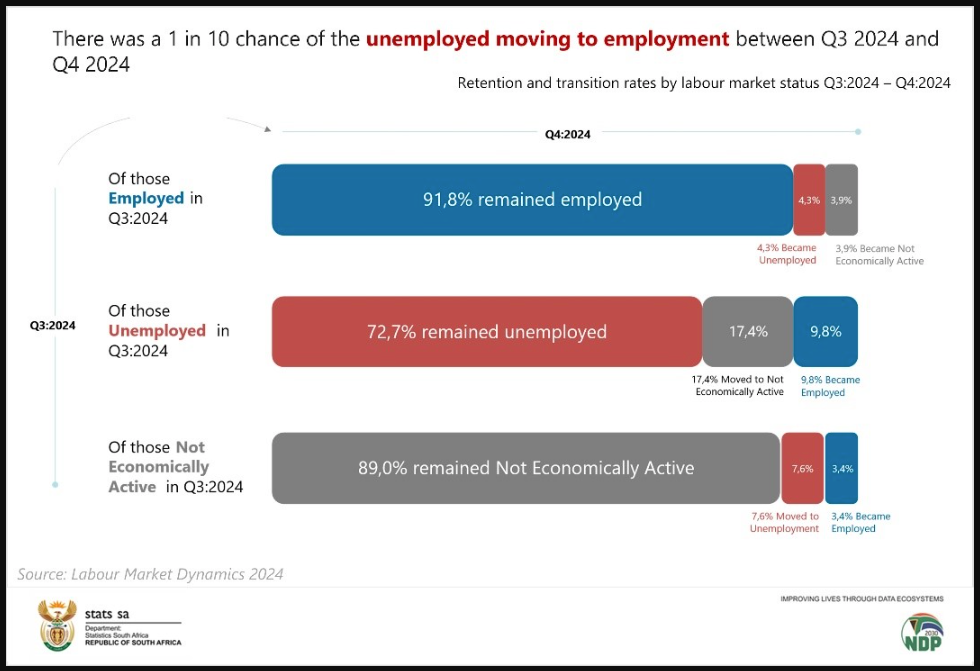
The QLFS follows the same individuals over time, allowing Stats SA to track multiple employment trends, including moves between employment and unemployment.
In a recent release, Stats SA revealed that one notable trend is location, as where South Africans live impacts their likelihood of finding and keeping employment.
The agency explained that retention rates vary across provinces, with the Western Cape leading the way with 93.9% of employed people staying in employment. In contrast, the Free State had the lowest retention rate at 87.8%.
Location also matters when it comes to moving into employment, with the North West recording the lowest transition rate at 4.4%.
Stats SA’s data showed that various other factors are also crucial determinants of South Africans’ ability to find employment.
For example, education, skills and experience play major roles in determining the likelihood of finding employment.
People with prior work experience had a much better chance of finding a job in 2024, with a likelihood of 9.8% compared to 2.6% for those without experience.
Similarly, those with a tertiary qualification saw a 7.5% transition rate – moving from unemployed to employed – while those without matric managed only 4.8%.
Stats SA said low-skilled workers also faced the highest risk of leaving employment, at 12.3% in 2024, followed by semi-skilled workers at 8.2%.
In contrast, skilled workers were much more secure, with only 2.8% moving out of employment.
South Africa’s growing unemployment crisis
Regardless of the reasons behind unemployment statistics in South Africa, experts agree that the country’s economy is simply not growing fast enough to create enough jobs for the population.
This results in the country’s unemployment rate steadily increasing, as the economy cannot absorb new entrants into its workforce.
Stanlib chief economist Kevin Lings has estimated that South Africa’s economic growth would need to more than triple to absorb the number of new entrants into the economy each year.
Crucially, even faster growth would be needed to reduce South Africa’s unemployment rate, which stood at 31.9% in the third quarter of 2025.
While this is a decrease from 33.2% in the second quarter of 2025, South Africa continues to face an uphill battle in tackling this unemployment crisis.
“I think a 1.3% growth rate is still nowhere near enough. We need to really get that growth rate above 3% and heading toward 4%,” Lings said.
“Then, I think, we will be in a position to be adding enough jobs to absorb the number of people entering the labour market.”
“At a growth rate of just over 1%, we are not going to create enough jobs to deal with the growth in the population.”
It is also important to consider that South Africa’s unemployment crisis runs deeper than merely those with or without a job.
A new indicator introduced by Stats SA shows that the country’s labour underutilisation rose over the past year, despite a decline in unemployment over the same period.
This indicator, labour underutilisation, includes those who are unemployed, underemployed, and the potential labour force.
Therefore, while South Africa’s official unemployment rate declined in the third quarter of 2025 compared to the third quarter of 2024, its labour underutilisation increased to 44.9% over the same period.
Stats SA explained that there were 13.3 million underutilised persons in South Africa during the third quarter of 2025.
Of these, 8 million were unemployed, 4.5 million were in the potential labour force, and 747,000 were in time-related underemployment.





Comments