Transnet going from zero to hero – but there is a big problem


Transnet appears to be turning the corner, with two of its ports among the most improved in the world in 2025 and rail volumes steadily improving.
Crucially, the utility has also begun the process of enabling private companies to use its infrastructure to enhance efficiency and increase investment in new equipment and machinery.
Due to Transnet’s substantial debt burden, the company cannot undertake these investments without private sector participation.
However, despite this need, the utility wants to retain its control over policy, legislation, and regulation in the sector.
Thus, while private companies will be able to invest and compete with Transnet, this will be done under the control of the utility and not in a free market.
This has led the Centre for Risk Analysis (CRA) to urge caution regarding Transnet’s turnaround, with the state-owned company still retaining a monopoly over the sector.
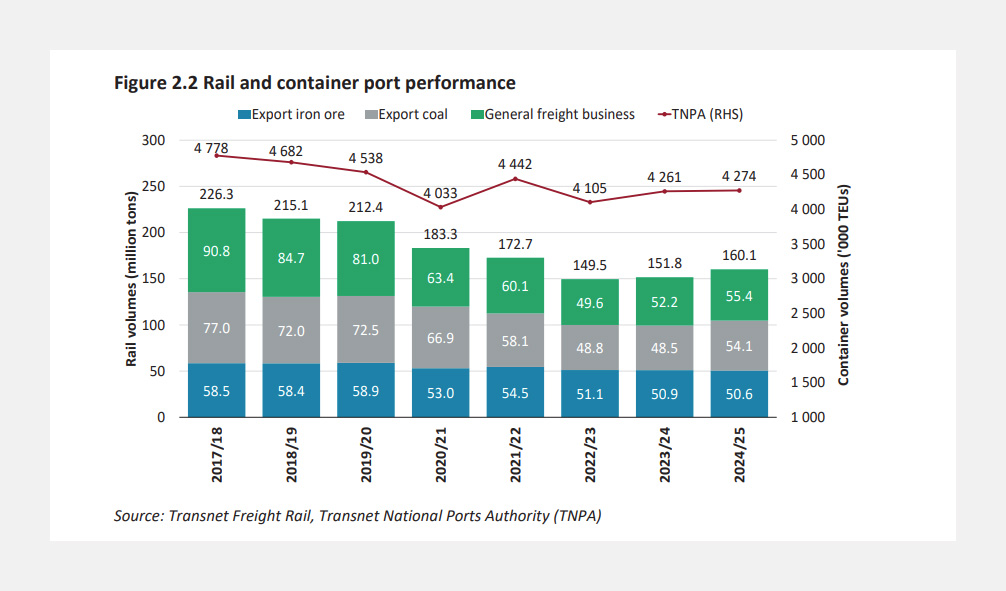
At present, Transnet is moving around 160 million tonnes of rail freight per year, 30% below the peak of 226 million tonnes recorded in 2017/18. The government has set a target of 250 million tonnes by 2030.
Private sector involvement is a critical component of achieving that ambitious goal, and so freight-rail operator Traxtion’s announcement of a R3.4 billion investment in November is significant.
The programme foresees R1.8 billion going to locomotives and R1.6 billion to wagons and forms part of a R5.8 billion overall investment programme.
In pursuit of first-mover advantage, Traxtion appears to be making the investment without knowing exactly how the equipment will be used.
“It may be that we take up the [transport] slots or that we provide maintenance with full operations to the freight owners themselves,” CEO James Holley said at the announcement.
“Or it could be that we provide full maintenance leases over these trains to other train operating companies that want to take up slots.”
The positive scenario is that the Traxtion investment enables Transnet to move more freight, lowers its operational and financial stress, and opens the door for other private operators to move in and invest, the CRA said.
The downside scenario sees players such as Traxtion investing and attempting to operate as an effective competitor to Transnet, while Transnet remains the monopolistic custodian of infrastructure in policy and legislation.
In practice, that would mean that Transnet – and in turn, the state – remains the entity that makes the ultimate decisions about capital allocation and who receives which rail slots.
This would keep alive the possibility of inefficiency, coupled with political patronage and corruption.
The private sector is getting into position to throw Transnet a lifeline. But critically, it appears the country’s rail and trade policy framework will remain state-centred, suppressing growth and job creation over the long term, the CRA said.
Transnet going from zero to hero
Transnet’s performance has improved significantly over the past year, with it reducing the handling time of cargo at its ports and increasing its rail tonnage.
South Africa’s ports are characterised by ageing equipment, inefficient operations, and inadequate infrastructure. All of this results in long wait times for vessels.
Over the past year, Transnet has been making some headway in addressing the various challenges at key ports in South Africa.
The country’s most important port, Durban, has benefited from modernisation initiatives, including the acquisition of new tugboats, ship-to-shore cranes, hauliers, and trailers.
This has improved the port’s performance, but is not enough to drag it off the foot of the rankings as much more needs to be done to bring it up to international standards.
Daily operational meetings and a container management system have enhanced cargo handling and turnaround efficiency, the World Bank said.
These efforts, alongside proposals to increase private-sector participation at Durban Container Terminal, signal an ambition for the port to align with global best practices.
The World Bank said other ports in South Africa, specifically Cape Town and Coega, have seen substantial improvements over the past year.
Cape Town is the most-improved port in the world due to investments in new cranes and equipment, upgraded warehousing, and new hydraulic shovels.
Transnet has also invested heavily in improving Cape Town’s weather prediction capabilities to mitigate weather-related disruptions.
Early data available for 2025 confirms that the investments and improvements have already had measurable positive impacts on performance.
Transnet’s improving operational performance was outlined by Toyota South Africa Motors CEO Andrew Kirby as part of the latest Business for South Africa (B4SA) briefing.
Transnet implemented a formal Recovery Plan, backed by new leadership and a R51 billion government guarantee facility. This marked a clear pivot from crisis management to structural reform.
Rail volumes have recovered to 171 million tonnes, up 15% from mid-2023, due to a significant reduction in vandalism of infrastructure and investment in new equipment.
Truck border queues have been reduced from an average of 19 kilometres to just three, and over 1,700 trucks are being processed daily.
 Loading ...


Comments