South Africa is being left behind


South Africa has been left behind by its emerging market peers over the past decade in terms of economic growth, with drastic changes needed to reverse this trend.
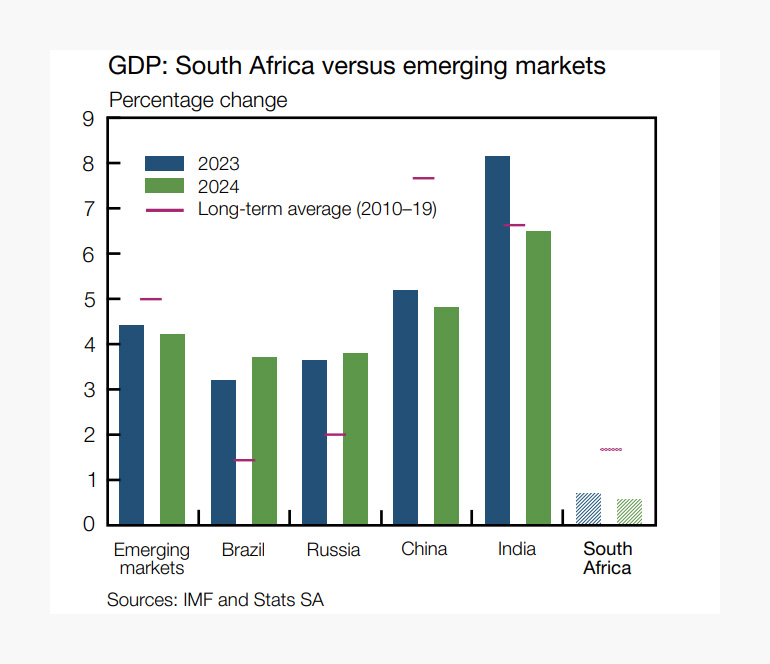
The country’s average annual growth rate of 1.1% over the past 15 years is significantly below the emerging market average of 4.5% during the same period.
While the difference appears small, over 15 years of compounding, the outcomes are vastly different.
Had South Africa just grown its economy at the same rate as the average emerging market, its economy would be nearly R5 trillion larger, and the government would collect around R800 billion more in tax.
Worryingly, there is little evidence that this trend will reverse in the near future, with significant reforms and investment needed to drive better economic outcomes.
In its latest report on African economies, credit ratings agency S&P Global said it expects South Africa to continue to suffer from slow economic growth.
This challenge is not unique to South Africa. However, given its relative advantages over other African economies, the country should be growing as fast, if not faster, than its peers.
South Africa has a highly developed and sophisticated financial services sector that can facilitate investment, significant historical infrastructure, and a young population.
However, it has failed to capitalise on these advantages to make its economy more productive, through various policy missteps and declining business confidence.
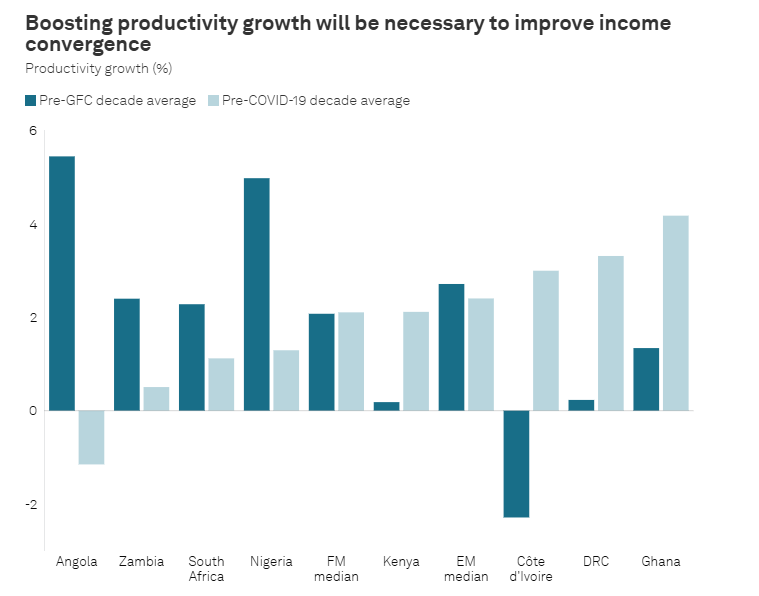
“Most African economies have lower productivity growth rates than other frontier and emerging markets due to challenges around infrastructure, logistics and energy, among other factors,” S&P said.
“In Angola, Zambia, South Africa and Nigeria, productivity growth has slowed over the last decade as infrastructure development and maintenance have not kept up with the needs of their fast-growing populations.”
The effects of this failure are still being felt today, with deteriorating infrastructure limiting economic growth and exacerbating extreme weather events.
South Africa’s poor growth compared to its African peers over the past two decades can be seen in the graph below.
South Africa is its own worst enemy
South Africa’s economic stagnation over the past 15 years is largely due to widespread corruption, policy instability, and the collapse of state-owned enterprises.
Efficient Group chief economist Dawie Roodt explained that these are all a consequence of the government’s poor policy choices, which have severely constrained growth.
“South Africa seems to have two speeds of economic growth, and those are very slow and terrible,” Roodt told the State of the Nation podcast.
Roodt explained that it is important to compare South Africa’s economic performance to that of other countries and to itself in the past.
This enables individuals to understand whether South Africa’s challenges are unique to its situation and what has worked or not in the past to generate economic growth.
“If you compare us to ourselves, we are roughly where we were 15 years ago in terms of wealth and purchasing power,” Roodt said.
This should not be the case in any well-functioning economy – an economy’s natural state is growth, as businesses expand and historic investment compounds.
“An economy always wants to grow. If you do the right things and put good policies in place, economies grow. That is what economies do,” Roodt said.
The picture is even worse when compared to other economies, with South Africa falling further behind developed markets and being overtaken by its developing peers.
In the early 2000s, South Africa was on track to steadily grow into a high-income country, with economic growth averaging 4% towards the end of the decade.
The government’s financial health was improving, with it posting a full budget surplus in the 2007/08 financial year and stabilising the rand.
However, South Africa’s economy has stagnated since then, and government spending has skyrocketed, saddling the state with a debt burden of over R5 trillion.
Since 2015, its economy has averaged an annual growth rate of 1.1%, while its other emerging market peers have grown at 4.5% per annum. As a result, they have effectively caught up with and overtaken South Africa.
Some of South Africa’s continental peers have also surpassed it in terms of GDP per capita, with the country ranking among the worst African countries in terms of growth prospects.
“If you compare South Africa to other countries – I am not even talking about rich countries, even looking at poor countries – it is much worse off than in the past,” Roodt said.
Roodt pointed to Mauritius as an example, which had a significantly lower GDP per capita than South Africa in the 2000s.
Now, the average Mauritian is richer than the average South African. On a GDP per capita basis, Mauritius is wealthier than South Africa.
“So, we are falling behind the rich guys, and the poor guys are catching up with us, and they are overtaking us,” he said.
Roodt estimated that if South Africa had grown at the same rate as its emerging market peers over the last decade, the country’s GDP per capita would have been 40% higher than it is now.





Comments