Cheap Indian car brand selling more cars in South Africa than BMW


Mahindra has had a strong 2025 in terms of sales, with the Indian brand rapidly catching up to its Chinese competitors in South Africa.
The brand has also overtaken historically dominant manufacturers in South Africa, such as BMW and Mercedes-Benz, with Mahindra being the fastest-growing car brand in the country.
Its growth has also shown no sign of slowing as the brand continues to climb higher up the top ten car brands in the country.
Mahindra has benefitted immensely from the shift in consumer behaviour towards value, with sales of luxury German brands coming under pressure.
An elevated cost of living, elevated interest rates, and rising car prices have made Mahindra’s affordable options increasingly popular.
Importantly for the brand, despite several interest rate cuts, declining inflation, and rising incomes, it has continued to grow its sales.
This comes as a slight surprise, as it might have been thought that with easing financial pressure on consumers, many may return to their favourite, aspirational models and brands.
However, Mahindra, alongside Suzuki and its Chinese competitors, has gone from strength to strength, cementing its place in the top ten car brands with the most sold vehicles in South Africa.
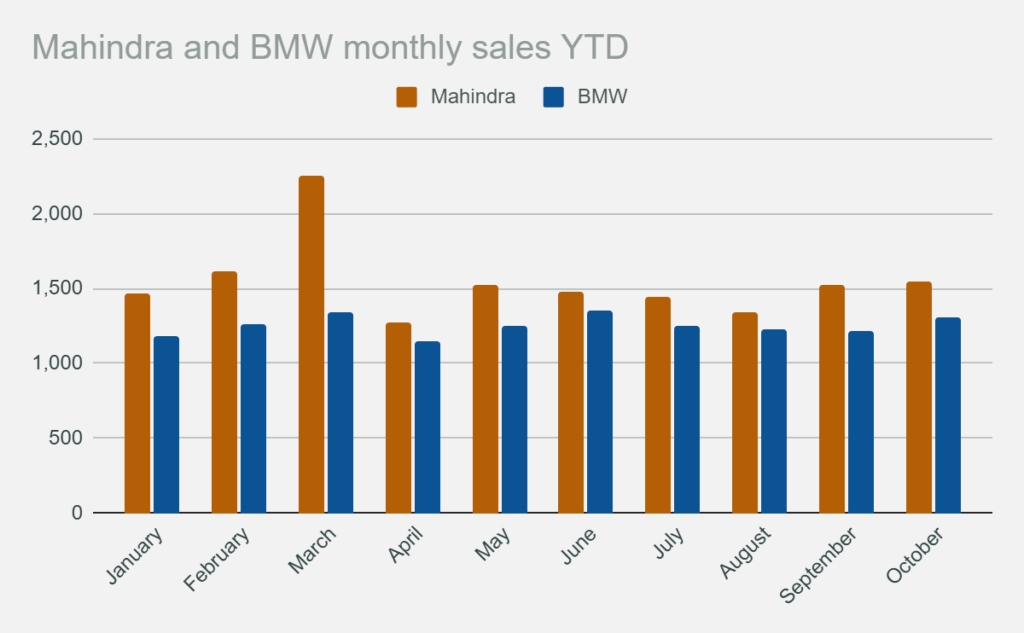
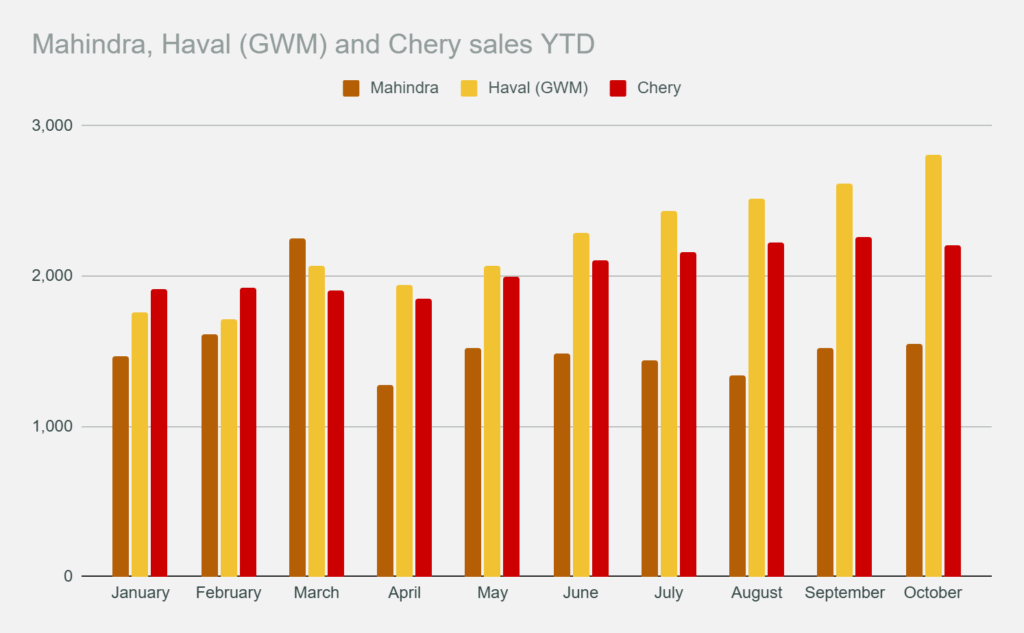
The Indian car manufacturer has sold over 15,000 vehicles so far in 2025 in South Africa, beating out BMW and edging closer to Chinese giants Chery and Haval (GWM).
Earlier this year, in March, the brand set a new record of 2,253 monthly sales, which was the first time it surpassed the 2,000 mark.
This rapid growth has not been a one-off, with Mahindra claiming the fastest-growing title for three years over the past decade, in 2018, 2022, and 2025.
Crucially, Mahindra has managed to grow its sales directly to individuals, breaking its historic reliance on bulk sales to fleet buyers.
It said at the end of its 2025 financial year in March that the overwhelming majority of its sales are now made to individuals. This is a reflection of the health of the Mahindra brand, it said.
In contrast, sales of the German luxury giants, such as BMW, Mercedes-Benz, and Audi have come under pressure as South African consumers hunt for value.
The graph below depicts Mahindra’s monthly sales so far in 2025 compared to BMW’s, with the Indian brand steadily pulling away.
Chinese competition
Mahindra faces stiff competition from cheap Chinese car manufacturers in South Africa, with GWM and Chery more than doubling their sales in less than five years.
Suzuki has also grown impressively over the past decade, with the Japanese giant having sold over 60,000 cars in South Africa year-to-date.
All of these brands have benefited from the shift to a more value-conscious South African consumer, which is a trend that is unlikely to change in the short term.
However, there are concerns that the rapid growth of these brands and the entry of new competitors will lead to oversupply in the South African market.
This may result in these brands having razor-thin margins to maintain sales growth, eroding the sustainability of their business.
The average selling price of cars in South Africa has dropped by 2.3% over the past two years, while inflation has averaged 4.5%.
So far, Mahindra has doubled down on its ambitions to compete against its larger Chinese peers in South Africa and continue taking market share.
The company is investing heavily in boosting capacity at its South African plant in Durban by two-thirds to around 1,500 vehicles per month.
This also makes Mahindra unique in that it has a manufacturing presence in South Africa, whereas many Chinese brands do not.
Mahindra’s local plant assembles its Pik-Up bakkie, which has proven popular with South African farmers and the Mozambican police.
The company also sells its sport utility vehicles, or SUVs, in South Africa, including the XUV 3XO, XUV 700, Scorpio-N, and Bolero.
Mahindra is also facing increased competition from its home country, with Tata making a significant expansion into the South African market through a partnership with Motus.
In response to this, Mahindra has accelerated its plans to bring EVs to South Africa, with plans to offer both the BE 6 and XEV 9e in the country.
Mahindra also plans to upgrade its existing strategy of assembling cars using completely knocked down parts, bringing it closer towards a fully-fledged factory.
Chinese brands have big plans to begin manufacturing vehicles in South Africa, with Beijing Auto Industrial Corporation (BAIC) already having an assembly plant in Gqeberha.
The graph below compares Mahindra’s sales in 2025 to those of GWM and Haval.





Comments