South Africa sitting on a R1.3 trillion goldmine


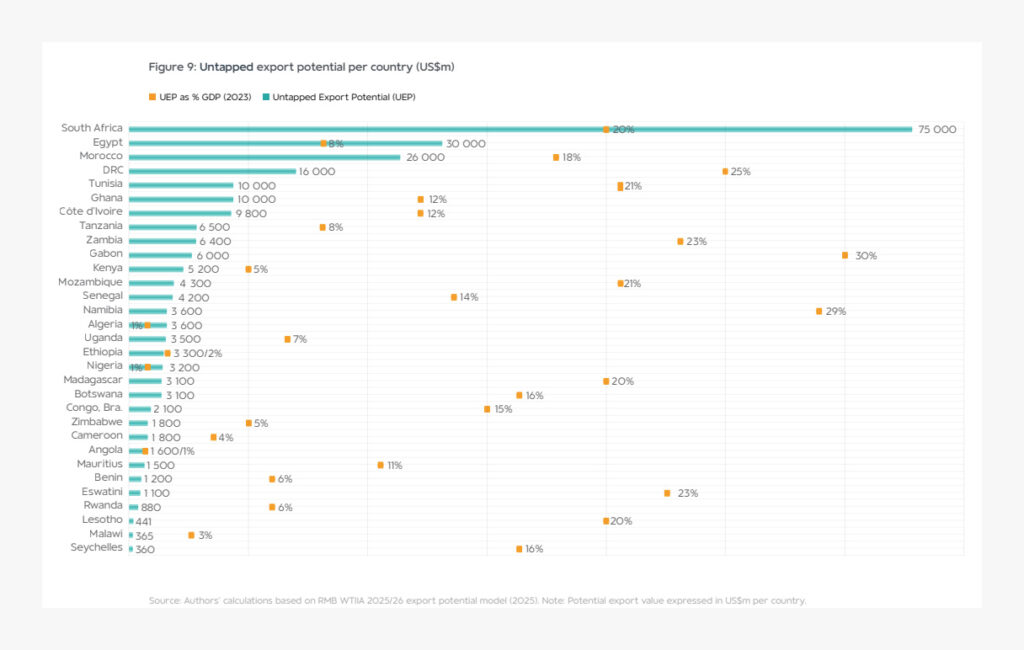
South Africa is sitting on R1.3 trillion ($75 billion) in untapped export potential as the country’s logistics sector continues to underperform.
Local ports continue to be ranked among the worst in the world by the World Bank, with the largest container port in the country, Durban, coming last among 403 ports.
This is despite significant reforms within the sector, a leadership change at Transnet, and several government bailouts.
RMB’s Invest in Africa report revealed that South Africa has the most untapped export potential of any country on the continent, worth around 20% of annual GDP.
This is a wasted opportunity for a country with a stagnant economy, record levels of unemployment, and a mineral bounty that is the envy of the world.
South Africa’s total untapped export potential, estimated at $75 billion or R1.3 trillion by RMB, is greater than that of the next three countries combined and more than double second-placed Egypt.
RMB ranked South Africa fourth in its list of the best countries to invest in on the continent, behind the Seychelles, Mauritius and Egypt.
“South Africa is economically stuck. The country’s GDP size may be Africa’s largest, but GDP growth is likely to be the continent’s lowest for 2025 at around 1%,” RMB said.
This picture is unlikely to change in the coming years, with RMB expecting South Africa’s growth to be close to the lowest on average until 2029.
“A Government of National Unity, formed after the May 2024 elections, has struggled to act decisively on major issues,” the investment bank said.
These issues include rampant unemployment, transport infrastructure that limits many growth opportunities, and insufficient energy supply.
Key to reversing this decline is the restoration of investor confidence, which comes as a byproduct of policy stability and an enabling environment for businesses to start and expand.
This requires concrete evidence of reforms resulting in positive outcomes, including increased private sector participation and faster growth.
The graph below, courtesy of RMB, shows South Africa’s untapped export potential compared to that of the other countries studied.
Transnet’s recovery
South Africa may begin to realise its untapped export potential in the coming years as Transnet’s reforms gather momentum.
These reforms will boost private participation in the logistics sector, resulting in increased investment in equipment and infrastructure.
Logistical inefficiencies due to Transnet’s deteriorating infrastructure have resulted in increased transport costs for companies, which have been forced to shift to road freight to transport their goods.
It has been estimated that the poor performance of Transnet’s railways and ports costs South Africa around R1 billion a day in lost economic activity.
However, there are signs of improvement, with the utility’s operational performance improving remarkably over the past year.
The ports and rail utility has significantly reduced the average handling time of cargo at its harbours, and its rail tonnage has stabilised.
Rail volumes have recovered to 171 million tonnes, up 15% from mid-2023, due to a significant reduction in infrastructure vandalism and increased investment in new equipment.
Truck border queues have been reduced from an average of 19 kilometres to just three, and over 1,700 trucks are being processed daily.
Coupled with these operational improvements is the opening up of particular rail corridors and port terminals to private players.
This will come in the form of the concessioning of key rail corridors and port terminals to private operators, with the assets remaining under the ownership of Transnet.
The sale of rail slots to third-party operators, establishing a Private Sector Participation office to engage with the private sector, and appointing an independent Infrastructure Manager are early steps towards a hybrid model.
These reforms are expected to translate into increased investment in the sector from private companies, with improved efficiency and volumes set to follow.
This is expected to create a virtuous cycle, with improved performance attracting further investment from the private sector.