The ‘cheap’ car brand selling more cars in South Africa than VW, Ford, and BMW


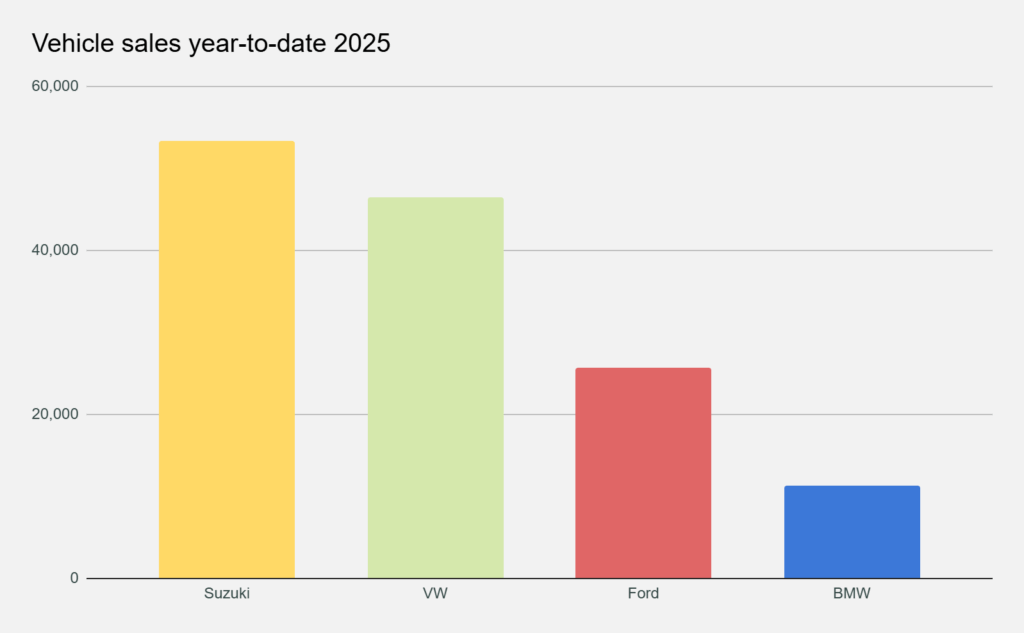
Suzuki has risen in the ranks of the best-selling car brands in South Africa, with the Japanese carmaker now regularly beating out Volkswagen and Ford to be second only to Toyota.
The rise of Suzuki has come amidst South African carbuyers’ increasing search for value, as an elevated cost of living and rising prices make historically dominant players unaffordable.
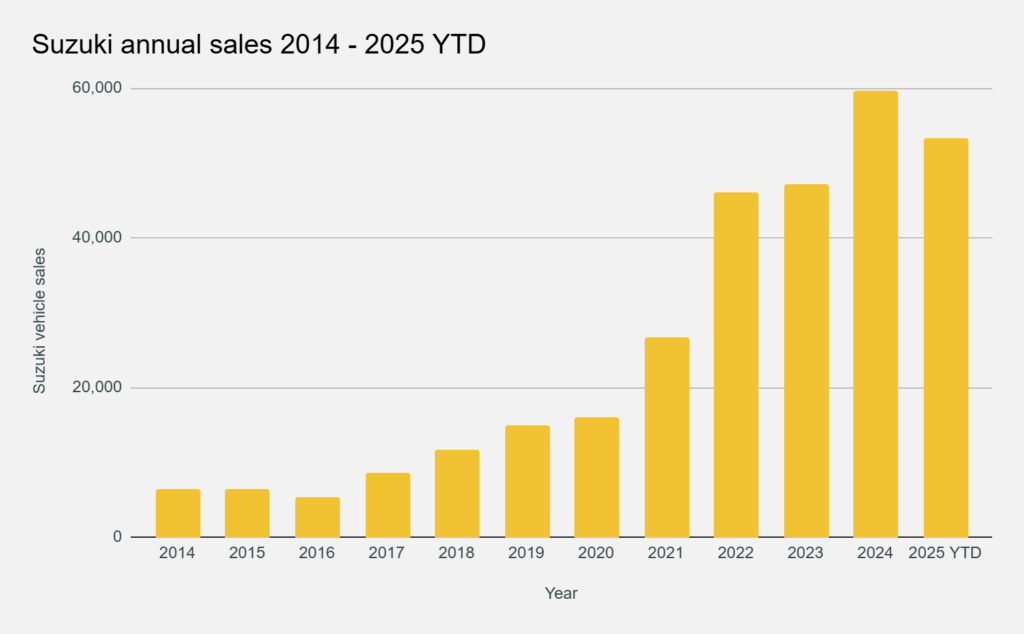
Suzuki’s sales have skyrocketed over the past decade, with the carmaker now selling more cars a month than it sold in the entirety of 2014.
In 2014, it sold a mere 6,402 throughout the year. Now it regularly crosses 6,000 sales a month and reached 6,534 sales in August.
Interestingly, despite several interest rate cuts, declining inflation, and strong growth in real household incomes, Suzuki has held onto its second place in the rankings.
With easing financial pressure on consumers, it might have been expected that South Africans would revert to more expensive models and brands.
However, Suzuki has only gone from strength to strength, becoming a regular among the top ten and consistently beating out VW for the second spot behind Toyota.
The secret behind this rise is a shift in Suzuki’s manufacturing to India and out of Japan, enabling it to significantly reduce production costs.
This has ensured its continued competitiveness in South Africa despite a difficult operating environment and a stagnant economy.
Suzuki identified the global shift towards more affordable vehicles earlier than many of its peers and quickly took advantage of cheaper manufacturing in India.
It leveraged the lower cost of production in India to manufacture and assemble huge volumes of budget-friendly compact vehicles.
Today, 14 of the 15 nameplates in Suzuki South Africa’s stable are imported from India, with the only model sourced elsewhere being the Vitara, which is imported from Europe.
The Suzuki Swift Sport derivative and the three-door Jimny are imported from Suzuki’s historical home of Japan.
This has enabled Suzuki to keep its cars affordable amid rising prices across the industry, fuelling its growth in South Africa.
Suzuki’s sales in 2025 compared to VW, Ford, and BMW can be seen in the graph below, followed by a graph showing the brand’s tremendous growth over the past decade. The sales data is sourced from Naamsa.
Chinese competitors
Suzuki is not the only rising disruptor in South Africa’s car industry, with Chinese giants Chery and Haval (GWM) also growing sales strongly.
More recently, Indian carmaker Mahindra has burst into the top ten on a regular basis, selling well over 1,000 vehicles a month in 2025.
While Suzuki and Mahindra have benefited from a lower cost of production in India, Chinese carmakers have leveraged the immense manufacturing capacity of their home country.
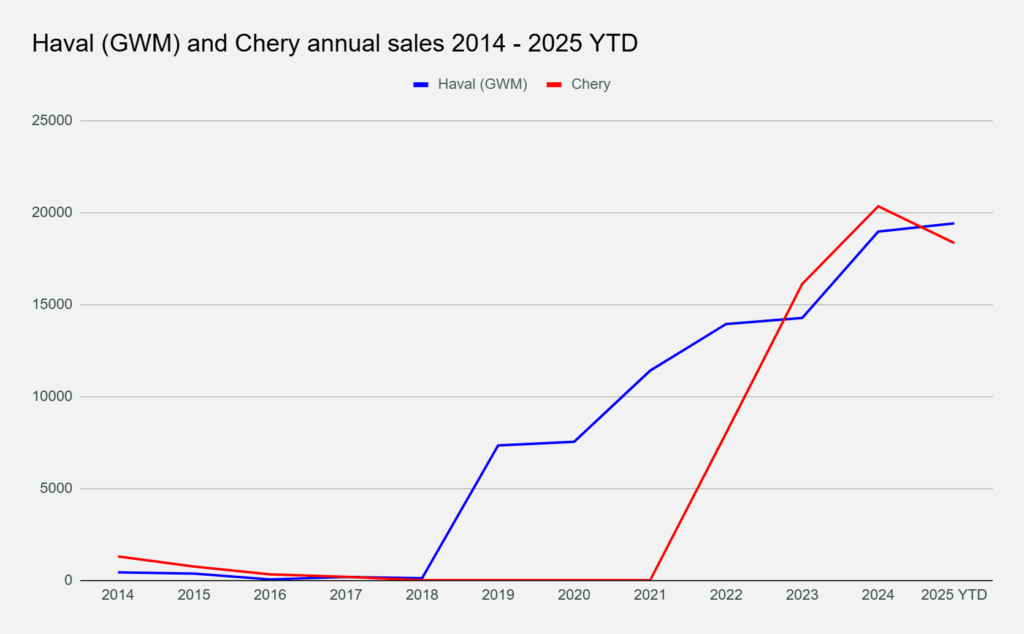
GWM and Chery have seen their sales skyrocket in a similar fashion to Suzuki over the past decade, with the brands selling more cars every month than they used to in a year.
Since reentering South Africa in 2022, Chery’s sales have soared from 8,013 to over 20,000 in 2024. It is on track to break this record in 2025.
GWM has already sold more cars in 2025 than it did last year, with three months left still to count. It sold 18,962 cars in 2024 compared to a mere 428 in 2014.
Chery’s rise has been most notable for its increasing popularity among young car buyers, breaking the misconception that these cars are only for older individuals.
The Chinese brand recently broke into the top ten most-financed vehicles by Standard Bank for young people, with most of these individuals preferring to buy used cars and practical vehicles.
Individuals under 35 comprise a significant share of the car loan market, accounting for 38% of vehicle loans with Standard Bank.
This is an increasingly important segment, as these individuals are very likely to buy another car from the same brand later on in life.
According to the bank’s data, the Chinese brand took a 5% share of the market, on par with Nissan and Renault, after experiencing tremendous growth in South Africa over the past few years.
This took Standard Bank somewhat by surprise, with young individuals willing to try new brands without established resale value or support systems in South Africa.
Furthermore, the majority of vehicles bought at this age are hatchbacks, and Chery does not offer one in the South African market.
The growth of Chery and GWM in South Africa over the past decade can be seen in the graph below. The sales data is sourced from Naamsa.
 Loading ...





Comments