1,000 South Africans became unemployed every day for 17 years


Certain government policies are holding back employment in South Africa, as their focus on projects and initiatives has diverted attention from fundamental structural reform.
In effect, this has resulted in around 1,000 South Africans joining the unemployment queue every day for the past 17 years.
Specifically, bad labour market policies, a dysfunctional skills system, and a shrinking small business sector are negatively impacting employment and preventing South Africa from addressing its deep unemployment crisis.
The country’s labour market requires urgent and radical intervention to address this growing issue, or risk creating another lost generation condemned to joblessness.
This is according to Centre for Development and Enterprise (CDE) executive director Ann Bernstein, who outlined the debt of South Africa’s unemployment crisis in a recent webinar.
This followed the publication of the CDE’s latest report, titled ‘South Africa’s Unemployment Catastrophe: A call for urgent action’.
Bernstein outlined South Africa’s current unemployment crisis, explaining that the country’s expanded unemployment rate has more than tripled between 1994 and 2025.
Since 1994, the expanded unemployment rate, which includes discouraged workseekers, has risen from 3.7 million to 12.6 million.
She explained that South Africa’s slow economic growth has deepened the crisis. Although the labour force increased from 20.6 million to 29.4 million between 2008 and 2025, slow growth meant total employment only increased from 14.5 million to 16.8 million.
In this period, an average of just over 500,000 people entered the labour market every year, but only 130,000 new jobs were created annually.
“Put differently, for every person entering the labour force who got a job, there were nearly four who did not,” the CDE explained in its report. “In effect, 1,000 people joined the unemployment queue every day for the past 17 years.”
“Some causes of slow growth, like the Covid-19 pandemic, were outside of South Africa’s control. But most were home-grown.”
Bernstein specifically pointed to the following three government failures that have held back employment in South Africa –
- Bad labour market policies
- A dysfunctional skills system
- A shrinking small business sector
Bernstein said South Africa can turn the tide on its unemployment crisis, but it will require urgent and dramatic reform.
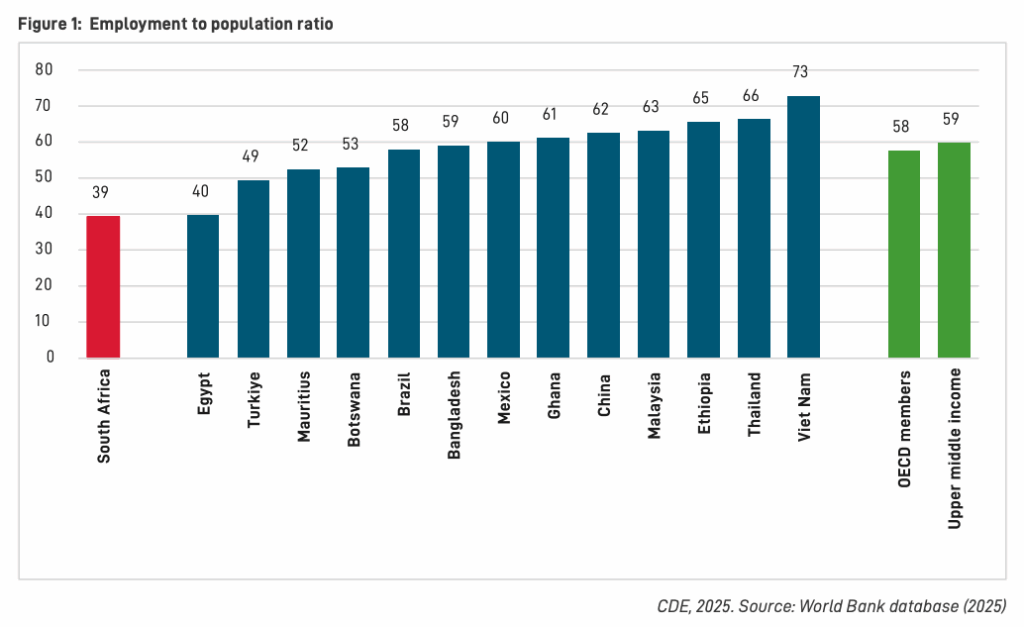
The graph below, courtesy of the CDE, shows how South Africa’s employment-to-population ratio compares to its emerging market peers and other countries.
Government policies hurting employment
Firstly, the CDE explained that the government’s current labour market rules make employers more reluctant to hire workers, especially unskilled workers.
Bernstein specifically pointed to factors like the high minimum wage, which has effectively priced workers out of the market, as small businesses in particular struggle to afford these costs.
The CDE report pointed out that the National Minimum Wage Commission itself has concluded that the level of South Africa’s minimum wage has resulted in the destruction of nearly 90,000 jobs.
The CDE explained that businesses not only need to consider the costs associated with employees’ wages but also compliance costs, compulsory training costs, and the costs associated with termination.
“Making it easier for businesses to invest, expand and hire will lay the foundation for a more prosperous and inclusive society for all,” it said.
Secondly, Bernstein pointed to South Africa’s dysfunctional skills system as a significant inhibitor to employment.
She explained that some universities and Technical and Vocational Education and Training Colleges (TVETs) do not adequately prepare graduates for employment by giving them the right skills.
This is a major problem, as skilled workseekers are much more likely to find employment than unskilled ones.
The CDE’s report showed that, in the first quarter of 2025, 62% of people who were employed had completed matric or had a post-secondary qualification, while 53% of the unemployed had not passed matric.
It found that over two-thirds of people with degrees were employed, whereas 75% of those with less than a matric were jobless.
“Improving skills will not only make individuals more employable, but will help boost growth and create additional jobs,” the organisation said.
Bernstein further pointed to the issues with South Africa’s Sector Education and Training Authorities (SETAs).
She explained that SETA’s have widely become seen as wasteful, corrupt and irrelevant with regards to addressing unemployment.
A 2021 Department of Higher Education and Training report found that SETAs generally fail to perform any of their core functions adequately.
It said SETAs suffered from “poor governance, inadequate human resources and training, and the absence of a proper monitoring and evaluation system”.
Despite this, the government spends billions on funding these programmes, and over 300,000 companies currently pay levies to SETAs, with little to no return.
Lastly, Bernstein highlighted the government’s failure to create an enabling environment for small businesses, with layers of red tape and unsustainable compliance costs hampering employment.
“Some of the main regulatory burdens hampering the growth of small businesses include the national minimum wage, the extension of bargaining council agreements, and a restrictive licensing and permit regime,” the CDE said.
Bernstein pointed to OECD data, which showed that South Africa’s economy-wide regulation regime is more restrictive than all OECD member countries.
The World Bank has also found that the level of restrictiveness in South Africa is close to three times higher than that in top-performing countries.
While this affects all companies in South Africa, smaller firms are disproportionately impacted, as they have fewer resources to keep up with compliance regulations and the associated costs.
“The government has sought to reduce ‘red tape’, but these efforts have mostly been marginal and failed to make an impact,” the CDE said.
“Ultimately, this hostile landscape stifles growth, discourages entrepreneurship and exacerbates the unemployment crisis.”






Comments