Transnet coming back from the brink


The performance of South Africa’s ports has improved dramatically over the past year, with Cape Town seeing the biggest jump, followed by Coega.
However, the country’s ports still remain among the worst in the world, with Durban being ranked last in the latest Container Port Performance Index (CPPI).
The CPPI is conducted by the World Bank and S&P Global Ratings to determine the performance of ports around the world.
It shows that ports in Southern Africa remain the worst-performing in the world, with Durban being ranked last at 403.
This performance is due to the operational collapse of Transnet in recent years after a decade of mismanagement and inadequate investment.
South Africa’s ports are characterised by ageing equipment, inefficient operations, and inadequate infrastructure. All of this results in long wait times for vessels.
Over the past year, Transnet has been making some headway in addressing the various challenges at key ports in South Africa.
The country’s most important port of Durban has benefitted from modernisation initiatives, including the acquisition of new tugboats, ship-to-shore cranes, haulers, and trailers.
This has improved the port’s performance, but is not enough to drag it off the foot of the rankings as much more needs to be done to bring it up to international standards.
Daily operational meetings and a container management system have enhanced cargo handling and turnaround efficiency, the World Bank said.
These efforts, alongside proposals to increase private-sector participation at Durban Container Terminal, signal an ambition for the port to align with global best practices.
The World Bank said other ports in South Africa, specifically Cape Town and Coega, have seen substantial improvements over the past year.
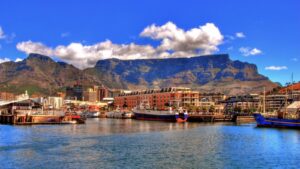
Cape Town is the most-improved port in the world due to investments in new cranes and equipment, upgraded warehousing, and new hydraulic share-tension units.
Transnet has also invested heavily in improving Cape Town’s weather prediction capabilities to mitigate weather-related disruptions.
Early data available for 2025 confirms that the investments and improvements have already had measurable positive impacts on performance.
The latest data provided by Transnet, between mid-2024 and August 2025, shows that vessel anchorage in South African ports went down by about 75%, gross crane moves per hour improved by 13%, and ship working moves went up by 25%.
Private investment is crucial

By far the most significant sign of improvement is the efforts to reform South Africa’s logistics sector entirely and introduce greater private participation.
This will unlock substantial investment in logistics infrastructure across key railway corridors and port terminals, with Transnet’s balance sheet being too weak to adequately invest in maintaining existing equipment and secure new technology.
The World Bank flagged the creation of the National Logistics Crisis Committee (NLCC) as a key initiative in this regard.
This committee has driven key reforms in the logistics sector and, alongside National Treasury’s Operation Vulindlela (OV), has begun reducing the barriers to entry for private companies in the sector.
In its latest update, the OV team outlined some of the key steps Transnet has taken to break its monopoly on the logistics sector in South Africa.
The formation of the Transnet Rail Infrastructure Manager (TRIM) has begun facilitating the private operation of some of the company’s railways.
This is a significant step towards private companies running rail corridors, investing in maintenance and locomotives, and ultimately bringing their products to market.
TRIM has begun making slots available across the freight rail network to private train operating companies and has received 98 requests for access so far.
A Private Sector Participation Unit has also been established within the Development Bank of South Africa to facilitate and fast-track private sector participation in logistics.
Since launching a request for information for private sector projects in the rail and ports system on 23 March 2025, the Transport Department has received over 100 requests.
Over 50 requests relate to the iron ore and manganese corridor, 48 for the coal and chrome corridor, and 63 focus on the container and automotive intermodal corridor.
This shows significant progress in the opening of the logistics sector to private participation, which should translate into enhanced investment in infrastructure and improved performance.
Despite these operational improvements, Transnet remains in an immensely difficult financial position, with the company relying on government bailouts to stay afloat.
As the private sector takes on more of the burden with regard to logistics infrastructure and the utility’s performance continues to improve, the National Treasury expects Transnet’s financial fortunes to begin to turn.
 Loading ...



Comments