Pick n Pay’s big plan: It is going after Mr Price, Pepkor, TFG, and Truworths in South Africa


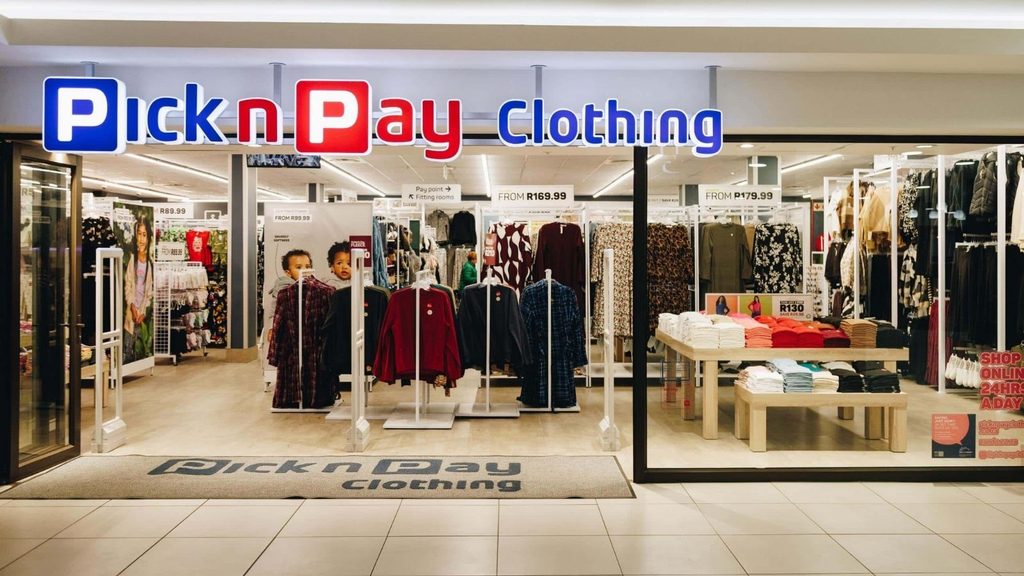
Pick n Pay Clothing has emerged as one of the retailer’s biggest growth engines, alongside asap! and Boxer.
However, this business segment operates in a highly competitive and challenging environment, with South Africa’s apparel retail market coming under pressure in recent years.
Established local players, including Mr Price, Pepkor, The Foschini Group, and Truworths, have struggled to grow sales consistently in a lacklustre consumer environment.
Despite this market pressure, Pick n Pay CEO Sean Summers believes the retailer’s apparel segment has what it takes to become a fierce competitor.
This comes as South Africa’s apparel market is becoming another growth lever for some of the country’s major grocery retailers, including Shoprite and Woolworths.
Woolworths’ Fashion, Beauty, and Home business has operated in the sector for years, while Shoprite’s Checkers is a newer entrant through its Uniq brand.
Pick n Pay Clothing was launched in 2002, opening its first stand-alone store in Menlyn Mall in Pretoria.
Since then, the business segment has also been opened to franchisees, and it now boasts a footprint of 439 stores.
The apparel business is positioned as a value-oriented, casualwear-focused retail format targeting family shoppers.
Its offering spans women’s wear, menswear, childrenswear, babywear, and sleepwear.
Over the past decade, Pick n Pay Clothing has repeatedly outpaced the broader South African apparel market, gaining market share across all of these categories.
From 2016 to 2026, Pick n Pay Clothing went from having 150 stores to 437. In the first half of the retailer’s 2027 financial year, this footprint expanded to 439.
In this interim period, Pick n Pay also revamped 13 Clothing stores, with sales at the revamped stores far outpacing the rest of the estate.
Pick n Pay reported that it plans to modernise 10 more stores in the second half of the 2027 financial year.
Pick n Pay Clothing’s advantage

At a media roundtable following the release of Pick n Pay’s H1 FY27 results, Summers identified the apparel division’s competitive advantage: a clear, affordable offering.
He explained that Pick n Pay Clothing is known for offering affordable, day-to-day basics with a touch of semi-fashion layered on top.
Despite this clarity in its offering, Summers acknowledged that the clothing business, along with the broader local apparel market, has experienced “two tough years”.
This was partly due to the entrance of affordable foreign e-commerce retailers, particularly Shein and Temu, which presented strong competition to local apparel players.
In addition, apparel sales were restricted during the initial phase of Covid-19 lockdown regulations, which hurt the industry as a whole, including Pick n Pay Clothing.
However, Pick n Pay Clothing rebounded strongly in the 2021 financial year with a 6.7% uptick in sales.
In the 2022 financial year, sales in this division jumped 21%, followed by 15.3% in 2023.
In 2024, Pick n Pay reported its first-ever loss due to the underperformance of its core supermarkets division. However, that same year, the clothing division saw 17% sales growth.
The 2025 financial year saw another 11.6% uptick in sales, while FY26 saw slower growth of 5.3%, or 0.7% like-for-like.
The first half of Pick n Pay’s 2027 financial year saw turnover in the clothing division grow by 3.9%, while like-for-like sales declined by 0.7%.
However, the retailer pointed out in its results that, over a two-year period, this division’s revenue still achieved a compound annual growth rate (CAGR) of 7.9%.
This is significantly higher than the 2.5% CAGR achieved by the broader South African clothing retail market.
The retailer attributed much of this growth to Pick n Pay Clothing’s integration on the asap! platform in March 2026.
This integration made Pick n Pay’s apparel offerings available on its online, on-demand delivery platform, which saw online turnover in this segment surge 137% year-on-year.
“In amongst those two tough years that we’ve had in clothing, we also had a change in selectors in one of our divisions that didn’t help as well,” Summers told Daily Investor.
“That’s been remedied, and if we have a look at where we are in clothing now, we’re feeling much, much better on the go forward from where we are.”
Summers also explained that he believes the appeal of retailers like Shein and Temu has peaked in South Africa.
“If you think back two years ago, you had Shein and Temu that all of a sudden arrived in the marketplace,” he said.
“Things were just going absolutely nuts in terms of the volume that was being done in that regard, and that has tapered off and peaked a little bit.”
“I think customers are over the sort of novelty, being able to go on and just shop, shop, shop, and then the stuff arrives and then you’ve got issues.”
“So, I think that phenomenon has peaked a little bit, and we’ve gone back to focusing on Pick n Pay Clothing.”