Major threat to Checkers and Pick n Pay in South Africa that is out of their control


Online gambling is posing a growing threat to grocery retailers in South Africa, with disposable income being spent on sports betting or “Vegas-style” games rather than basic necessities.
New data from Trade Intelligence indicates that grocery retailers such as Checkers, Pick n Pay, SPAR, and Woolworths are the most heavily affected by the surge in online gambling.
This erodes the potential sales growth of these companies, as South Africans cut back on grocery spending to gamble online.
Online gambling is nothing new to South Africa. However, since pandemic-era lockdowns, its popularity has surged. South Africa’s gross gambling revenue amounted to R75 billion in 2024/25, with online betting generating around 60% of this total.
The value of gambling wagers grew by nearly a third in 2025, with the vast majority of growth coming from online gambling.
Online gambling has also taken on a new form in South Africa, with the launch of “live” or “Vegas-style” games by betting sites in recent years. An example of this is the infamous Aviator game.
It is unclear whether these games are completely legal in South Africa, with a 2011 ruling from the Supreme Court of Appeal declaring that online gambling (interactive) is illegal in South Africa.
Online sports betting or bookmaking is perfectly legal. However, this enters a grey area when live or Vegas-style games are offered on betting platforms.
The National Gambling Board argues that these are illegal casino games, while the operators argue they are “fixed-odds betting events” which currently fall under their legal licences.
Regardless of their legality, the surge in popularity of these games has become a cause for concern for the government and retailers.
To understand its impact on local retailers, Trade Intelligence surveyed hundreds of South Africans who said they have played at least one online gambling game.
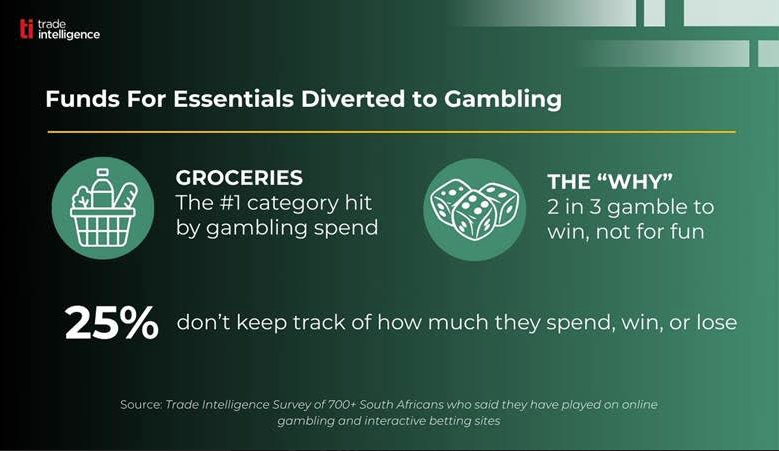
The survey indicated that grocery spending is taking the biggest, or at least the most widespread, knock from funds being diverted into online gambling.
Trade Intelligence provided respondents with a list of ten categories where the money used to gamble online would have been spent otherwise.
Groceries and household essentials were the most chosen category, with fast food and takeaway being a distant second.
Online gambling crackdown in South Africa
South African retail CEOs have raised the alarm regarding online gambling eating into the disposable income of their customers.
While some may see this as a convenient excuse for lacklustre performance, it is becoming a common theme across retailers across different market segments. Trade Intelligence’s data also indicates that it is a serious issue.
These CEOs have also pointed to the fact that online gambling companies are largely offshore entities and are purely extractive in South Africa, taking money out of people’s pockets and out of the country.
In October 2025, Pick n Pay CEO Sean Summers warned that online gambling is draining tens of billions of rands from South Africa’s economy.
Summers called for a complete ban on the marketing and advertising of online gambling in the country to slow its growth.
The money spent gambling online could otherwise support local jobs and businesses, Summers argued, calling it a complete scourge on South Africa.
Pick n Pay’s CEO also said the industry should be taxed far more than it currently is and tighter regulations should be introduced, pointing to efforts to reduce smoking as an example.
Apart from Summers, clothing retailer Mr Price has also warned that disposable income growth has been absorbed by higher household debt-servicing costs and increased spending on online gambling.
The government has moved to begin clamping down on online gambling, with the National Treasury proposing a 20% tax on online gambling revenue.
“Due to the surge in online gambling and its impact on society, it is proposed that a 20% tax is applied on gross gambling revenue from online betting, including interactive gambling”, the National Treasury said in its discussion paper published late last year.
While the proposed tax could generate about R10 billion in additional revenue, its main purpose is to “discourage problem and pathological gambling and their ill effects”, the Treasury said.
“The way we look at this is that it is closer to a sin tax. The mechanism is not quite the same. It won’t be taxed like alcohol or tobacco on a per-drink or per-cigarette basis, but we are going to tax the companies,” National Treasury’s Christopher Axelson said.
“We look at it like a sin tax. If there is a reduction in online gambling because of this tax, we would be happy with that, even if it reduces tax revenue.”
However, Axelson said it would be good if the proposed tax raised revenue, potentially alleviating pressure on other forms of government revenue.
“This is a good thing. This is good for social expenditure, good for development, and it might mean that there is less pressure on other taxes in future,” Axelson said.
“But our main aim here is to try to deter activities and reduce the amount of online gambling that is actually taking place in South Africa.”
 Loading ...


Comments