Top South African retail CEO announces drastic measures at his company


The Foschini Group (TFG) CEO Anthony Thunström announced numerous cost-saving measures, including headcount freezes and tighter travel restrictions.
This announcement, sent to managers across the retail group around a month ago, followed poor results from TFG.
TFG is one of South Africa’s largest apparel retailers, with well-known brands such as @home, Jet, American Swiss, Sportscene, and Total Sports in its portfolio.
It operates in Africa, the United Kingdom, and Australia. On Friday, 7 November, TFG released its results for the six months ended 30 September 2025.
Revenue rose by 12.22% to R31.39 billion, while retail turnover increased by 12.66% to R29.15 billion. However, this only tells part of the story.
The turnover growth was primarily due to the acquisition of the British chain White Stuff in 2024, which bolstered the group’s sales figures compared.
When the impact of White Stuff is removed, sales only rose by a more subdued 3.5% over the last six months.
TFG’s profit declined by 21.20% to R944 million, and its basic earnings per share declined by a similar percentage to 290.8 cents.
The retailer stated that the period was characterised by weak and uneven consumer demand in South Africa, which negatively impacted profitability.
During the period, 47 stores were opened. However, it also closed 42 stores, which means TFG Africa now trades out of 3,619 stores in 6 countries.
The only truly promising part of TFG’s latest financial results was its online sales, which increased by 55.3%.
These sales were driven by TFG’s Bash eCommerce platform, which continues to gain momentum in South Africa.
The market did not like what they saw, especially after Thunström and his management team painted a rosy picture just three months earlier.
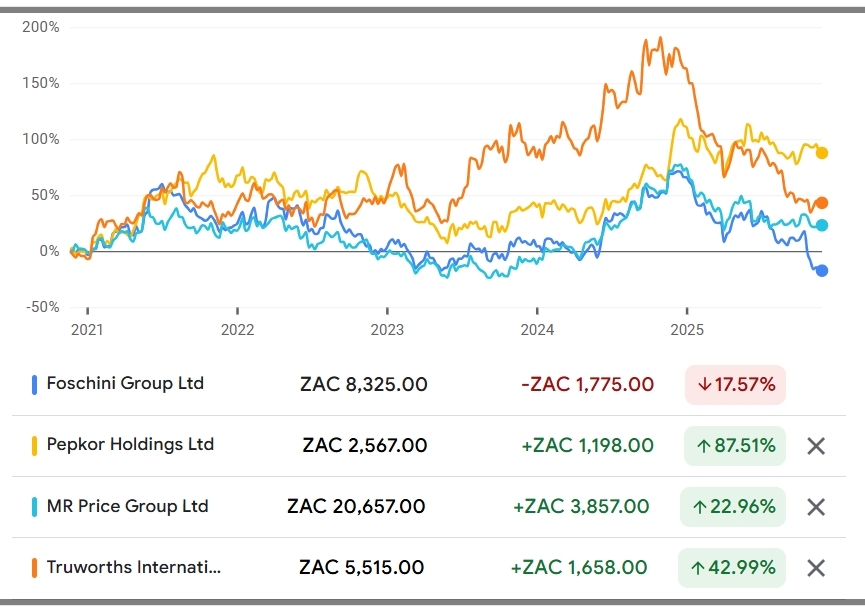
TFG’s share price has plummeted by 30% since it first released a trading statement regarding its performance.
It has also significantly underperformed against its main competitors, including Mr Price, Pepkor, and Truworths.
The chart below compares TFG’s share price performance to that of its South African competitors over the past five years.
TFG CEO Anthony Thunström announced drastic measures
In a message to senior members of the company, Thunström announced drastic measures to reduce costs across the organisation.
There have also been meetings with managers around the planned austerity measures and cost-saving projects.
He explained that TFG’s performance in the first half of the financial year has been negatively impacted by lower-than-expected top-line growth in South Africa.
“This does not place the group in a position to approach the second half of the year as business as usual,” he said.
“The current environment requires us to operate with even greater discipline and ensure that our cost base reflects the reality of the trading conditions we face.”
Thunström explained that they cannot sustain current levels of expenditure without the growth and gross profit expansion they had forecast.
“We need to take immediate steps to manage what we can control this year – our expenses,” he said.
Looking beyond the short-term plan, he said TFG needs to reset its cost base in line with the prevailing macroeconomic outlook for the next few years.
TFG’s chief strategy officer, James Wilkinson, established a cost savings initiative and is working with managers to identify and implement savings opportunities.
These cost-saving initiatives will affect all areas of the business, including operating expenses and capital expenditure. It includes:
- Policy-driven controls, including headcount freezes and tighter travel restrictions.
- Central cost analytics and intervention, like reviews to reduce, re-negotiate, or defer specific cost categories.
- Business-led expense reduction initiatives, like tasking a business to take action on cost items within its direct control.
- Deep dives in major functions, including reviews of large spend areas.
To ensure the process is effective, the project team will engage with each business area where potential savings have been identified.
“By proactively engaging, we can manage this challenge together and hopefully reduce the extent of difficult measures,” he said.
He added that TFG will maintain a savings scorecard and provide regular updates to the business on progress and outcomes.





Comments