Cape Town is leaving Joburg in the dust


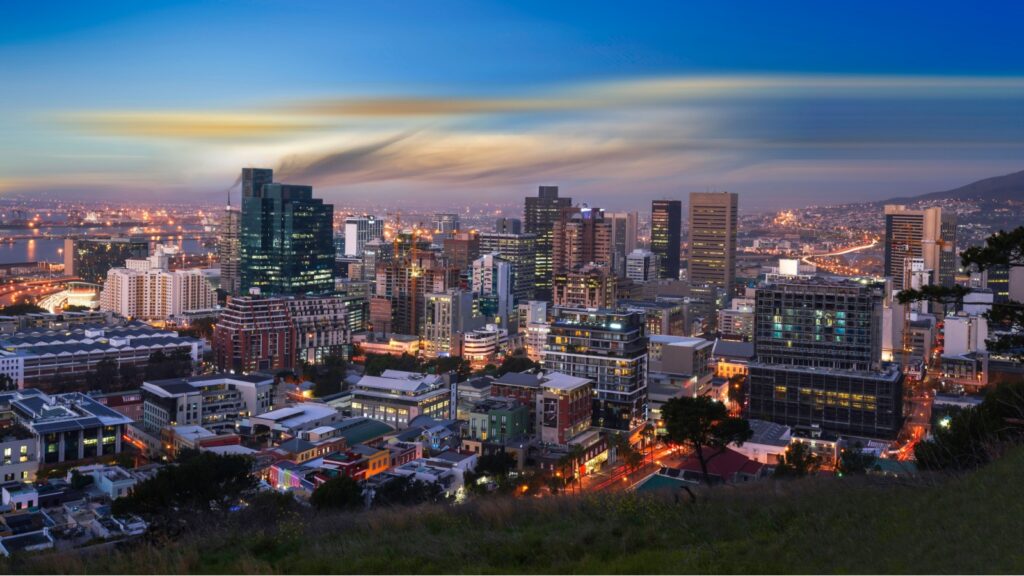
A divide in governance between South Africa’s two biggest cities has opened up a gap of at least R200 billion in commercial property values between Cape Town, the leader, and Johannesburg.
Though the value of commercial properties in both municipal markets is roughly equal at about R368 billion, comparable office space in Cape Town costs about twice as much as in Johannesburg, according to a Gmaven study.
“The cities share a currency, central bank, sovereign risk premium, tax system, and the same listed landlords,” said Gmaven CEO Will Harris, whose study covered 25,700 properties and more than 1,500 high-value transactions since 2020.
“Their asset-value divergence offers an unusually revealing comparison of how municipal performance may influence market prices or economic performance within one economy.”
The data reflects a broader reshaping of Africa’s biggest economy as capital shifts away from Johannesburg, which is grappling with strained finances, poor service delivery, stalled projects and corruption scandals.
Cape Town is booming, with construction underway at a new super-yacht marina, an office park that includes Amazon’s Africa headquarters and Marriott’s most luxurious hotel on the continent.
The coastal city also created more jobs than any other major hub last year, helping fuel internal migration and drive up property prices.
With Africa estimated to account for about a quarter of the world’s population by 2050, the divide between the cities offers “a live experiment” about governance that may influence investment decisions across the continent, he said.
Local government elections scheduled for Nov. 4 could represent a turning point for Africa’s biggest city, if the winning party takes immediate action to uplift perceptions and address issues, Harris said.
“If Johannesburg does achieve a turnaround, that turnaround is almost a case study for what is possible throughout all other cities and towns in South Africa and indeed other countries across Africa.”
Growthpoint, South Africa’s biggest listed real estate investment trust, has since at least 2022 worked to rebalance its exposure from Johannesburg’s province toward coastal areas such as Cape Town and the eastern port city of Durban.
Meanwhile, Hyprop is pursuing a strategy of allocating more capital to the Western Cape, where Cape Town is located, and to Eastern Europe.
While the gap between the South African cities is widest in office property, Cape Town isn’t a bubble, according to Gmaven data.
The study shows the coastal city is among the cheapest across a comparable set of benchmark markets, while Johannesburg is an anomaly.
It also found that a major local bank recently paid less per square foot for prime office space in Johannesburg’s Sandton business district than suburban homeowners would pay builders for construction work.
South Africa’s sluggish economy and the rise of hybrid working have left the country with an oversupply of older office space, prompting developers to convert some buildings into apartments.
While demand for modern, high-quality offices remains resilient, landlords of ageing properties are increasingly finding that residential use offers better returns than trying to attract corporate tenants.
In Johannesburg, commercial property doesn’t live up to expectations of being “dull, illiquid, stable, slow-moving” because businesses have voted with their feet amid a decline in service delivery, the migration of skilled workers to better-governed coastal cities, and fraying transportation links, according to Gmaven.
“Landlords cannot conjure up tenants, so owners have watched, largely helplessly, as value drained away,” it said.






Comments