Owning a house in Cape Town versus Joburg – the winner is clear


A comparison of residential house price developments across South Africa’s metros showed that Cape Town is the only city to have experienced meaningful real increases in property prices since 2010.
This was revealed in an analysis by Codera Analytics, recently shared by the firm’s CEO and economist Daan Steenkamp.
Codera looked at residential house price developments across South Africa’s eight metros compared to consumer inflation and owners’ equivalent rents.
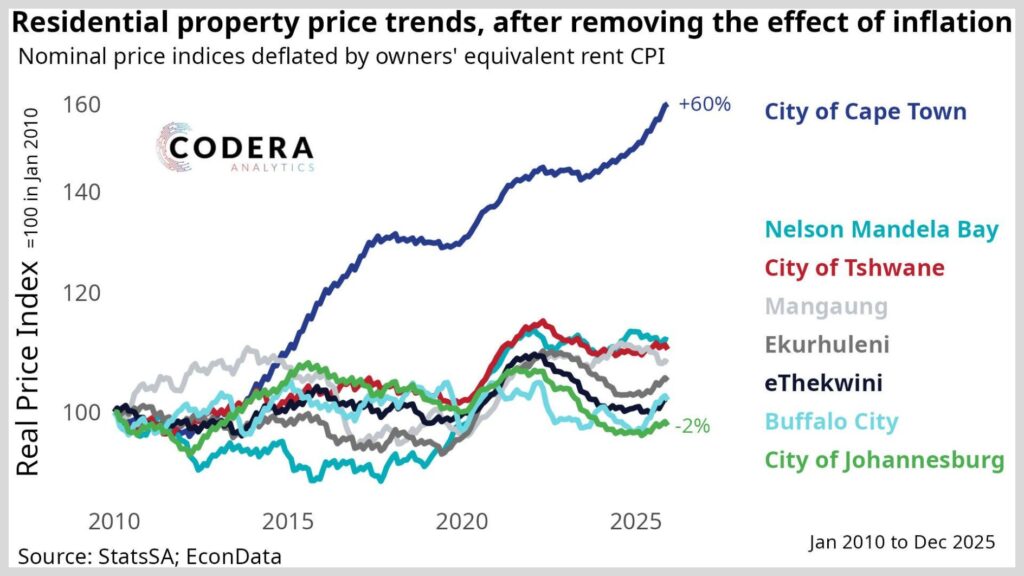
This analysis showed that Cape Town is the only metro that has experienced meaningful real increases in property prices between January 2010 and December 2025.
Cape Town has experienced a remarkable 60% increase in residential property prices over the past two and a half decades.
This is by far the highest among South Africa’s eight metros, and stands in stark contrast to Johannesburg, which actually saw a 2% decline in property prices over the same period.
Cape Town and Johannesburg are often pitted against each other, with both being well-known, major metros in South Africa and considered bellwethers for their respective provinces and the country as a whole.
At a provincial level, both Gauteng and the Western Cape boast higher GDP per capita rates than the national average.
However, Gauteng contributes far more to the national GDP than the Western Cape, at 33.2% and 14.2% in 2024, respectively.
Gauteng is considered South Africa’s economic heart, and Johannesburg is its biggest driver, with many of the country’s top companies headquartered in the city.
Johannesburg is also home to the JSE, Africa’s biggest stock exchange, and Sandton, the richest square mile on the continent.
In contrast, Cape Town is South Africa’s tourism hub, welcoming over 3 million visitors every year.
This is not to say that major companies do not also call Cape Town home, with giants like Naspers and Shoprite headquartered in the Mother City.
Both Cape Town and Johannesburg also house some of South Africa’s top universities and major international airports.
The results of Codera’s analysis can be seen in the graph below.
The property winner
While there are many similarities between Cape Town and Johannesburg, the trajectory of the metros’ property markets could not be more different.
As Codera’s analysis showed, Cape Town is by far the leader when it comes to property price growth.
This has largely been attributed to South Africa’s ongoing ‘semigration’ trend, whereby citizens are moving from one part of the country to another.
The trend is most common among skilled, middle- to higher-income South Africans, who relocate to different regions in search of opportunities or a better quality of life.
Independent economist John Loos recently explained that while this trend has benefitted many parts of South Africa, the Western Cape has been by far the biggest beneficiary.
Therefore, while both the Western Cape and Gauteng have strong overall net population inflows, semigration usually refers to movement from Gauteng towards the Western Cape.
Loos said that despite the Western Cape’s relative affordability of housing having deteriorated as property prices rose over the past few decades, the semigration trend remains strong.
However, he pointed out that semigration is not the only driver of the Western Cape and Cape Town’s remarkable property price growth over the past two decades.
“I believe that many people place too much emphasis on current semigration inflows in explaining what drives the Western Cape’s housing market,” he said.
“The importance of the past two decades of net skilled and affluent semigrant inflows into the Western Cape must be emphasised here.”
He explained that this population segment has led to a stronger cumulative build-up of the Western Cape’s skills and purchasing power base.
“The cumulative effect of this multi-decade semigrant inflow puts the Western Cape in the likely position to outperform the rest in terms of economic growth,” he said.





Comments