Glimmers of hope as South Africa’s richest city continues to crumble


Talks of a potential turnaround for Johannesburg’s property market are on the rise despite the city’s continued struggles with crime and urban decay.
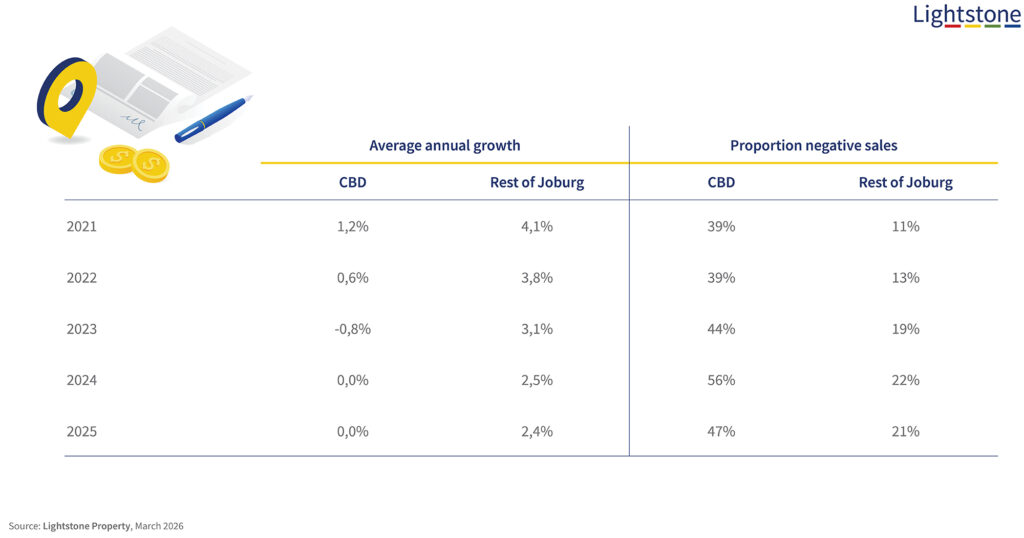
Lightstone Property reported in its March 2026 property newsletter that between 2021 and 2025, property transfers in the Johannesburg CBD saw a slight uptick over the 2016 to 2020 period.
Despite this, the CBD still lags behind the city’s outer suburbs in terms of average annual growth, while having a much higher proportion of negative property sales.
Lightstone Property managing executive of real estate Hayley Ivins-Downes said that while there is a genuine desire to turn the city around, it has not yet been reflected in property data.
“I think with polls looming in terms of the voting coming up, I think there’s a real drive to try and turn Johannesburg around,” Ivins-Downes said.
“If we’re looking at just property, it’s not a great picture. But I do think that, with some level of sentiment and hope it may bring some renewal and some vigour on that.”
House price inflation in the city reportedly picked up towards the end of 2025, which individuals such as Pam Golding CEO Dr Andrew Golding saw as a positive shift for the city.
However, Ivins-Downes said this positive sentiment quickly faltered due to the outbreak of the Middle East conflict, which may negatively impact interest rates in the country.
“Johannesburg was pretty flat, sometimes negative, and we started seeing an uptick,” Ivins-Downes said. “At the beginning of this year, we were actually all really positive around this year to come.”
“Unfortunately, not knowing what was ahead in terms of the conflict globally and the effect that’s starting to have really put another dampener back on the property market again.”
While Johannesburg has shown pockets of individual growth and investment activity, Ivins-Downes said this is not necessarily reflective of a positive trajectory for the city at large.
Restoring confidence in Johannesburg
Years of grappling with issues such as high crime rates, decaying infrastructure and poor governance have severely weakened investor confidence in the city of Johannesburg.
Ivins-Downes believes restoring this confidence through improved service delivery is crucial to effectively turning the city around.
While this process may take some time, she said there is some activity already taking place which could drive further improvements.
“Look at some of the activity just around the fact that old offices are being repurposed to affordable housing,” Ivins-Downes said.
“That certainly brings in a dimension that is really helpful to what we’re needing within the CBD to give people a property and places to live, which makes sense when offices are not being utilised.”
While Ivins-Downes conceded that this is not yet at a scale which will affect noticeable change, she believes it has the potential to with enough time and investment.
However, she noted that the most effective way to invite private-sector investment into the city of Johannesburg is through better governance and service delivery.
The city continues to face major infrastructural challenges, including water shortages, issues with electrical grids, and dilapidated roads, among others.
Fixing these issues would show private investors that the government is willing and able to improve the city, and would encourage them to get more involved as well.
Ivins-Downes said this collaboration between government and private investors is needed to bring about the desired change for Johannesburg.
“I think we have an opportunity to address what is missing and to address the service delivery and to make a difference,” Ivins-Downes said.
“I think what we’re going to require is a collective effort between government and some private enterprises to try and work together, to try and bring the change that everybody would like to see.”





Comments