South Africa’s platinum bullet


South Africa is set to receive a significant boost from sharply rising prices for platinum group metals (PGMs), which have risen between 25% and 50% so far in 2025.
One of the main benefits of this is increased corporate income tax revenue for the government, if the elevated prices hold or keep rising.
This should help the government improve its financial standing, providing it with a windfall to pay down its debt or invest in the economy.
The rising prices could have another benefit in offsetting some of the economic impacts of tariffs on South African exports to the United States.
However, South Africa has experienced commodity booms and the associated tax windfalls before, with the additional revenue often being squandered on salary increases and consumption rather than productive investment.
Old Mutual Wealth’s chief investment strategist, Izak Odendaal, explained that elevated PGM prices could also translate into a stronger rand.
This, in turn, will make it cheaper to import goods and keep inflation contained, which will boost real household income and consumer spending.
Overall, it will be good for the South African economy and offset some of the impact of tariffs on goods exported to the United States.
Standard Bank’s research indicates that a 10% increase in tariffs translates into a 0.1 percentage point decrease in economic growth. Thus, the 30% tariffs currently in place could cut off 0.3 percentage points of growth.
While small, this is significant considering the country’s economy is only expected to grow by 1% in 2025.
Odendaal expects the 30% tariffs on exports to the United States to be lowered in due course, with the main question being when this happens.
Several companies have already warned that export contracts to the United States are in danger, as are the associated jobs.
The biggest concern is around the automotive industry, where decisions will be made at company headquarters in Germany or Japan.
There are crucially also economic offsets to the impact of tariffs, with the Reserve Bank having cut the repo rate by 125 basis points over the past year, while lower inflation, currently around 3%, raises real income growth.
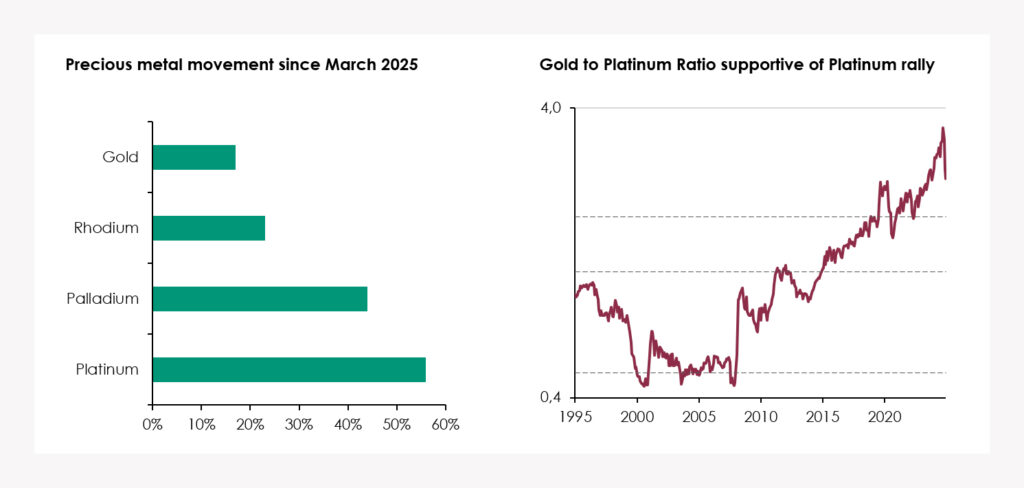
The jump in platinum and palladium prices since the start of the year, 45% and 25%, respectively, will have a positive effect, if sustained, by supporting a firmer rand and also feeding into higher corporate taxes.
Some of this windfall will presumably also end up in the pockets of workers as bonuses and shareholders as dividends. The same is true of gold, but South Africa is no longer the major gold producer it once was.
The graphs below show the rise in platinum prices since March 2025, courtesy of Old Mutual Investment Group.
The GNU’s opportunity
Old Mutual Investment Group’s head of equity research, Meryl Pick, said it is crucial that the Government of National Unity (GNU) use the windfall from higher corporate taxes wisely.
Pick explained that PGM prices have risen due to a slowdown in electric vehicle sales in the European Union and the United States.
With demand for these vehicles expected to remain strong, investors are increasingly betting on demand for PGMs to be more resilient than expected, Pick said.
While the slowdown in demand for electric vehicles has pushed platinum prices higher, over the long run, the main driver has been declining supply.
Mining companies have been hesitant to invest heavily in new capacity or in expanding current mines, due to fears of declining demand for PGMs.
These companies have also looked to diversify their revenue by increasing their investments in copper mines and crop nutrients businesses.
The supply of PGMs is highly constrained at a time when demand may prove more resilient than expected, squeezing prices higher.
As a result, the price of platinum has soared nearly 50% over the past six months, with palladium up 33% over the same period.
Pick said that this could result in a commodity-driven tax windfall of the same size as South Africa experienced in 2021, when PGM prices boomed.
Following a sustained rise in the price of PGMs in 2021, the government collected an additional R120 billion in revenue.
The key question is how these funds will be used, with Pick advising investment in infrastructure or paying down the government’s debt rather than increasing consumption and higher salaries.
This windfall positions the GNU for potentially its first ‘big win’, which could justify the immense optimism surrounding its formation.
It may also ease tensions within the coalition, as the potential windfall would greatly reduce fiscal pressure in the current financial year and the coming years.
 Loading ...





Comments