South Africa has been left behind


Investment in mining and exploration is booming across the world, led by the United States, as countries rush to secure minerals critical for modern industries and reduce their reliance on global supply chains.
However, no exploration for new minerals has occurred in South Africa for over 20 years, despite it having one of the richest natural bounties.
This has resulted in the once-dominant mining powerhouse being left behind, with companies looking to invest elsewhere to tap into rising global demand for key minerals.
Anglo American CEO Duncan Wanblad recently said the country has lost an entire generation of mines due to unsupportive policy for exploration.
This downward spiral shows no sign of ending as the government fails to make South Africa more attractive for investment, with policy uncertainty and onerous regulations inhibiting exploration.
Modern Corporate Solutions mining analyst Peter Major explained that mining investment has completely changed for the better over the past year, and South Africa has missed the boat.
Major told BizNews that firms that provide financing for new mining projects are not interested in South Africa, as it is not seen as an attractive investment destination.
“They are not afraid of risk, but they have no intention of investing in South Africa. In some cases, these companies invested in the DRC, where they had to employ people just to protect their mines from terrorists,” Major said.
“They were clear that everything has changed in just the past six months because of Donald Trump. Mr Trump is known for ‘Drill, baby, drill’ and ‘Dig, baby, dig’.”
“Mining companies in the United States are getting permits in weeks now, rather than years. We are seeing massive exploration projects across North America.”
Major explained that South Africa has missed the opportunity to attract some of this investment by changing its mining charter to make it easier to explore and build a mine in the country.
South Africa used to be the number one jurisdiction for mining in the world, with regulation and protocol built up over 150 years of experience. Now, it ranks among the ten worst jurisdictions, according to the Fraser Institute.
“Instead of changing South Africa’s mining charter to encourage investment, it has been more of the same and doubling down,” Major said.
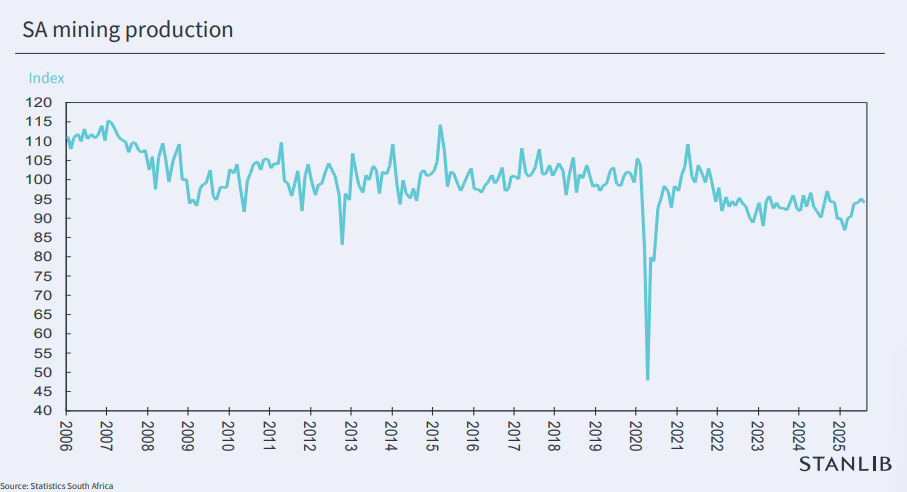
The graph below, courtesy of Stanlib chief economist Kevin Lings, shows South Africa’s mining output over the past twenty years, with it declining steadily.
Regulation and stability
Major explained that it is key for a country to have a stable regulatory environment to get mining companies to explore and investment, as mines have extremely long lead times.
It takes around 17 years for a mine to go from exploration to full capacity, making these companies extremely sensitive to any potential change in regulation.
South Africa’s regulatory environment has been relatively volatile over the past 30 years, with repeated threats of nationalisation and onerous transformation regulations imposed.
This has made it more difficult to open and operate a mine in South Africa, resulting in the country having over 6,000 abandoned mines.
“The simplest explanation is that you had an established mining law and protocol system on how to develop and run mines and who owned them,” Major said.
“That had been built up over 150 years and was working pretty well. It made us the number one mining country on the planet.”
This changed rather quickly once increasingly severe Black Economic Empowerment requirements were placed on the sector, and politicians, who had called for the nationalisation of the industry, rose to power.
With a resurgence in American mining, there will be even less capital to invest in South Africa’s ailing industry as it adds another country to investors’ radar.
“It is quite a finite pool of capital, with investors putting most of their money into technology companies as they have generated greater returns,” Major said.
“The pool that goes into mining has not changed much over the past 20 years. There are these capital flows into Africa, Asia, and South America that are going to flip and look at America.”
“Everybody likes to have a project in America because the first thing is that the Mining Act has not changed since 1872. Second of all, nobody even knows how to spell the word expropriation in America.”
Coupled with America’s vast natural resources, which rival South Africa’s, capital will flow into the world’s largest economy, looking for mining opportunities.
South Africa fundamentally has to make itself more attractive to investors by reducing the regulatory burden, ending uncertainty, and ensuring that mining projects will not be expropriated.
“It has to be easier to get a licence in South Africa than in America. There needs to be a quicker turnaround, greater certainty, and surity that their licence is legitimate and cannot be messed with,” Major said.




Comments