Where South Africans invest their money


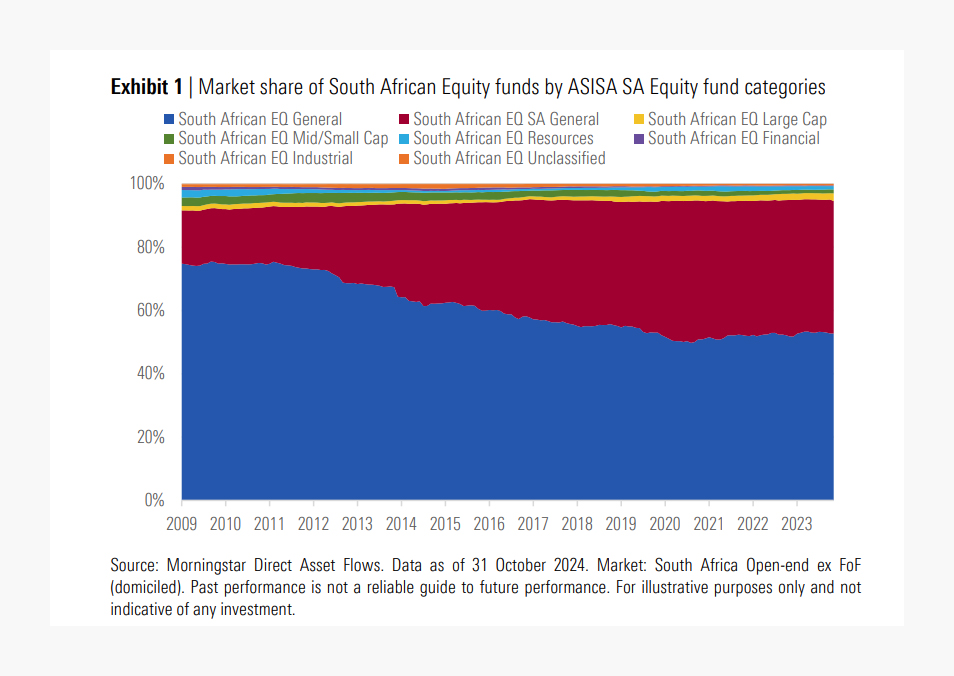
The market share of South African-only equity funds has greatly increased over the past decade and now takes up 42% of all assets held in equity portfolios in the country.
Senior fund analyst at Morningstar South Africa, Michael Dodd, said this is somewhat surprising given the JSE’s relatively poor returns in the past ten years and a rise in delistings.
The latest data revealed that despite this, there is over R500 billion invested in South African equity funds.
It also revealed that most of this is invested in general equity funds, with niche categories focusing on a specific sector or company size having their market share and number of funds plummeting in recent years.
While it is difficult to attribute this to one factor, the rise of passive investing likely played a significant role as these funds are more likely to be SA-only funds.
Furthermore, the general preference of allocators to separate their local and offshore equity allocations may have played a role in the increased popularity of SA-only funds.
This shift has been so significant that it has necessitated the creation of a new category by the Association for Savings and Investment in South Africa (ASISA).
The new South African Equity SA General category was introduced specifically for local funds that invest exclusively in shares listed in South Africa.
Data from the Reserve Bank shows that the performance of local equities is also increasingly important for ordinary South Africans, with listed companies making up nearly half of household wealth.
These are investments directly in listed equity and can be skewed heavily by wealthy executives, with a portion of their remuneration paid in stock options.
When investments in unit trust and retirement funds are included, the share of household wealth invested in equities rises above 50%.
Less than 5% of household wealth is exposed to money market funds, which invest in fixed-income assets such as government debt or corporate bonds.
The strong growth of investments in South African equity funds can be seen in the chart below, courtesy of Dodd and Morningstar.
Dodd warned that as the popularity of these SA-only funds has grown, so too as the difference in the returns of equity funds in South Africa.
The main driver behind the increase in dispersion between funds in the old category appears to have been the regulatory increase in offshore limits.
As funds are allowed to increase their offshore exposure, their performance has become increasingly linked to global market trends rather than local developments.
Generally, this means that the performance of different equity funds is greater now than ever before, depending on whether they allocate assets offshore or not.
Dodd explained that this makes the creation of the new ASISA category vital for investors as they can more easily compare the performance of SA-only funds with those that can invest offshore.
Since implementing the new regulations enabled fund managers to allocate up to 45% of their assets offshore, it would have been far better to invest in global equity.
In 2023, the JSE All Share delivered a solid return of 9.3% for the year, while the MSCI World Index delivered a return of 33% in rand terms.
Thus, investors would have benefitted greatly from an equity fund that had some offshore exposure.
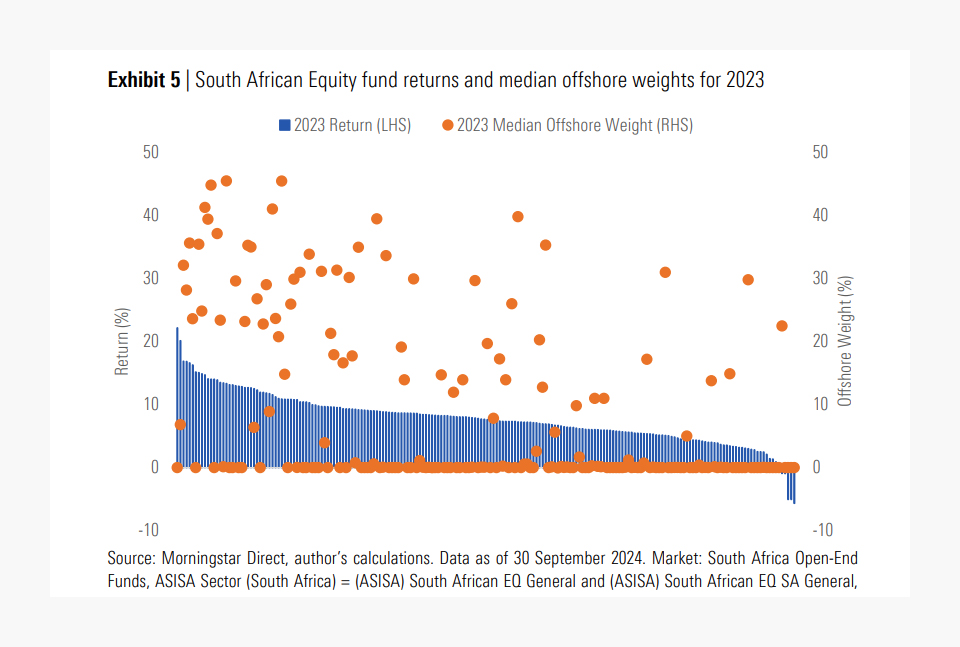
This can be seen in the graph below, with funds that have greater offshore exposure generally performing better in 2023.
However, this is not a rule, with some funds that have significant offshore exposure performing poorly. This reinforces the idea that a lot hinges on the quality of the individuals managing the fund and picking the stocks.





Comments