One wealth manager with a moat so unique that nobody else can touch it


PSG Financial Services (PSG) has compounded organic revenue at 12% annually for 10 years, supported by its 998-strong adviser network, client inflows, and market growth.
With the company now having low market share, high returns, and disciplined reinvestment, it is well-positioned for continued growth.
This is the view of Coronation investment analyst Tracy Brodziak, who identified PSG as a member of the firm’s “Crown Club”.
The Crown Club comprises some of South Africa’s best businesses with enduring competitive advantages, above-average organic growth, strong capital allocation, and good pricing power.
PSG has been selected as the second member of the Crown Club, being one of the few JSE-listed companies to meet Coronation’s criteria for more than a decade.
“In a weak economy, in which most domestic stocks have performed poorly, PSG has delivered extraordinary returns for shareholders that have been prepared to take the long view,” Brodziak said.
She explained that, over the last decade, PSG’s stock has returned 5.6 times the initial invested capital, far outpacing the JSE Capped All Share Index.
“Our framework prizes organic growth above all, and PSG passes this test convincingly,” she said.
“Over the past decade, organic revenue has compounded at around 12% a year, roughly double nominal GDP growth.”
“The key drivers have been adviser recruitment and net inflows, supplemented by market movements.”
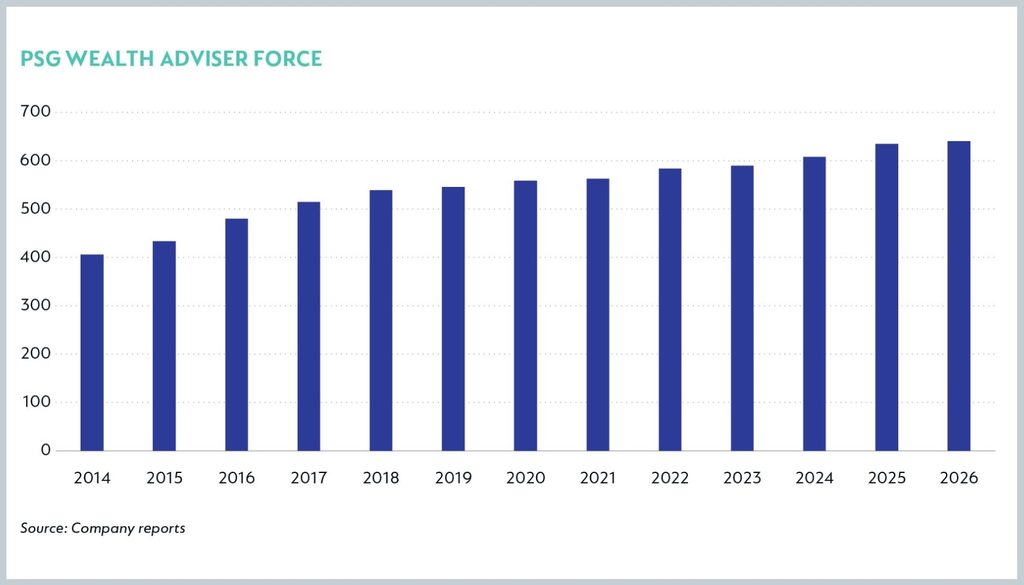
PSG’s adviser network has been one of its biggest strengths for years. Its results for the first half of the 2027 financial year showed that its network grew to 998 advisers in the six-month period.
Brodziak explained that PSG’s primary moat is its distribution, which is why it has continued to attract advisers to its network.
“It now has the largest independent wealth adviser force in the country,” she said.
PSG’s moat
Brodziak said PSG’s moat is unusual for two reasons: its advisers are effectively owners, and the moat compounds.
Firstly, she explained that PSG’s advisers effectively serve as owners rather than employees, since the company operates a franchise-like partnership.
In this partnership, advisers typically retain equity in their practices and share in the economics of the client book.
“This aligns incentives and makes the network very difficult to poach,” Brodziak explained.
“An adviser leaving PSG must give up their platform, their compliance and technology infrastructure, and a share of their own goodwill.”
Secondly, she pointed out that the moat compounds, since every new adviser brings a book of potential clients, and every new client is a prospect for PSG’s platform, asset manager and insurer.
“The strong growth that this has delivered has enhanced the group’s scale and lowered the unit cost of compliance, technology, and administration that a stand-alone practice cannot match,” she said.
Brodziak said companies that have such a strong distribution moat often damage it by pushing their own products rather than pitching the best solution for the client.
In PSG’s case, it has been very disciplined in avoiding this by allowing advisers to pick the best products for their clients.
“This means its own products must compete against those of their competitors and demonstrate their value to clients,” Brodziak explained.
“When it comes to attracting clients, PSG has consistently gained ground as a result of this unbiased product selection and superior digital platforms.”
In an interview with Daily Investor following the release of its H1 FY27 results, PSG CFO Mike Smith said the company has also invested heavily in technology, to the benefit of its advisers.
“The guys can focus on doing what they’re good at: the relationship and concluding transactions with clients,” Smith explained.
He said PSG’s advisers can use the infrastructure and systems that the company built to streamline things that might have taken a lot of time and admin, allowing them to focus on the client.
“It’s about asking, ‘Where do you have friction?’ and spending time on it and improving those processes so that they can spend most of their time on the high-value, quality client relationship,” he said.
Brodziak said PSG has invested R3 billion in cumulative technology capital expenditure over the past ten years.
She said this investment has enhanced the client experience and further lowered PSG’s cost to serve.
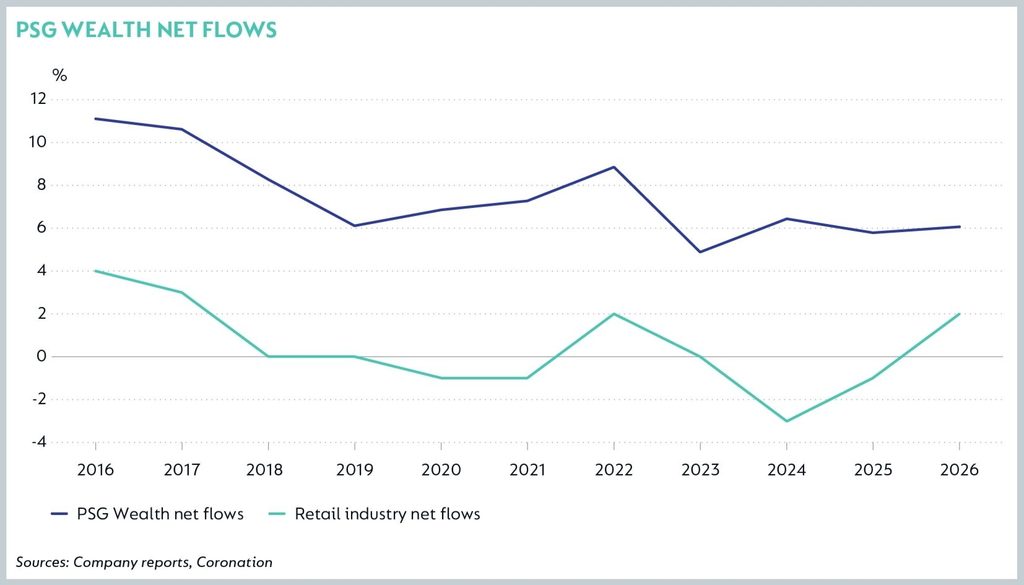
“The combination of these factors has led to PSG Wealth attracting net inflows materially above the industry,” she said.