The South African CEO who made his company R1.2 million every day for 30 years


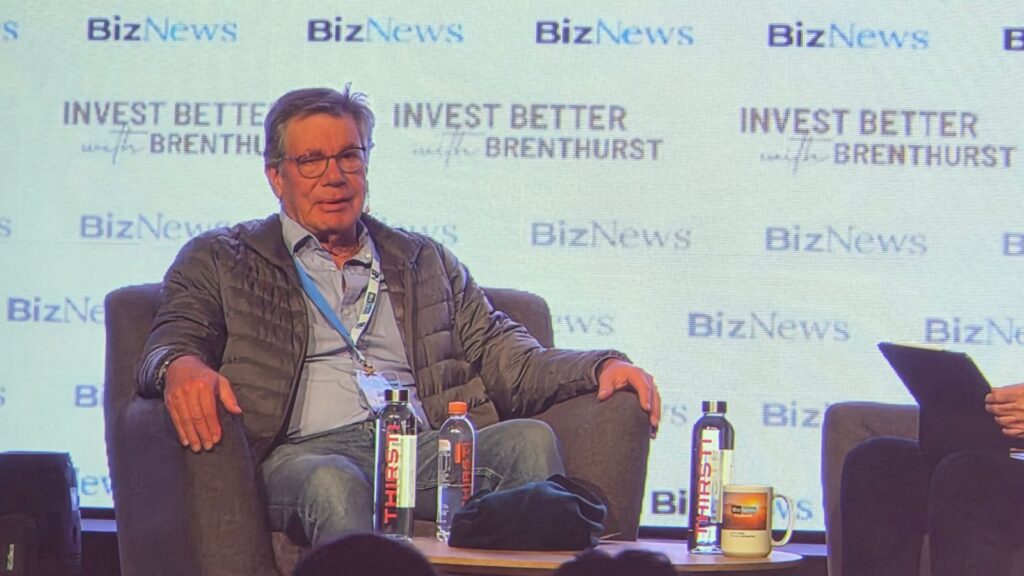
Johnny Copelyn has turned Hoskens Consolidated Investments (HCI) from a cash shell worth R1.4 billion in 1997 into a R14 billion investment giant in his three decades as CEO.
This translates to an average gain in market capitalisation of R1.2 million per day over his 30 years as CEO.
HCI’s share price has gone from R2.50 per share when Copelyn started to being above R160 per share. This equates to 15% compound annual growth.
Copelyn recently revealed that he will be stepping down as CEO of the company in the 2027 financial year, but will retain his position as chairman of the board.
The mathematics makes Copelyn’s success seem inevitable and HCI’s march towards a R14 billion valuation on the JSE relentless.
However, it has been anything but simple, with Copelyn telling the 9th BizNews Conference that luck and hard work have played their role in HCI’s success.
The histories of both Copelyn and HCI go back beyond 1997, when they joined forces.
Copelyn was a prolific trade unionist and organiser, rising to the position of secretary general of the Southern African Clothing and Textile Workers Union (SACTWU).
This status ensured Copelyn was chosen by COSATU as one of the 20 union representatives included in Nelson Mandela’s first democratic government.
After serving in government for three years, Copelyn left politics to run SACTWU’s investment fund, which sought ways to create wealth for its members.
To circumvent the strict rules applied to pension funds, SACTWU became the controlling shareholder of an obscure JSE-listed company, HCI.
HCI was an empty cash shell, Copelyn explained, and provided the perfect opportunity for SACTWU to create a private equity-type company to invest on behalf of its members.
The company had been created by Investec co-founder Larry Nestadt as the holding company for Incorporated General Insurance.
After the insurance business went bust, HCI was effectively an empty company, with no assets besides a pile of R1 million in cash.
SACTWU became its controlling shareholder and appointed Copelyn as CEO, thanks to his business acumen and trade union ideals.
Copelyn describes himself as a “business unionist”, which is viewed disdainfully by many union members who are staunchly socialist and communist.
“Business unionism is viewed with great disdain by many. It refers to unions that are not committed to socialism or communism. They are just trying to improve the lives of their members,” Copelyn said.
“We have been branded that way, and I probably view that as the central role of a union. It is about making the lives of workers better.”
Prague, Johann Rupert, and making money

Copelyn fell out of love with socialism and communism during a visit to Prague after the Berlin Wall fell in 1989.
“In Prague, I listened to a group of clothing workers who were begging for the previous owner, whose business had been confiscated by the state in 1946, to come back,” Copelyn recalled.
“They said that if the previous owner came back, they would be free of the state. As you listen to that, you realise that the experience of workers under socialism was not great.”
“That was an eye-opener for me, and I would say it is probably the reason why I am business-union oriented.”
The first major test of this ideological stance came when the apartheid government granted telecoms licences to MTN and Vodacom in the 1990s.
This was seen by unions as the apartheid government robbing the incoming government of state control of communications, which it enjoyed through Telkom.
The unions wanted the ANC to declare that it would not honour these licences if it came to power, effectively killing Vodacom and MTN in their cradles.
A compromise was eventually reached in the early 1990s, and trade unions were given 5% shareholdings in Vodacom and MTN.
“There was a big ideological discussion about it. I would say, in the end, a minority element objected, but my union just felt this was absolutely ideal,” Copelyn said.
“We can get 5% of Vodacom without doing much, and that gave our investment fund its start. I would say it gave us a great start.”
Copelyn and his longtime partner Marcel Golding used this investment to build up an asset base from which HCI could fulfil its primary purpose.
HCI’s guiding principle has been to take large stakes in listed and unlisted South African companies, lend them its Black Economic Empowerment (BEE) credentials, and improve their operations.
The company would also leverage its political connections to help companies get access to operating licences in regulated industries.
This is how it sealed its first major deal, securing e.tv’s licence to operate in 1998 as South Africa’s first private free-to-air television channel.
HCI still holds a stake in eMedia Holdings, which has generated significant cash that it could redeploy elsewhere.
This was the name of the game for HCI, as Copelyn explained that it did not have the luxury of investing in ready-made businesses. With its limited capital, it could only invest in startups.
It had to have businesses that were stable and cash-generative so it could then deploy capital into other ventures and opportunities.
Television was one of those businesses, with HCI steadily adding casino assets to its portfolio and coal mining to boost its cash generation.
Battling with Cyril Ramaphosa and HCI today

Copelyn has had his fair share of boardroom battles, including notable struggles with Cyril Ramaphosa and his partner, Marcel Golding.
Both Copelyn and Ramaphosa had the same idea in the early 2000s: buy up casino and gaming assets to generate cash for future investments.
HCI and Ramaphosa-led Johnnic wanted to buy Tsogo Sun for access to its casino licences and as a ready-made asset generating cash for shareholders.
Copelyn took the battle right to Ramaphosa’s front door and bought up shares in Johnnic through HCI, with his company eventually becoming Johnnic’s largest shareholder.
The war then went to the public domain and the boardroom, with Copleyn saying that Johnnic’s management was distanced from the company and had no skin in the game.
He put the matter to Johnnic’s institutional shareholders, asking them to accept a mandatory buyout offer. All the while, Ramaphosa called Copelyn a predatory corporate raider.
Shareholders accepted HCI’s offer, and regulators approved the deal on the condition that HCI give up ownership of the Gallagher Estate. Ramaphosa promptly resigned from Johnnic.
HCI absorbed Johnnic’s gaming assets into Tsogo Sun and dismantled the rest of the business by unbundling or liquidating all its assets.
Tsogo Sun’s assets gave HCI a base from which to invest in new assets and expand its reach into other sectors.
Another key acquisition for the company was that of Golden Arrow Bus Services, which is immensely lucrative. However, it is also one of the most difficult businesses to run.
“Choosing businesses and building them into real companies that are making money has a lot of tricky pieces to it,” Copelyn said.
“For example, we took over Golden Arrow, and it has been attacked mercilessly by the taxi industry, as it is a competitor and is subsidised.”
“It is not an easy business to be involved in, and we have survived over the past 20 years. We have over 1,000 buses, and we regard it as normal if we lose 12 buses a year to arson.”
“That is what is normal in South Africa now. You can be insured and have political risk cover and all those wonderful things, but ultimately you have to pay for it.”
Today, HCI is valued at R14 billion on the JSE and has a diverse portfolio of listed and unlisted assets. It retains key stakes in Tsogo Sun and eMedia Holdings.
Copelyn also pushed the company to invest heavily in Southern Sun, with the company owning a 41% stake.
In recent years, he has diversified the company’s asset base to include ownership stakes in Frontier Transport, Deneb Investments, the wine farm La Concorde, and various oil and energy holdings.
The challenge of making oil and energy investments work in South Africa will be left to Copelyn’s successor, Kevin Govender.
“We have never built a startup to a point of breakeven in less than six years, but oil is a different game,” Copelyn said.
“We got into the oil business in 2013, and 13 years later, we still have not seen a single drop of oil. We think it will be 17 years of plodding around cash-negative before we see any money.”
“If you want to be a trader and see the results next week, this is not the game for you.”





Comments