End of an era for South African investors


South African investors are likely to find investing over the coming decades much more challenging than the previous 15 years, as tailwinds flip into headwinds.
The era of a relatively peaceful world with low inflation and declining interest rates appears to be coming to an end as globalisation fractures.
This will result in slower technological development and weaker economic growth, which will filter through to company earnings and cash generation.
Old Mutual Investment Group’s (OMIG) head of equity research, Meryl Pick, explained that over the past 15 years, investing has been more about triumph than disaster.
This script is about to flip, with new storms brewing on the horizon and the global economy heading for its most significant changes in decades.
Speaking at OMIG’s Tomorrow investment conference, Pick said it is quite clear investors are sailing into the storm and inflexion points are coming when drastic changes will become reality.
Pick explained that increased tension, frequent market corrections, and elevated inflation and interest rates will become the new normal for investors.
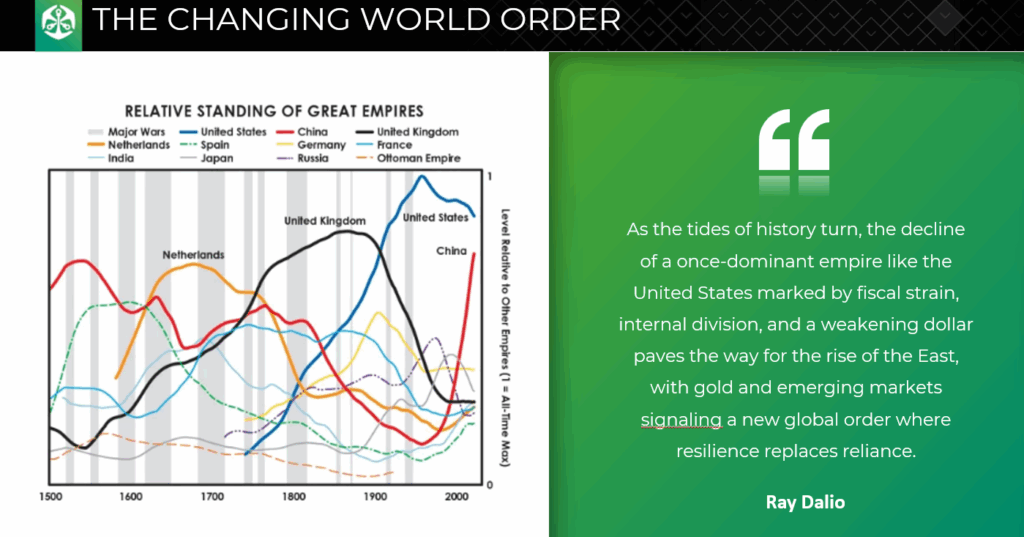
This type of environment has not been seen in decades, with the world enjoying a historic peace dividend from having a global hegemon in the United States.
The end of this hegemony, with the rise of China, is likely to result in a fracturing of global supply chains, increasing costs and inflation.
Heightened competition may drive immense technological innovation, but the benefits will be increasingly limited to a select few allies rather than widely distributed as in the past.
All of this will result in slower global economic growth, impacting company earnings and changing the return profiles of assets.
Most importantly, elevated inflation is likely to translate into higher interest rates, which will affect the risk-free rate of return.
This, in turn, creates a higher hurdle for investments to be made into equities, new projects, and riskier assets that drive faster growth.
As a result, the virtuous cycle for economic growth investors over the past 15 years is likely to be flipped into a vicious cycle that could make it more difficult to match the returns seen in recent times.
The five signals of changing times
In setting the scene for the rest of the conference, Pick explained the five signals that Old Mutual has identified to inform its thinking around major changes to the global economy and market returns.
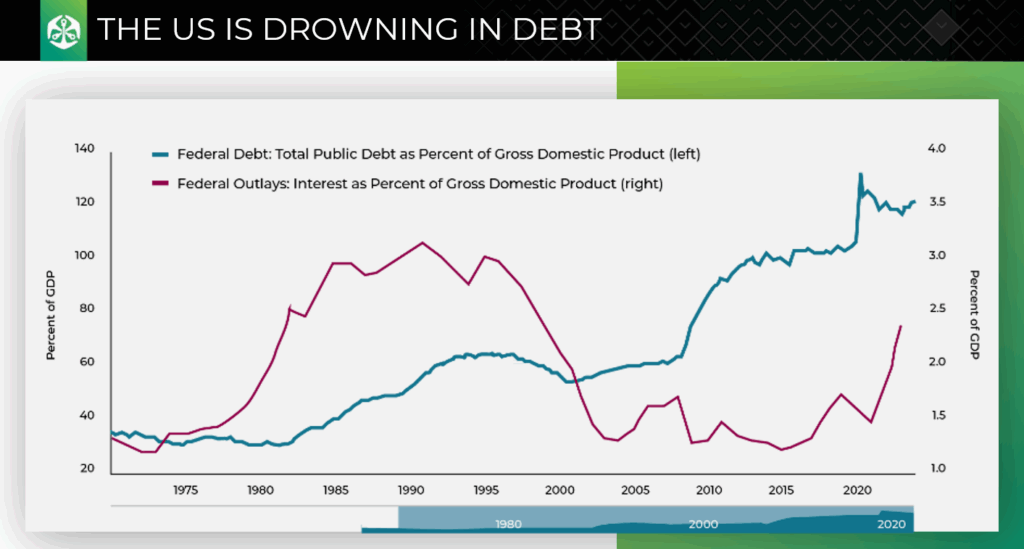
The first signal is the rise in the debt load of the United States, which is important to the global economy given the country’s outsized role in financial markets as the custodian of the international reserve currency.
Pick explained that debt used to be seen as a stabilising force in an economy, with states raising money to spend heavily to avoid a recession or severe financial crises.
However, more recently, it has been used as a driver of economic growth, with debt-fuelled spending key to increasing activity.
This is unsustainable, with the United States’ debt burden crossing 100% of GDP and debt-servicing costs crowding out expenditure in more productive sectors, slowing economic growth.
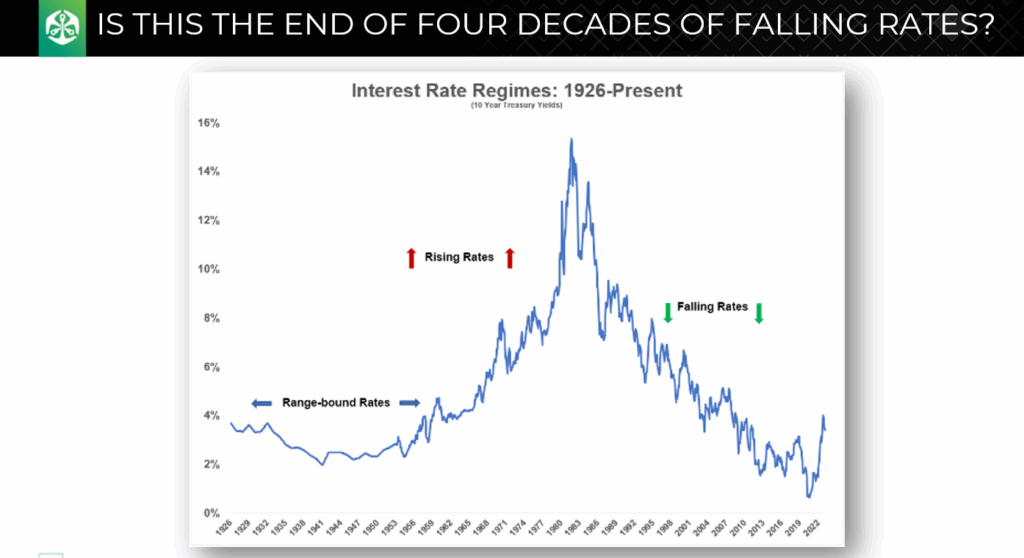
The second signal is higher interest rates for longer, as inflation has not been comfortably contained by central banks in developed economies.
This signals the end of the era of cheap capital driven by near-zero interest rates and ever-increasing government spending that juiced the economy.
Pick explained that the main driver of this is the fracturing of globalisation, with supply chains breaking amid increased great power competition.
This results in rising labour costs, less efficient production, and increased spending on making supply chains resilient and not efficient, pushing prices higher. Central banks have to counteract this through elevated interest rates.
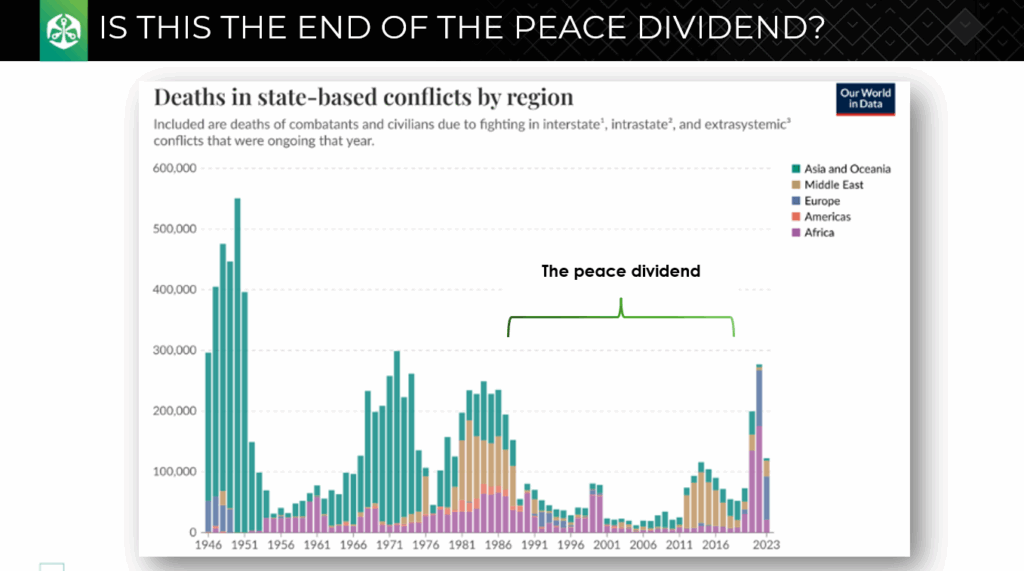
Thirdly, this is compounded by the end of an extended period of peace, never before seen in human history, with declining military expenditure and casualties in war.
This resulted in an immense productivity boom as capital was reallocated to more economically productive sectors of the economy.
Increased spending on military equipment and security drives governmetn debt higher, while also keeping inflation elevated for longer.
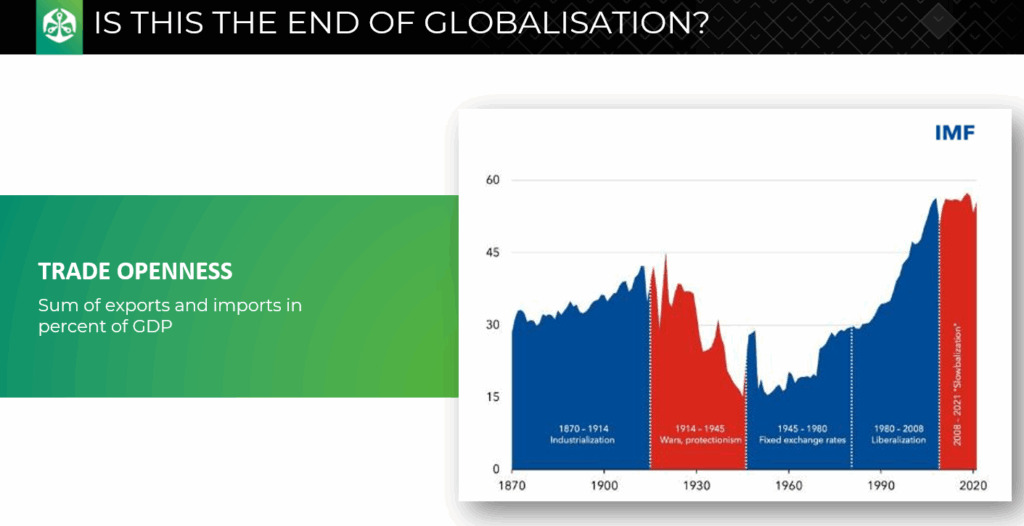
The fourth signal is the end of globalisation, with trade openness peaking and global supply chains fracturing as great power competition heats up.
This results in elevated inflation and interest rates as resilience is very expensive and inefficient, making it harder to access capital.
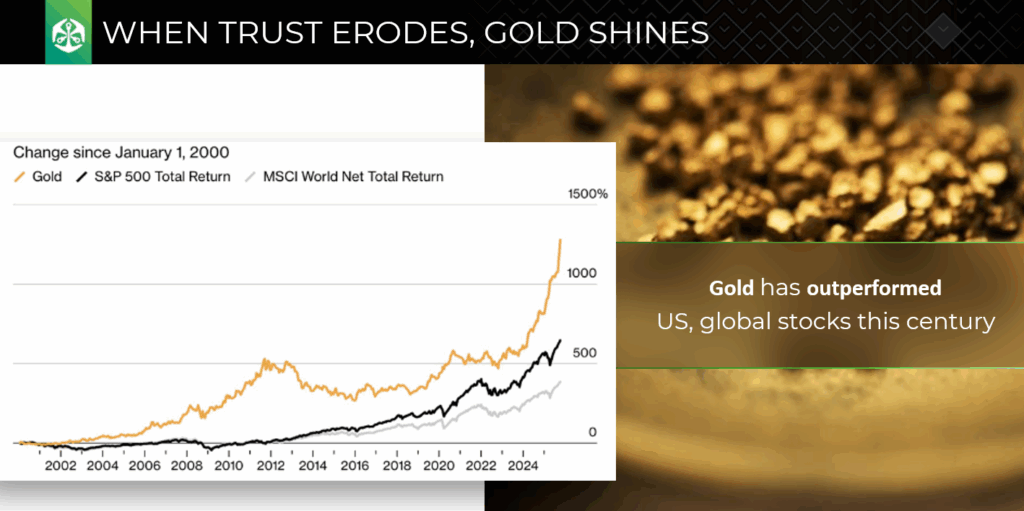
Pick explained that the fifth signal is more of a symptom of the others, with a rise in gold prices indicating declining trust in fiat currency and traditional assets.
These five signals can be seen in the graphs below, courtesy of Pick and OMIG.