Lumbering GNU is not just sound and fury


By Jason Swartz, Portfolio Manager, Old Mutual Investment Group
One year in and the government of national unity has yet to usher in a tangible business and investment boost.
Yet, despite its ructions, one positive is slowly emerging: when push comes to shove, South African politicians can actually work together.
- Click here to learn more about Old Mutual Investment Group’s local and global investment strategies.
With a fractious year under its belt, the long-term prospects for South Africa’s government of national unity (GNU) are as changeable as the weather.
Yet, despite the simmering tensions, it’s becoming increasingly apparent that there is also a pragmatic realisation among those at the coalface of governing that these are early days and all parties are still getting to grips with the dynamics of coalition politics.
Ruling by coalition is notoriously challenging, even more so when the two biggest partners are primed to be at each other’s throats, as is the case with the African National Congress (ANC) and the Democratic Alliance (DA).
Even well-established democracies like Finland, Italy and Germany – all of whom have greater coalition experience and the appropriate legislation to support this give-and-take form of government – stumble at times.
The reason why coalitions so often fail has everything to do with putting a collection of political parties with widely divergent ideologies into a room and effectively saying ‘get on with it’.
It is hard to find alignment, and it is challenging to build consensus and a shared vision for the future when the fundamentals are not aligned.
Yet, the discomfort that comes from being forced to listen and hear one another can be powerful.
As American civil rights activist Bernice Johnson Reagon once put it: “If you’re in a coalition and you’re comfortable, you know it’s not a broad enough coalition.”
Take comfort in the discomfort
Fortunately, few are really comfortable with South Africa’s GNU; so that must spell some good news.
With only a handful of multi-party coalitions under our belt – including the 1994-1997 GNU and the City of Cape Town coalition between 2000-2006 – much was being asked of the widely divergent partners in this GNU.
As if the fundamental differences in opinion and style among the main players – the ANC, DA and Inkatha Freedom Party – weren’t enough, South Africa’s GNU also features seven smaller parties: the Patriotic Alliance, Freedom Front Plus, United Democratic Movement, Rise Mzansi, Al Jama-ah, the Pan Africanist Congress of Azania, and GOOD.
Given the line-up, perhaps our expectations were too high in June 2024 when the coalition was first formed, as South Africans hoped for a happy ‘marriage’ of sorts.
Certainly, overseas commentators were not as optimistic, with many regarding this as a Band-Aid, a honeymoon period, and a coalition destined to collapse.
What was simmering under the surface, however, was a fervent hope that the GNU partners would find a way to support business and create a more investor-friendly economy.
Indeed, the initial response by markets to the GNU’s formation was encouraging: the JSE ticked up, South African bonds surged, the rand strengthened, and foreign investment flows improved.
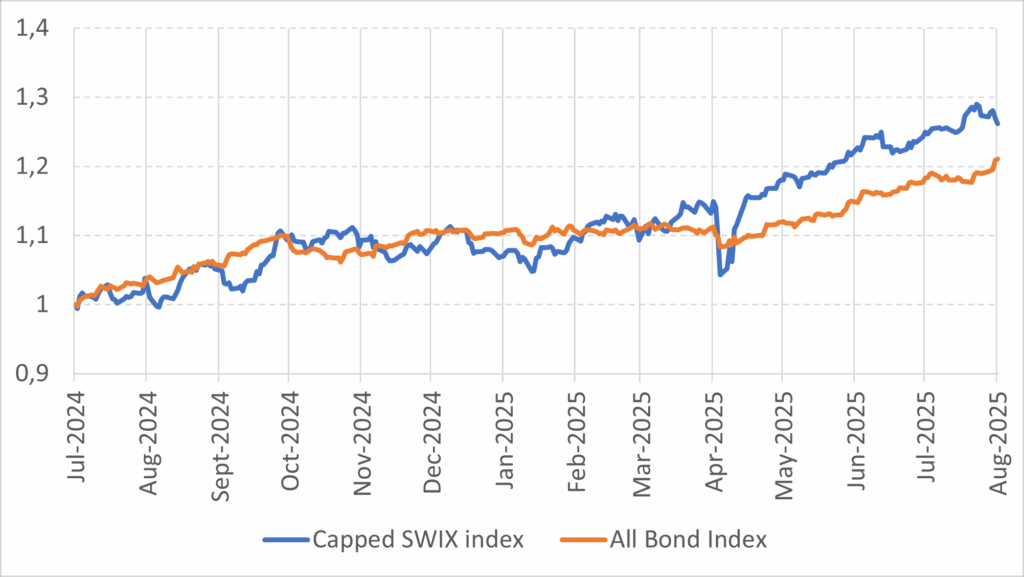
Regrettably this sentiment has not been sustained, and investment inflows and GDP continue to disappoint with growth of 1% expected for 2025, as per the SARB’s latest forecast.
However, there have been some wins.
All 10 parties have rallied behind Operation Vulindlela’s structural reforms to the country’s rail network, electricity and water, and digital infrastructure.
Some of the milestones that the GNU government set have been reached, and notable reforms are underway with respect to South Africa’s visa system.
Unfortunately, there have also been some significant stumbling blocks, with this year’s National Budget proving a pivotal moment as cross-party support derailed Finance Minister Enoch Godongwana’s proposal to raise VAT.
The tensions played out publicly between February and May, with April representing the peak of the country’s anxiety as the market priced in a coalition break up.
In addition, many still find the somewhat harsh and condescending tone of the second-largest party in the GNU, the DA, difficult to stomach.
This approach may work well on the election campaign trail, but it doesn’t sit well in a partnership where all parties need to soften their approach, adapt and work out issues behind closed doors if the coalition is to remain sustainable.
Political growth
Despite all the Budget upheaval, what is interesting to note is that investors were less worried, with many regarding the fact that the Budget had gone through three iterations as a signal that the GNU was, actually, quite robust.
If anything, the recent announcement of Budget process reforms by National Treasury, and a call for better coordination, a wider consultation process, and increased focus on fiscal efficiencies, is to be welcomed.
Greater public and cross-party participation is a good thing.
It speaks to a more robust and accountable government and invites active listening.
Developments like this – alongside the united front shown by South Africa’s delegation to the White House in May 2025 – indicate that maybe, just maybe, our political approach is maturing.
The longer the GNU lasts, and compromise on both sides eclipses ugly public standoffs, the harder it will be for individual parties to differentiate themselves and their achievements and failures in the eyes of the public.
As we gear up for municipal elections in 2026, it will be interesting to see how the ‘GNU 10’ handle this period and how, if at all, it affects the way elections are fought in South Africa.
Does this mean an election with greater policy discussions and fewer personality attacks? At least from the GNU members.
And how much firepower do these blurred lines give parties outside the coalition?
Action SA has already put out a scorecard for the GNU which awards a resounding F for ‘ethical leadership and public service’, ‘economic growth that creates jobs’, ‘improved basic service delivery’ and ‘law and order that upholds a just society’. The ‘quality education for all’ category got an E, and ‘enhanced infrastructure for efficient trade and transport’ top-scored with a D.
Some may argue that with the strike of this red pen, Action SA has already kickstarted its electioneering.
Getting the house in order
The reality, of course, is that the outcome of the next general election in 2028 may well deliver another coalition.
What the past year confirms is the critical importance of formal and structured coalition agreements, with clear guidelines and formal dispute mechanisms.
In countries like Germany, specific legislative processes are in place giving coalition agreements legal weight, which improves the durability of German coalitions.
The transparency would also go a long way to regaining some of the trust that these internal tensions have eroded among the general public.
As a recent Ipsos survey shows, 50% of adult South Africans regard the cooperation within the GNU negatively, and 49% rate the GNU poorly when it comes to addressing inter-party issues.
To win back this all-important confidence, the GNU needs to get down to the business of racking up some small wins.
Ultimately, steady progress in the right direction, yielding tangible results, is the only way to coalesce society around a common goal of driving jobs and increasing GDP growth.
That, in turn, should build much-needed business confidence and local investment. While South Africa is a small open economy, we will always remain vulnerable to external developments like the United States’ current tariff rate flip-flopping.
However, South Africa’s GDP growth should ultimately be more firmly in our own control.
On this score, the GNU’s Operation Vulindlela efforts are a strong step in the right direction.
While these changes will take time, they are the right actions to dislodge us from the current rut of less than 1% growth.
These reforms should unlock better investment opportunities and private sector participation in the economy, and that would represent a big GNU win and the demonstration of its success.
Click here to learn more about Old Mutual Investment Group’s local and global investment strategies.





Comments