Staying invested after strong market gains



Markets can change direction quickly, and attempting to “time the market” can feel like a shot in the dark.
Developed-market equities have continued to advance despite this year’s persistent uncertainty over inflation, interest rates and geopolitics.
The MSCI World Index factsheet (September 2026) shows the index returned 21.1% in 2025 and a further 11.8% in the first nine months of 2026, in US dollar terms with net dividends reinvested.
Those gains demonstrate the market’s resilience, but also leave investors weighing the opportunity for further growth against the risk of a reversal.
Zooming out of the daily and weekly moves, however, we have plenty of data to show the benefit of time in the market, as well as diversification.
Index-tracking investments offer a straightforward way to access equity markets, with built-in diversification across the companies and sectors represented in an index, reducing reliance on any single business’s success.
Long-term returns can be compelling: In broad terms using Morningstar data, the S&P 500 delivered a total return of over 300% over the decade to 30 September 2026 – depending on the exact date and assuming dividends were reinvested and before fees.
Strong markets, harder decisions
The above does, however, represent a period of considerable gains and – once again – the sometimes-surprising resilience of equity markets.
Of course, historical returns are no guarantee of future performance, and the mere appearance of diversification cannot protect against truly broad market declines.
The MSCI World index’s ten largest constituents, for example, account for almost 28% of the index as of 30 September 2026 (MSCI Index Factsheet), illustrating that broad market exposure can still hide substantial concentration.
The takeaway is that staying invested is often easier in principle than in practice.
When markets rise, investors may question whether valuations have become stretched.
When they fall, concerns about further losses can make it difficult to maintain exposure.
It also means considering how an investment fits into a portfolio, the period over which it will be held, and the losses one can afford to absorb.
A different way to shape market exposure
For investors seeking equity growth while limiting potential losses, a strategy may include allocating a portion of their portfolio to investments with defined payoff terms.
Structured products specify how returns and potential losses will be calculated.
Furthermore, index-linked structured products provide access to familiar equity markets and an investment approach that can accommodate uncertainty without relying on accurately predicting the next market move.
Structured products combine exposure to an underlying asset, index or basket with a predetermined formula for calculating returns.
Depending on their design, they may offer growth potential, income or a specified degree of capital protection.
Investec ZAR Developed Markets Digital Plus illustrates this approach.
Its reference basket comprises four equally weighted developed-market equity indices: the S&P 500, Euro Stoxx 50, FTSE 100 and Nikkei 225.
The investment profile has a term of three years and seven months.
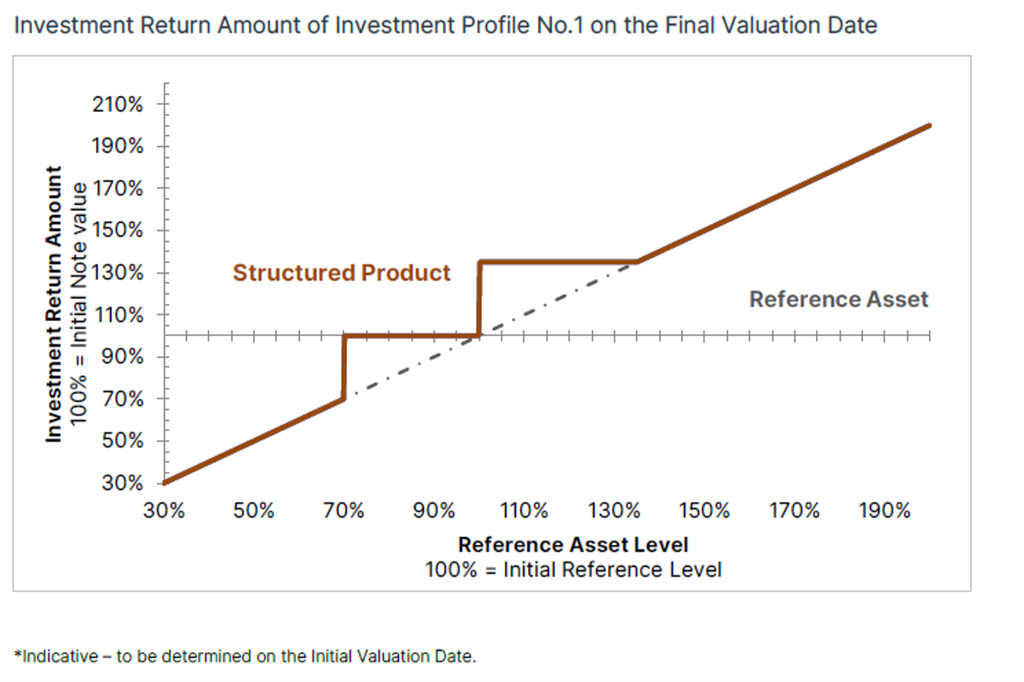
It offers an indicative digital return of 35% in rand over that period if the basket’s return is zero or positive, plus any basket return above 35%.
In practical terms, if the basket finishes unchanged or rises by up to 35%, the indicative investment return is 35%.
If the basket rises by more than 35%, the investment adds the basket’s gain above that level to the digital return.
The structure therefore does not require substantial market gains to deliver its indicative digital return.
A flat basket performance at the Final Valuation Date would meet the return condition.
Structured for capital protection
Investec ZAR Developed Markets Digital Plus also provides conditional capital protection.
If held to the Final Valuation Date, 100% of capital is protected in rand provided the basket has not declined by more than 30% on that date.
If the basket finishes below its starting level but within that threshold, the digital return would not apply, but the capital-protection condition would be met.
The role of Investec ZAR Developed Markets Digital Plus within a portfolio will depend on the investor’s existing holdings, objectives and liquidity needs.
It may suit South African investors seeking diversified developed-market equity exposure in rand, with downside protection.
Click here for more information about Investec ZAR Developed Markets Digital Plus.
Applications close on 20 November with a minimum investment amount of R100,000.00 (100 Notes at an initial price of R1,000.00 per Note)
For full regulatory disclosures, please click here