Painful decision of 1920s repeated


World-renowned economist Thomas Sowell said United States President Donald Trump’s tariffs are a repeat of the ruinous decision from the 1920s.
He explained that historically, increased tariffs have always led to further increased tariffs in retaliation from other nations.
Worldwide trade wars have a devastating history, and everyone loses. Increased worldwide tariffs hit everyone, leading to an overall reduction in international trade.
South Africa was one of the biggest casualties of the recently announced tariffs by President Trump.
He said South Africa charges a 60% tariff on imports from the United States. In response, it started charging a 30% tariff on South African exports to the USA.
There was some confusion in the market about where he obtained the 60% tariff, as the World Trade Organisation reports an average 7.6% tariff on all US exports to South Africa.
The USA has a trade deficit of $8.8 billion with South Africa, and South Africa exports $14.4 billion of goods to the USA.
The trade deficit of $8.8 billion divided by the total exports from South Africa of $14.4 billion equals the 60% given by the United States.
Using the same formula results in the same tariffs that the White House claimed other nations imposed on their exports.
However, a trade deficit does not represent a tariff. It merely means that the United States buys more goods from a country than that country buys from the US.
The White House’s reference to these deficits as tariffs shows how the Trump Administration views trade deficits.
Donald Trump stated in a recent interview, “I want to solve the deficit problem we have with China, the European Union and other nations.”
It shows that the United States Administration wants to swing its trade deficits to surpluses, and generate revenue through tariffs.
It is important to note that trade deficits are not a bad thing. It means that a country obtains more value buying goods internationally so that it can sell them at a lower price domestically.
The causes of the United States’ trade deficits are complex and differ from case to case. The US set out a trade barrier report highlighting these barriers for each of its trading partners.
Trump aims to use the recently imposed tariffs as leverage to secure a more favourable international trading position for the United States.

History of tariffs
Sowell stated that there is a devastating history of tariffs starting trade wars. He said that if the US tariffs aim to achieve a set of short-term objectives, it may not cause harm.
However, if this is going to be the policy for “four long years”, people will hold on to their money, meaning a slowdown in economic growth.
Sowell has commented on tariffs for years and believes that the Great Depression of the 1930s was primarily caused by the Smoot-Hawley Tariffs, not the stock market crash of 1929.
In 1930, the Smoot-Hawley tariffs were imposed on thousands of imported goods to protect United States jobs and reduce foreign competition.
According to Sowell, it caused one of the biggest financial and economic disasters in the history of the United States.
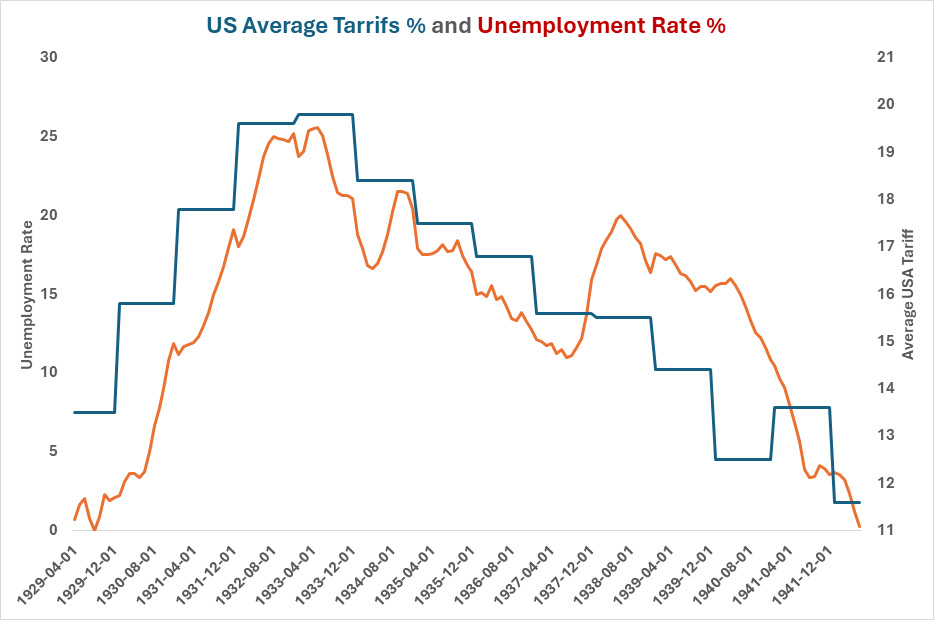
Instead of creating jobs, it deepened the stock market crash and caused one of the most significant unemployment crises, with US unemployment rising to over 25%.
Plotting the US tariff increases against the US unemployment rate, it is clear that both measures move together.
As tariffs increased, unemployment increased, and as tariffs decreased, unemployment decreased.
If the recently imposed tariffs remain in place for the long run, it may cause significant pain to the United States workforce.
Increased tariffs across the international playing field can slow down international trade and negatively impact the world economy.
If the current administration plans to use the tariffs as leverage in short-term trade negotiations and then reduce them afterward, their impact on global trade may be significantly reduced.
 Loading ...




Comments