Big threat to South Africa


A strong US dollar, expected to continue strengthening under President Donald Trump, spells bad news for South Africa’s currency, inflation and interest rates.
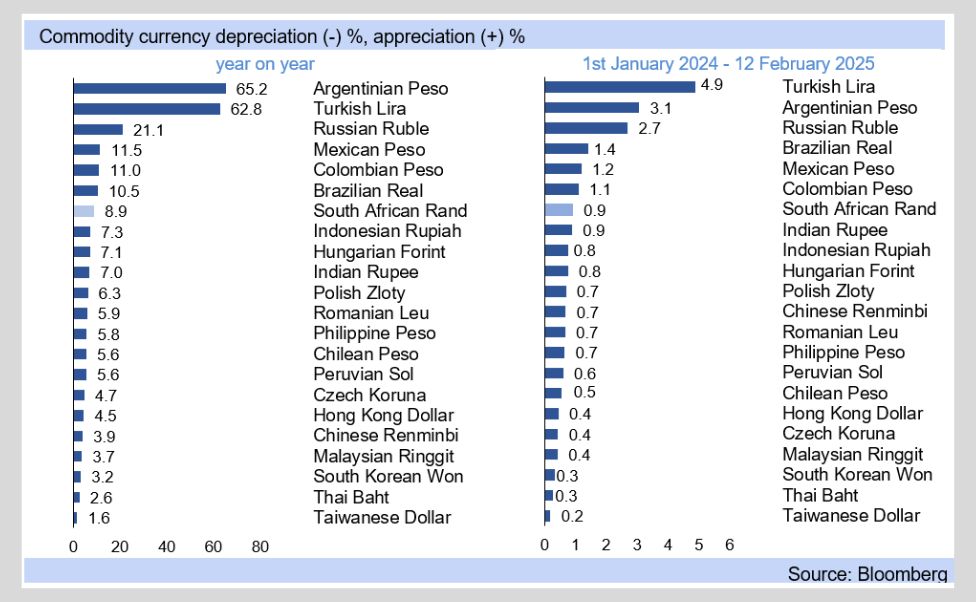
Investec chief economist Annabel Bishop explained that investor sentiment has swayed this year toward the rand and other commodity currencies.
This comes as the US dollar has gained substantially against other currencies in general since October in the run-up to and then over the Trump administration.
The US dollar has reached its strongest point over the last few months, excluding the financial crisis of 2001/02 and most of the 1980s, which saw one of the most severe economic recessions in recent times.
In addition, 2022’s period of elevated market risk aversion stemming from the Covid-19 lockdowns, high inflationary environment, and the impact of the Russian/Ukraine war would need to be excluded in this US dollar scrutiny.
Bishop explained that these three periods have tended to see risk aversion in the financial market. This risk-off sentiment led to safe-haven flows into the US, particularly into US bonds, strengthening the dollar.
However, this time is different – financial markets are not risk-off now and have not generally been over the past several months.
Yet, US equities have seen substantial support, including foreign flows, and the US economy is expected to see robust growth this year and next. In addition, the dollar is at its strongest level in years.
Bishop explained that this spells bad news for South Africa because of its impact on the rand.
The rand is a commodity currency, meaning its value is strongly influenced by the prices of key commodities that South Africa exports, such as gold, platinum, coal, and iron ore.
In addition, commodity prices are directly affected by dollar movements, as international commodities are US dollar-denominated.
Therefore, a stronger dollar makes these commodities more expensive for buyers using other currencies.
This reduces global demand for commodities, lowering their prices. Since South Africa relies heavily on commodity exports, falling prices mean less foreign income, which weakens the rand.
“South Africa is a commodity exporter, with metals and minerals making up the bulk of exports, and consequently movements in global commodity prices, and the US dollar does have an impact on the rand and so inflation, interest rates and growth,” Bishop explained.
The rand’s strength plays a crucial role in South Africa’s inflation and interest rates by influencing the cost of imports, fuel prices, and investor confidence.
Simply put, when the rand strengthens, imported goods such as fuel, food, and machinery become cheaper, helping to keep inflation low.
Since South Africa relies heavily on imports for essentials like oil, a strong rand reduces transportation and production costs, leading to lower consumer prices.
Conversely, when the rand weakens, imports become more expensive, driving up inflation.
For example, a weak rand makes oil imports more expensive, pushing up petrol prices, which then increases the cost of goods and services throughout the economy.
This has a knock-on effect on interest rates in South Africa, as one of the Reserve Bank’s mandates is to protect the value of the rand.
The bank uses interest rates to control inflation. Therefore, when the rand weakens and inflation rises, the Reserve Bank may increase interest rates to stabilise prices and attract foreign investment, which can help strengthen the currency.
However, higher interest rates also slow down economic growth by making borrowing more expensive, as seen in the past few years while the Reserve Bank has been in a hiking cycle.
While the bank is currently in a cutting cycle, having slashed interest rates by a cumulative 75 basis points so far, Reserve Bank Governor Lesetja Kganyago has warned that the bank remains data-dependent.
“The Monetary Policy Committee (MPC) would like to emphasise that its decisions will be made on a meeting-by-meeting basis, with no forward guidance and no pre-commitment to any specific rate path,” he said.
“Such decisions will continue to be outlook-dependent, responsive to data developments, and sensitive to the balance of risks to the forecast.”
“The MPC’s main contribution is to deliver low and stable inflation, with well-anchored inflation expectations. The committee remains vigilant and ready to recalibrate policy as needed.”
Therefore, if the dollar continues to strengthen under Trump, South Africans may be in for a tough few years as the rand weakens, inflation increases, and interest rates remain high.






Comments