Warning about destructive taxes in South Africa


South Africa’s debt-to-GDP ratio has been sharply increasing over the last decade, and as a result, households are forced to pay the price as taxes become more destructive to compensate for this problem.
This is feedback from chief investment strategist at Investec, Chris Holdsworth, Investec chief economist, Annabel Bishop, and Investec treasury economist, Tertia Jacobs, who spoke on the No Ordinary Wednesday podcast.
Bishop said the real problem South Africa is facing is its slow economic growth, which translates to a lack of revenue and profitability and insufficient business activity.
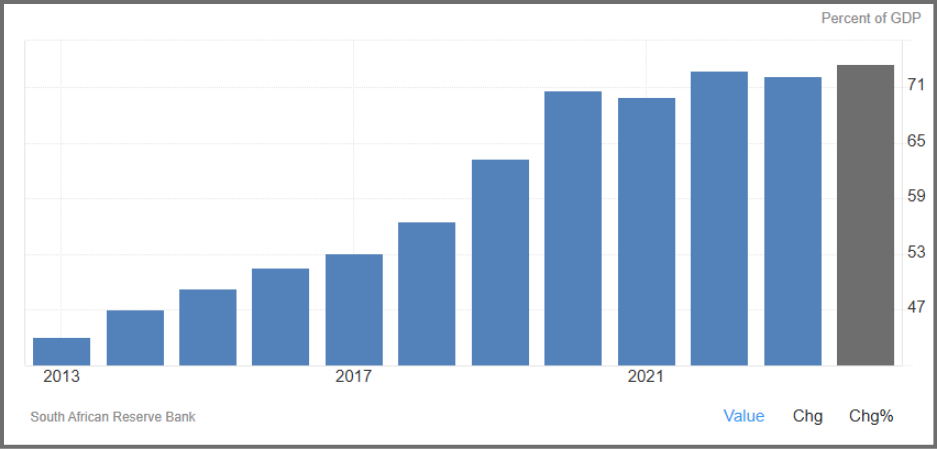
“Over the past decade and this decade, in general, the trend has been for fiscal slippage, a worsening of government finances, and you can see the debt is now expected to peak 75% of GDP.”
“Of course, it was worse a few years ago, and it does vacillate, but it’s way up compared to the 50% of GDP or closer to 30% in previous decades. So this is the problem for the government.”
According to Trading Economics, South Africa’s debt-to-GDP ratio reached a record low of 27.8% in 2008, and a decade ago, in 2014, it was sitting at 47%.
However, this number continued to climb gradually through the years until jumping by over 7% between 2019 and 2020 to 70.7%.
In the years since, it has remained at over 70%, giving the country very little wiggle room in terms of its budget.
The trend of fiscal slippage over the past decade has led to higher borrowing costs. This, in turn, has resulted in increased bond yields, a weakening of the rand, concerns about the overall economic situation, and the downgrading of South Africa’s credit ratings.
Looking ahead, the country will regain some wiggle room once it moves to a fast economic growth environment, she added.
Economic growth for 2023 was 0.7% in 2023, and it projected to be around 1% for 2024. For 2025, Investec forecasted a faster pace of 1.7%, reaching 1.9% in 2026. By 2029, Investec expects growth to exceed 3%.
“That will make a big difference,” Bishop said. “And of course, that’s what government’s counting on to bring these ratios down, whether it’s the government debt or fiscal deficit ratios.”
South Africa’s tax problem
As a result of the country’s poor debt-to-GDP ratio, South Africans are also feeling the pain of an increasing tax burden. “I firmly believe that South Africa is taxed out,” Bishop said.
“The tax buoyancy ratio shows it cannot absorb more on the tax front. While we probably will have a weaker year this year from a GDP perspective, things will start turning, and we should see strong growth next year.”
According to Jacobs, the best-case scenario South Africa is currently looking at is its debt-to-GDP stabilising at about 75% to 77% in the medium term. “From that perspective, it will be very difficult for us to get to investment grade.”
She explained that while the country waits for economic growth to kick in in the coming years, she hopes that the 2025 budget will be a “holding year”.
“From that perspective, taxes are becoming destructive. There’s not much that they can do on that side and on the expenditure.”
“There’s not much space for them to actually increase spending because we need to consolidate that budget deficit.
This tax problem has been particularly detrimental to South African households, Holdsworth pointed out.
“When you look at the previous budget, what has become a very easy source of revenue is fiscal drag,” he said.
In other words, as inflation or income growth moves taxpayers into higher tax brackets, government tax revenue effectively increases without actually increasing tax rates.
“That generates nearly R15, R16 billion per annum, so that’s in the baseline forecast for the coming year as well.”
In the 2024 budget speech, personal income taxes weren’t increased, but the tax brackets also weren’t adjusted for the effects of inflation.
This means that anyone who receives an inflation-related increase will end up paying higher taxes due to “bracket creep”.
“The problem is it’s becoming very damaging to household balance sheets,” Holdsworth said.





Comments