From bad to worse for interest rates in South Africa


The Reserve Bank is likely to hike interest rates again in November, with inflation expected to exceed 5% when the September data is released.
Inflation is not the only factor at play, with the Reserve Bank facing a perfect storm from the US Federal Reserve hiking rates and a weakening rand.
Symmetry chief investment strategist Izak Odendaal explained that the Reserve Bank may not follow the Fed directly, but it will always keep a close eye on it.
The Reserve Bank will watch the Fed particularly closely during a hiking cycle, as actions in the United States have significant consequences for the rest of the world.
As the world’s dominant financial powerhouse, the United States influences borrowing costs and interest rates, which feed through to every financial asset.
During a Fed hiking cycle, US-based assets become more attractive as yields rise, drawing investor capital.
This increases demand for dollars, pushing their value up relative to other currencies, such as the rand. Investors in this situation tend to flock from emerging markets to developed economies.
As a result, the rand weakens relative to the dollar when the Fed raises rates without a response from the Reserve Bank.
This creates an inflation problem in South Africa by increasing the cost of importing goods, pushing consumer prices higher.
Odendaal said a weakening rand raises alarm at the Reserve Bank because it has a wide impact and rising prices can quickly become entrenched.
Crucially, this is also something the Reserve Bank can address through higher interest rates, which make local assets more attractive.
“They cannot open the Strait of Hormuz or increase oil production. Their main tool, interest rates, is more effective when inflation is demand-led,” Odendaal said.
“Nonetheless, cost increases from supply disruptions can spill over into other items. A weaker currency makes this worse, forcing the Reserve Bank to act.”
The worst is yet to come
Inflation is expected to worsen due to a weakening rand and a sharp rise in oil prices throughout September.
Petrol and diesel prices are expected to rise by R3 per litre at the pumps in October, offering no respite for motorists and the logistics sector.
With 80% of South African goods being transported via road at some point in their journey, this has significant price implications for the rest of the economy.
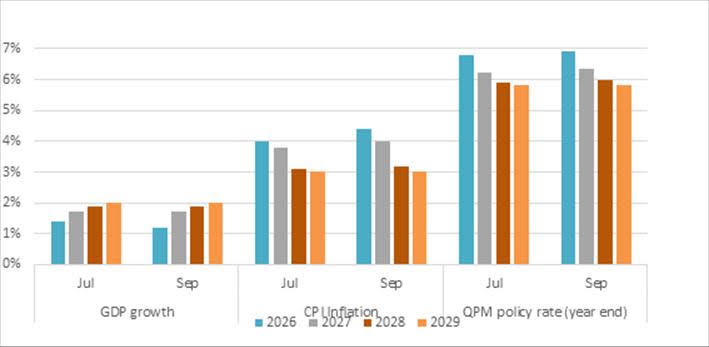
According to the Reserve Bank’s projections, inflation is expected to run slightly above 5% in the last quarter of 2026 and the first quarter of next year.
This is before base effects pull it down to 3.9% in the second quarter of 2027.
Since fuel prices increased sharply in the second quarter of this year, it creates a high base for year-on-year comparisons twelve months later.
The Reserve Bank expects inflation to be close to the 3% target by the end of next year, enabling rate cuts to begin again.
While higher fuel prices feed into higher inflation readings, it also represents a real income shock that will weigh on consumer finances and business margins.
Where to place the emphasis is a difficult decision, and most central banks have moved cautiously since the war started.
In effect, central banks can choose between downward pressure on economic activity or upward pressure on inflation.
As a result of higher interest rates and slow reform, the Reserve Bank cut its economic growth forecast for this year from 1.4% to 1.2%.
Its forecast model, the QPM, does not point to any further hikes, and indeed did not favour a rate increase as inflation is expected to return to target eventually.
However, with risks tilted to the upside given the uncertainty over global fuel and food prices and against the backdrop of rising global rates, the Reserve Bank will feel compelled to act.
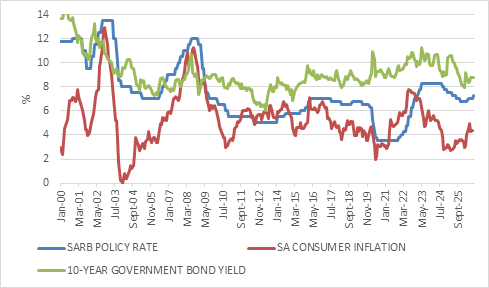
South African government bond yields are well above any reasonable future inflation scenario, and if the Reserve Bank achieves its 3% target, forward-looking yields on local bonds remain very attractive in real terms.





Comments