The one type of business that SARS can’t get its hands on


A significant number of businesses in South Africa’s informal sector operate under SARS’s radar and do not pay tax.
Some estimates from financial institutions such as Standard Bank and Lesaka Technologies put the share of businesses in the informal sector that are not registered for value-added tax (VAT) as high as 60%.
These businesses are often small-scale, unregistered, and not incorporated. As a result, they largely operate outside of the formal regulatory framework and tax regime.
A growing point of tension in this sector has been the rise of foreign-owned businesses, with questions surrounding whether they contribute to the local economy in a meaningful way.
National Assembly member Mokgaetji Mafagane recently asked Finance Minister Enoch Godongwana about the surge in foreign-owned businesses in this sector and whether they pay tax.
Godongwana explained that SARS does not store VAT registration data classified according to the nationality of business owners or by business type.
This is because VAT registration is purely entity-based and not nationality-based. Every company, regardless of ownership, faces the same compliance requirements.
This makes it difficult to know exactly how many informal businesses or foreign-owned companies are registered for VAT.
However, due to the rapid growth of the informal sector and the potential for billions in tax revenue to go uncollected, SARS has begun tightening the compliance net around this sector of the economy.
This has resulted in the entity not only enhancing compliance but also collecting data as to how many businesses should be paying VAT but do not.
Godongwana explained that over the past five years, SARS has targeted non-compliance among small and micro businesses, including spaza shops.
This is achieved through targeted audits and verification, internally triggered VAT registrations, and outreach or enforcement actions where non-compliance is identified.
Godongwana said that, so far, SARS has identified 48,773 taxpayers that are above the VAT threshold but not VAT-registered. A notable 11,998 non-registered taxpayers were identified in the past financial year alone.
This is a significant number, with these businesses generating turnover above the VAT threshold of R1 million at the time. The VAT threshold has since been increased to R2.3 million.
As a result, over R50 billion in taxable income that should be assessed is going under the radar, with SARS potentially losing out on billions in additional revenue.
The sector that does not pay tax in South Africa
South Africa’s informal township economy is valued at R900 billion and plays a vital role in the country’s broader economic activity and job market.
While these businesses are relatively small and unregistered, they absorb a huge number of South Africa’s unemployed population.
These businesses also provide goods and services to millions of South Africans who otherwise would not be able to access them as easily or cheaply.
Furthermore, while many of them do not pay direct tax, they contribute meaningfully in the form of supplementing income that is then spent in the formal economy.
These businesses also pay tax when buying supplies, such as sin taxes on alcohol, particularly, and VAT on basic foodstuffs.
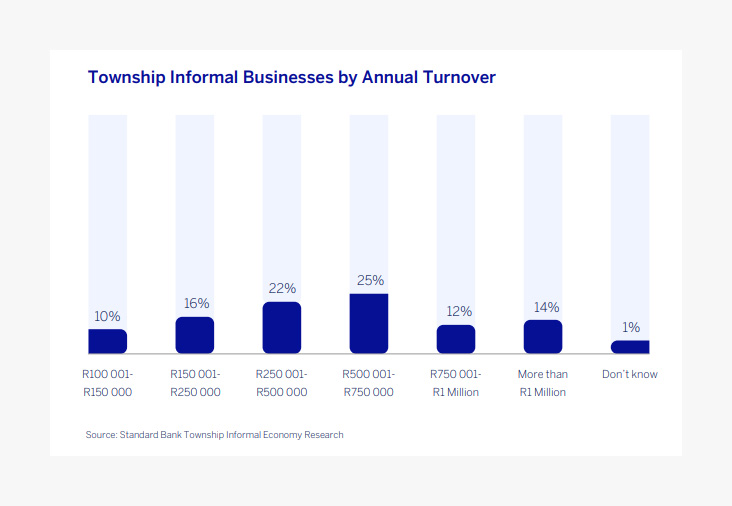
Standard Bank’s Business and Commercial Banking unit produced its first Township Informal Economy Report in 2025, which detailed the sheer scale of this economic sector.
The study focused on businesses with an annual turnover of between R100,000 and R50 million across townships in Gauteng, the Western Cape, KwaZulu-Natal, Limpopo, and the North-West Province.
Its data showed that 80% of these businesses are unregistered, limiting their access to banking products and funding, while also ensuring they do not pay direct tax.
The bank explained that this is not due to nefarious reasons. Often, the businesses are too small to register, and the administrative burden of registering is too high.
This burden does not make it worthwhile for a business to formally register with the state and access formal banking products.
Informal economy expert GG Alcock explained that these businesses, while not contributing directly, make meaningful contributions to the fiscus through indirect means.
Most spaza shops and alcohol traders will also contribute to the fiscus by purchasing supplies from formal businesses, often directly from large wholesalers.
For example, many spaza shops or superettes will source stock from a Shoprite Usave, Pick n Pay Boxer, or even directly from food producers such as Tiger Brands.
Taverns, shebeens, and liquor traders will purchase their stock directly from liquor wholesalers, Coca-Cola, or traditional bottle stores.
Thus, the informal economy is closely intertwined with its formal counterpart and significantly contributes to the bottom line of large, often JSE-listed businesses, thereby strengthening the country’s fiscus.
 Loading ...




Comments