South African students gamble away taxpayer money


The National Student Financial Aid Scheme (NSFAS) is increasingly concerned about students gambling away money given to them to pursue higher education.
Through its partnership with the National Gambling Board (NGB), the scheme aims to raise awareness regarding the dangers of online gambling in particular.
“This collaboration arises from growing concerns about the increasing exposure of young people to gambling, particularly illegal online platforms, and the unintended use of student allowances for gambling activities,” NSFAS said in a statement.
The collaboration will aim to protect students from gambling-related harm, while also safeguarding public funds allocated for education.
Tech expert and Durban University of Technology lecturer, Siphumelele Zondi, told 702 that this is a result of a surge in online gambling in South Africa.
The NGB’s latest data shows that R1.5 trillion was wagered in South Africa in 2024, with online gambling being the primary driver of growth.
Zondi said online sports betting appears to be particularly prevalent among young individuals, with “Vegas-style games” also increasing in popularity.
“Sports betting is a huge part of this, and it is the main one they are worried about. Students seem to be spending their NSFAS money on betting on various games locally and internationally,” Zondi said.
Most of this money flows through to the operators of online gambling sites, which tend to be international companies with headquarters and investors outside of South Africa.
In effect, this money is flowing out of the country to these operators, with it having little benefit in terms of economic activity or employment.
“I have heard many stories of students who put money into these platforms, and it disappears. Today, I heard of a student who won R4,000 and decided to put it back in, with all of it disappearing,” Zondi said.
Zondi explained that students appear to be particularly vulnerable to online gambling, due to the amount of time they have and the desire for get-rich-quick wins.
“They are seeing these games and are hoping to make a quick buck, and they are hoping that some of that NSFAS money is going to grow beyond the R1,700 allowance they may get,” Zondi said.
Destructive behaviour

Online gambling is extremely destructive for the local economy, with it having none of the positive effects of increased consumer spending in other areas.
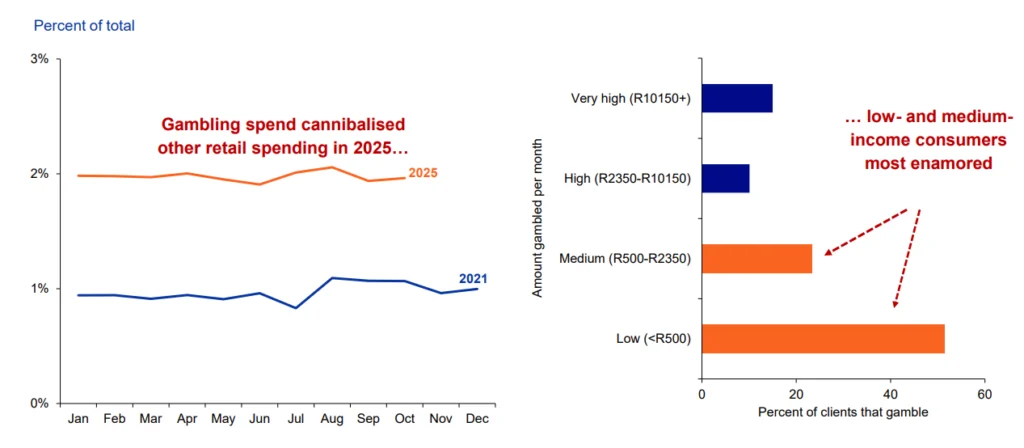
Standard Bank chief economist Goolam Ballim warned that increased spending on online gambling threatens to undermine household finances and slow economic growth in the long run.
Ballim explained that the financial health of South African households is improving amid lower inflation and strong wage growth.
However, as spending on online gambling continues to grow, this threatens to reverse these gains and see household finances come under renewed pressure.
“There is one area that is somewhat troubling with regard to consumer spending, and that is the allocation to gambling,” Ballim said at the bank’s Economy 2026 event.
“From 2021 to more recently, the share of spending on gambling has surged. Digital formats, aggressive marketing, and gamification have made it more attractive for individuals to gamble more.”
Ballim said the bank’s research indicates that at least half of South Africans, sampled by the bank, spend up to R500 gambling each month.
“You may not think that is much, and it is not a large proportion. But, close to a third of South Africans are spending over R2,350 on gambling,” Ballim said.
This spending has very few positive effects on the local economy, with much of the revenue going offshore, minimal tax being generated, and little employment opportunities being created.
“The key thing with gambling is that it is fundamentally redistribution. It does not have the multiplier effect. It does not create value or economic activity. It is a redistribution of income away from individuals,” Ballim said.
Spending in other areas of the economy, such as groceries, durable goods, or even investment, generates increased economic activity and tax revenue, which tends to result in an uptick in employment.
“One hopes that some regulation, awareness or consciousness enters society to guard against the social perils of gambling and the way in which it can be a menace to economic momentum,” Ballim said.
He also noted that increased gambling can indicate growing consumer vulnerability, as many see it as a means to supplement their income.
A recent Trade Intelligence survey indicated that grocery spending is taking the biggest, or at least the most widespread, knock from funds being diverted into online gambling.






Comments