Every South African owes R97,000


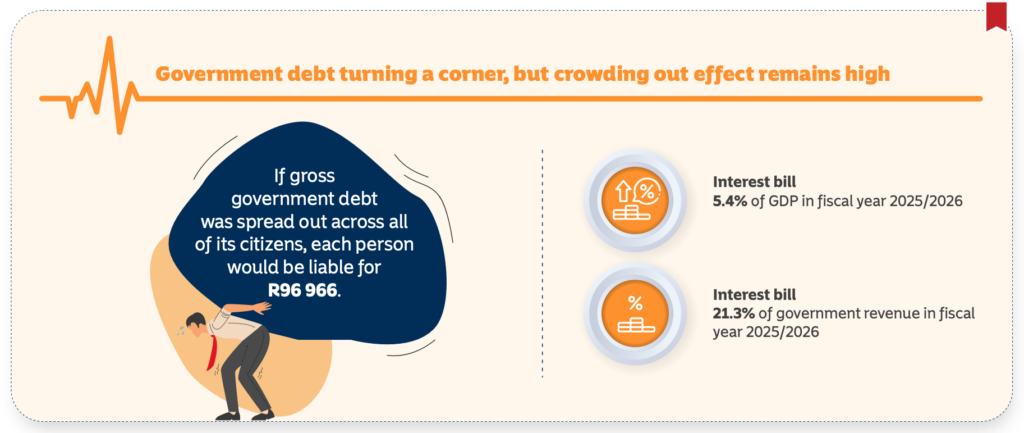
Momentum has calculated that, if the government’s gross debt were spread across all of South Africa’s citizens, each person would be liable for R96,966.
This puts into perspective how large the government’s debt burden has become, with the figure now standing at around R6.12 trillion.
While the government has made significant progress in stabilising its debt burden, with plans to reduce it in the coming years, the costs of servicing its debt continue to crowd out spending on more productive line items.
In addition, the government’s strategy to reduce its debt relies on limiting spending while increasing revenue, meaning South African taxpayers are essentially paying more for less.
Momentum Investments economists Sanisha Packirisamy and Tshiamo Masike explained in a recent research note that debt-service costs are the government’s third-largest spending category.
Debt-service costs are set to consume R432.4 billion of government expenditure in the 2026/27 fiscal year, or around R1.2 billion a day.
Since the 2008/09 fiscal year, debt-service costs have risen from 8.8% of government revenue to 21.3% in 2025/26.
Positively, the government is taking steps to reduce this burden. The National Treasury’s fiscal consolidation efforts are starting to pay dividends, with the state’s debt-to-GDP ratio having stabilised in the 2025/26 fiscal year.
In the coming years, as fiscal consolidation continues and the government runs primary budget surpluses, the debt burden is expected to decrease, and debt-service costs along with it.
However, this has not been and will not be a painless process, as fiscal consolidation is a painful process that involves limiting state spending while increasing revenue.
Therefore, in the next few years, South African taxpayers will be expected to pay more for less from the government.
At the same time, Packirisamy and Masike explained that the state’s high debt burden will also continue to be a hurdle to South Africa’s credit rating being upgraded to investment status.
While South Africa is expected to see credit rating upgrades over the next year, they said investment-grade status remains distant without stronger growth and structural reform to contain persistent expenditure pressures and high debt-service costs.
Thinking long-term
The Treasury’s fiscal consolidation efforts and the resulting stabilisation of state debt deserve praise, but now the real work must begin to ensure South Africa doesn’t find itself with the same problem again.
To this end, Finance Minister Enoch Godongwana has announced plans to introduce legislation that will, in essence, make fiscal sustainability and discipline law.
“In 2026, the National Treasury, in consultation with Cabinet, will undertake detailed analytical work to prepare legislation to anchor sound fiscal principles in law,” the 2026 Budget Review stated.
“It will require each new government to table a plan to ensure that the fiscal position is sustainable throughout its term of office and that an appropriate fiscal metric is selected to measure compliance.”
This, the Treasury hopes, will build confidence and maintain the gains of fiscal consolidation without resorting to painful spending cuts or tax increases.
The government’s exact fiscal anchor is expected to be announced in the Medium-Term Budget Policy Statement later this year.
Fiscal rules can vary significantly, but all share the same overarching goal – ensuring fiscal discipline and keeping state debt in check.
For example, the United States’ fiscal rule takes the form of a debt ceiling, whereby the government aims to keep its debt below that ceiling.
However, not all fiscal rules are necessarily effective, as seen in the United States, which simply raises its ceiling every few years to accommodate rising debt.
Following the tabling of the 2026 Budget, economist Dawie Roodt explained that he would prefer for South Africa’s fiscal rule to be aimed at ensuring a balanced budget over a rolling period of, for example, three years.
“So, if you run a fiscal deficit one year, you have to run a fiscal surplus in the other year until you bring your debt levels down to an X percentage of GDP,” he explained.
Details about what South Africa’s fiscal rule will look like have been scarce, but if implemented effectively, it could ensure that the country stays on a sustainable path.
Bank of America analyst Tatonga Rusike previously explained that a credible fiscal rule could lead to lower bond yields, improve creditworthiness, and reduce the country’s risk premium.
He explained that the National Treasury has traditionally used a nominal expenditure ceiling as its unofficial fiscal rule, which has not been very effective at curbing the state’s rising debt-to-GDP levels.
“Options for the fiscal rule include a headline deficit limit, a primary balance target or a debt-to-GDP ceiling,” he suggested, adding that a deficit limit could also work together with a debt ceiling.






Comments