Bad news about petrol prices in South Africa


South African motorists are set to feel the pain of higher petrol and diesel prices, with various taxes levied at the pump being raised by the government.
The increases to the General Fuel Levy, Carbon Fuel Levy, and the RAF Levy were announced by Finance Minister Enoch Godongwana in his 2026 Budget Speech.
Godongwana explained that over the past three years, South Africa’s tax system has demonstrated resilience despite slow economic growth.
For 2025/26, the gross tax revenue is revised up by R21.3 billion compared to the estimate in the 2025 Budget, Godongwana revealed.
This is due to higher-than-expected net VAT, corporate income tax, and dividends tax collections, which improved the in-year outlook.
“As a result, the government has decided to withdraw the R20 billion in tax increases provisionally included in the May 2025 Budget,” Godongwana said.
“The improving fiscal position allows us enough room to withdraw the proposed tax increases, without putting fiscal sustainability or economic activity at risk.”
However, the minister said that increases to certain taxes are unavoidable, particularly sin taxes and fuel levies.
In terms of the fuel levies, the increases are in line with inflation and will apply across all grades of petrol and diesel –
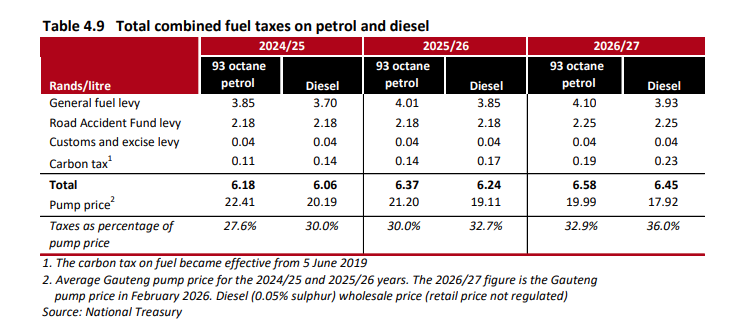
- The General Fuel Levy will increase by 9 cents per litre for petrol and 8 cents per litre for diesel.
- The Carbon Fuel Levy will increase by 5 cents per litre for petrol and 6 cents for diesel.
- The RAF Levy will increase by 7 cents per litre.
These increases will significantly increase the price of fuel at the pumps for South African motorists, with taxes now making up around a third of the total price.
National Treasury data shows that taxes as a percentage of the pump price will now be 32.9% for 93 octane petrol and 36.% for diesel.
In absolute terms, taxes will contribute R6.58 to the price per litre of petrol and R6.45 per litre of diesel.
PwC tax experts noted that the government is likely to increase these levies to exploit the current low petrol and diesel prices.
The increases for the 2026/27 Budget follow on from an inflation-linked increase to the General Fuel Levy in the previous year. This was the first increase since 2021.
Increases were avoided for three successive financial years because of high fuel prices in the aftermath of the Russian invasion of Ukraine.
PwC’s experts explained that the increase to the RAF Levy is likely purely down to the dire financial health of the organisation, with it desperately needing funds to continue operating.





Comments