South Africa’s rand in its golden era


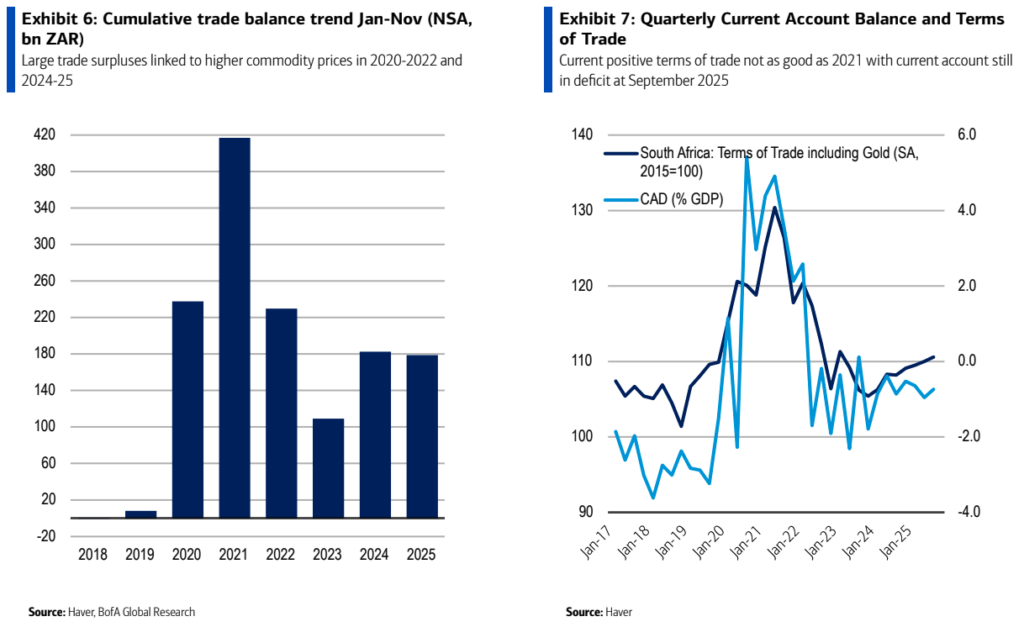
Bank of America (BofA) researcher Tatonga Rusike said South Africa’s rand is in a golden era, driven by the ongoing commodity rally that has immensely benefited the country’s current account.
These tailwinds support BofA’s view that the rand will end 2026 at R15.60 to the US dollar, a significant improvement from the end of 2025, when the local currency stood at R16.65/USD.
In a recent research note, Rusike outlined economic trends in South Africa and argued that the country’s “turnaround story” should continue in 2026.
This view is supported by steadily rising GDP growth and moderating inflation, which is paving the way for three more rate cuts.
Rusike also highlighted the strong performance of the rand, which he believes will continue in 2026.
The local currency has been on a winning streak, largely driven by a weaker dollar and a commodity rally that has seen the prices of precious metals like gold and platinum group metals (PGMs) surge.
This has been positive for South Africa’s commodity-driven economy, with many of the world’s largest gold and PGM producers operating in the country.
The gold price, in particular, recently hit a record high of $5,500 per ounce and, despite a recent two-day sell-off, the precious metal continues to trade at historically high levels.
BofA’s commodity strategists assume gold will average $4,500 per ounce in 2026, up significantly from $3,200/oz in 2025. Rusike said this implies that South Africa’s current account could narrow by 0.5% of GDP.
Higher platinum prices, expected to average roughly $1,825 in 2026, contribute a further 0.7% of GDP to exports.
Based on this, BofA forecasts a current account surplus of 0.5% of GDP for South Africa in 2026 and a balanced current account in 2027.
Rusike explained that this is positive for the rand, which BofA now forecasts to reach R15.60/USD by the end of 2026.
Rand risks
One threat to BofA’s outlook and the rand’s strength in 2026 is a stronger United States dollar on the back of a hawkish Federal Reserve.
This was recently seen when US President Donald Trump’s pick for new Fed chair, Kevin Warsh, was reported.
Before this announcement, many expected Trump to pick a dovish chair who would slash US interest rates, risking inflation and, therefore, a weaker dollar.
However, he selected Warsh, who has publicly criticised the Fed for weakening monetary policy independence and neglecting its duty to maintain price stability.
This announcement saw the US dollar strengthen by around 1% over a few days, weakening the rand and triggering a sell-off in precious metals like gold and silver.
While the gold price and rand have since stabilised and strengthened again – though not to the record-high levels seen prior to the sell-off – a hawkish Fed could put downward pressure on both in 2026.
Rusike explained that South Africa is currently on track to continue its interest rate-cutting cycle, with three more cuts expected in 2026.
BofA expects South Africa’s Reserve Bank to continue easing restrictiveness, although slowly. “That means cuts at every other meeting,” Rusike said.
“After a cut in November 2025, the SARB is likely to stay on hold in January while it assesses global risks,” he said.
“Faster cuts would be probable if CPI were to reach the 3% target near-term. We still see it averaging 3.5% in H1 before moderating to 3.3% in H2.”
“Besides, the Fed outlook remains uncertain – no cuts in 2026 could bring back a strengthening USD, translating to a weaker ZAR.”
He noted that there is also uncertainty over US policies that could skew the outlook, with new tariffs on the cards for the European Union and the likely Fed chair change in May 2026.
 Loading ...





Comments