South Africa has 28 million grant recipients and only 7.7 million taxpayers


The South African Revenue Service’s (SARS) latest Tax Statistics show that South Africa has only 7.7 million personal income taxpayers.
This stands in stark contrast to the country’s number of social grant recipients, which is north of 28 million as of the latest reading.
This puts South Africa in a precarious position, as it is an unsustainable trajectory for the state to manage over the coming decade.
More worryingly, the growth in the number of grant recipients over the past five years has outstripped that of taxpayers.
SARS released its 2025 Tax Statistics late in December, which showed just how concentrated the country’s personal and corporate income tax bases are.
The revenue service collects this data every year and shares it with government departments and the public to help inform debates regarding tax policy.
SARS’ data shows that relatively few individuals and companies pay the majority of taxes in South Africa, making its tax base highly vulnerable to economic shocks.
This highly concentrated tax base also means the government is unable to raise tax rates effectively, as it is likely to result in less revenue being collected as wealthier individuals minimise their tax burden.
Crucially, this data touches on another important issue with South Africa’s tax base, which is that a large number of people effectively stack up at zero.
These individuals do not earn enough income to meet South Africa’s income tax threshold of R95,750. This means they do not pay personal income tax.
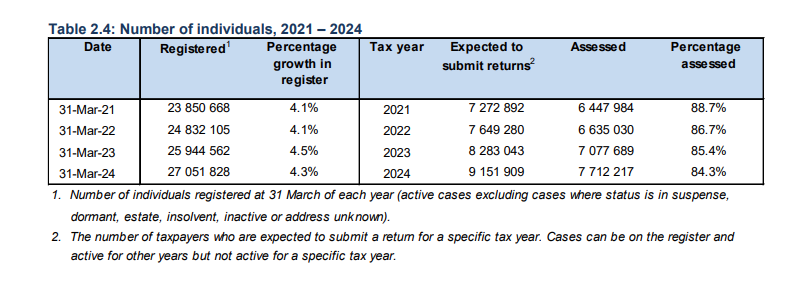
According to SARS’ tax data, there are just over 27 million South Africans registered for personal income tax. This has grown at a steady 4% per year over the past five years.
While this number is large, SARS only expects around 9.1 million of these individuals to submit tax returns in the current financial year.
This number dwindles further when the revenue service shows how many taxpayers actually have any taxable income assessed.
Only 7.71 million South Africans have their taxable income assessed by SARS as they meet the relevant thresholds. As a result, only 84.3% of those expected to submit returns actually have their tax assessed.
Concerningly, this percentage has fallen since 2021 from 88.7%, indicating that a smaller proportion of South Africans are earning enough to pay meaningful personal income tax. This can be seen in the table below, courtesy of SARS.
Grant recipients surge
In contrast to South Africa’s tax base, the number of grant recipients has surged in recent years due to the introduction of the Social Relief of Distress (SRD) Grant during the Covid-19 pandemic.
This has led to increased government spending on South Africa’s “social wage”, which is increasingly weighing on the state’s financial health.
While this wage is seen as necessary by many, it is becoming increasingly unaffordable in a stagnant economy with a very small tax base.
In 2003, only 5.8 million South Africans received a social grant. This number more than doubled over four years, reaching 12 million in 2007. Since then, the growth rate has slowed to reach 19 million in 2025.
However, these figures exclude those individuals receiving the SRD grant, which was introduced during the Covid-19 pandemic to assist South Africans who lost their jobs during the series of lockdowns implemented by the government.
In the five years it has been in effect, the number of recipients has surged to 8.7 million as of the current financial year.
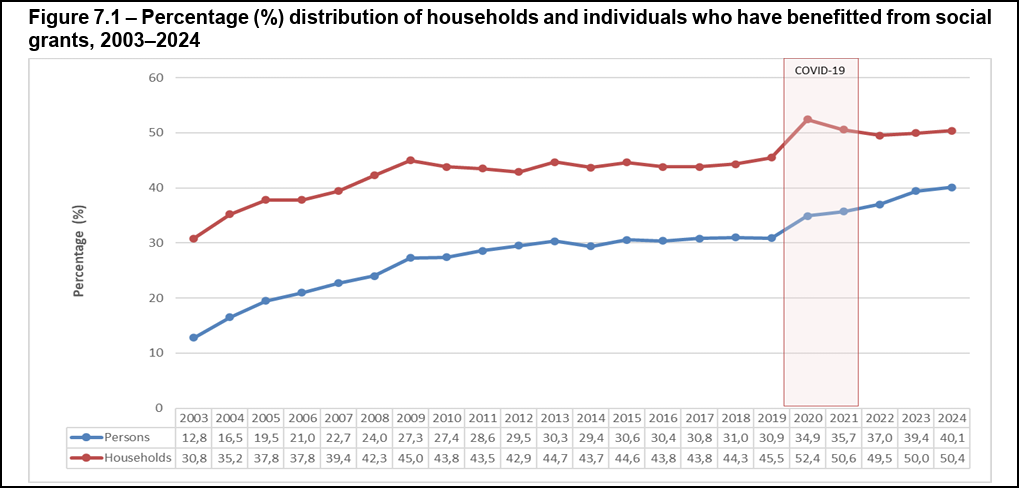
Including the SRD Grant, the proportion of individuals receiving social grants has skyrocketed from 12.8% in 2003 to over 30% in 2019 and hit 40% in 2024.
Similarly, the percentage of households that received grants increased from 30.8% to 50.4%.
President Cyril Ramaphosa has repeatedly celebrated this fact in his State of the Nation Addresses (SONAs), where he routinely praises the ANC’s pro-poor policies.
“Since the dawn of democracy, we have worked together to reduce poverty. Today, our country spends around 60% of our national budget on the social wage,” Ramaphosa said to cheers during his 2025 SONA.
“More than 28 million unemployed and vulnerable people in our country receive social assistance. More than 10.5 million learners go to public schools where they do not have to pay fees.”
Furthermore, over 900,000 students pursuing tertiary education received funding.
“We are providing the means through which South Africans can rise above poverty that has been passed down from one generation to the next,” Ramaphosa said.



Comments