South African households in dire straits


Despite modest income improvements, many South Africans remain under financial strain and are forced to cut spending and struggle with bills as uneven economic recovery leaves a significant portion of households behind.
TransUnion’s latest Consumer Pulse Study reported that in the fourth quarter of 2025, South African households continued to navigate a complex financial landscape.
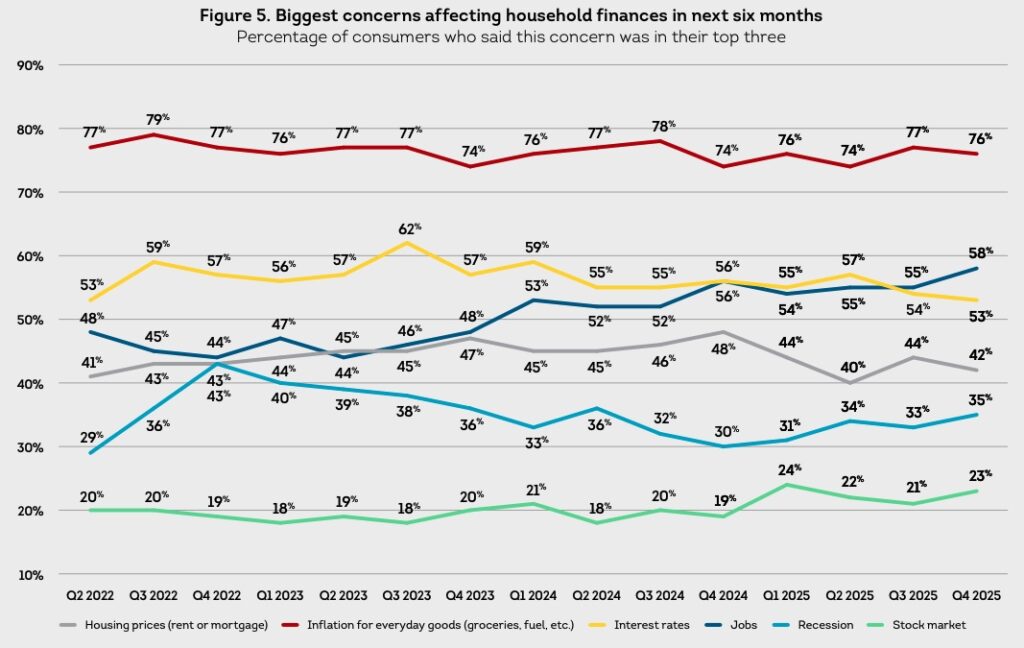
Most consumers expressed that inflation for everyday goods such as groceries and fuel, the job market, and interest rates were among the biggest concerns affecting their household finances.
In the fourth quarter of 2025, 48% of consumers reported that their household income was better than planned, an improvement from 44% in the second quarter.
While 15% of consumers said their finances were as expected, 37% said household income was worse than expected.
TransUnion said these figures reflect a population split between those benefiting from economic momentum and those still facing financial headwinds shaped by uneven sectoral recovery and inflationary pressures.
Confidence in future financial prospects remained steady, even as short-term stress persisted, with 72% of consumers reporting optimism about their household finances over the next year.
Positively, 75% of consumers said they expected their incomes to grow. This sentiment suggests a resilient mindset despite 36% who anticipated difficulty meeting current bill and loan obligations.
The contrast between forward-looking optimism and present-day financial strain highlights the importance of both short-term support and long-term planning, TransUnion explained.
It also reflects a growing consumer awareness of the need to manage risk while remaining hopeful about recovery. In response to these pressures, households reported that they were adjusting their financial behaviours with intent.
“Consumers are entering 2026 with a renewed sense of financial discipline,” said TransUnion director of research and consulting, Ayesha Hatea.
“We’re seeing households make more deliberate choices, reducing non-essential spending, paying down debt and preparing for the future. This speaks to a financial confidence grounded in awareness and adaptability.”
Consumers adapt their spending
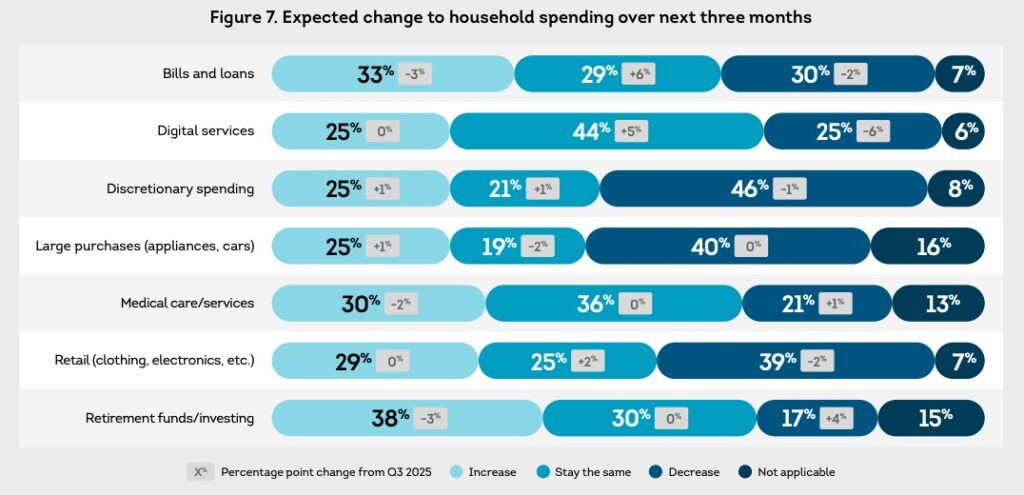
In the fourth quarter of 2025, half of consumers reduced discretionary spending on non-essential activities such as dining out, entertainment, and travel, while 34% cancelled subscriptions or memberships.
At the same time, 38% intended to increase contributions to retirement funds and investments, 35% planned to accelerate debt repayments, and 27% planned to set aside more in emergency funds or stokvels.
TransUnion said this all signals a growing focus on future financial security. These actions reflect a population that’s not only reacting to affordability constraints but also actively building financial buffers to withstand future financial volatility.
“Consumers are demonstrating a more strategic approach to money management,” Hatea said. “They’re preserving stability today while laying the groundwork for tomorrow.”
The shift toward more conservative financial planning is evident across age groups, with younger consumers leading in planned spending on digital services and older consumers prioritising debt reduction in the next three months.
The emphasis on savings, debt management and reduced non-essential spending points to a more strategic approach to financial health.
Consumers also showed greater interest in financial tools that offer flexibility and control, such as budgeting apps, credit monitoring services and tailored financial advice, TransUnion reported.
For financial institutions and insurers, these evolving behaviours present an opportunity to engage more meaningfully with consumers through relevant, empathetic solutions, TransUnion said.
As South Africans continued to adapt, their financial choices reflected a deeper awareness of risk, a commitment to long-term stability, and a desire to take ownership of their financial journeys.
“Resilience has become the defining characteristic of South African consumers,” Hatea said. “They’re not waiting for conditions to change; they’re taking control of their financial journeys, showing that confidence and caution can coexist.”






Comments