Forgotten force boosting the South African rand


The story surrounding the rand’s appreciation versus the dollar throughout 2025 and into 2026 has focused largely on the greenback’s weakness.
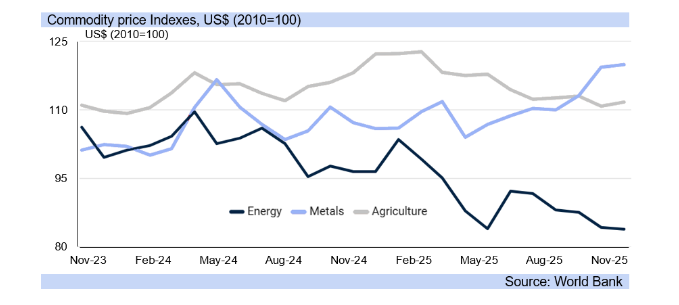
While a weaker dollar is a major driving factor behind the rand improving to trade at R16.36/USD, the local currency has also been boosted significantly by surging commodity prices, particularly precious metals.
As these are South Africa’s most valuable exports, the continued rally in their prices has widened the country’s trade surplus and bolstered the rand.
Importantly for South Africa, it appears as though this rally still has some legs, with commodity prices rising by 2.3% month-on-month in December and by 5.5% year-on-year.
This was largely driven by a rise in precious metals prices, which rose by 6.4% month-on-month and by 26.7% annually in December.
Investec chief economist Annabel Bishop noted that this was coupled with a rise in industrial commodities, both of which are positive for the rand.
Bishop said the rise in the gold price continues to persist, with it accelerating since the mid-2000s, and in particular in the last few years, and is up 69.2% year-on-year.
The rise in prices of precious metals and industrial commodities, such as iron ore, has contributed to driving the rand stronger, Bishop said.
Surging commodity prices have been coupled with some improvement in local economic fundamentals, with the country receiving its first credit ratings upgrade in over a decade in 2025.
South Africa has seen its credit default swap (CDS) rate lessen from a year ago, signalling a marked improvement in perceived risk for South Africa.
Investor sentiment has improved towards South Africa over the last few years, which can be seen in the bond rate.
The benchmark ten-year domestic bond yield is significantly lower, at 8.36% versus closer to 11% at the start of 2023.
South African-focused stocks have yet to improve on the back of this sentiment, as many investors remain cautious regarding the country’s economic growth.
These companies, which earn most of their revenue in South Africa, are heavily reliant on the country’s economic prospects to drive earnings growth.
Rand strength to continue
Bishop explained that prices of precious metals and minerals are largely expected to continue to rise in 2026 as investors hunt for security and industrial demand remains strong in major economies.
Metals and minerals prices have gained on improved market sentiment, and the World Bank expects prices for most base metals to firm further in 2026 and 2027 as modest demand growth coincides with tightening supply conditions.
“A range of upside risks could push metal prices above baseline projections (of 2% growth over the period), including possible production disruptions, new trade restrictions, and a faster-than-expected expansion of data centres,” the lender said.
This will support the rand throughout the next year, with dollar weakness also expected to persist as the greenback loses its lustre.
The dollar is expected to remain the world’s reserve currency and be the main conduit for global trade, but investors are increasingly questioning the fundamentals underpinning the greenback.
Unconventional trade policies, including tariffs, have led to increased scrutiny of the dollar’s security. This has been coupled with America’s willingness to weaponise the currency through sanctions.
As a result, countries, particularly central banks, have been searching for alternatives to the dollar. Many have found their answer in gold and other hard commodities.
Simultaneously, investors have become increasingly concerned about the United States’ financial health, with its debt burden surging to over $38 trillion.
Again, while much of the focus is on the dollar’s weakness, the rand is benefiting from the shift to precious metals as safe-haven assets and improving local fundamentals.
Crucially, the rand has also become a more stable currency in recent months, with the shift to a lower inflation target set to bring the country in line with its peers.
Reserve Bank Governor Lesetja Kganyago has made it clear that the rand is not the volatile currency it once was.
Kganyago has explained that the rand is settling down into a “more mature stage of life”, saying the currency deserves more respect for its stability in recent times.
“When people tell you the rand is a weak and volatile currency, encourage them to think again,” he said.
“I would also like more people to recognise that rand volatility has declined. Option-implied volatility is now at long-term lows.”
“Yet, outside of financial markets, most people still believe the rand is a highly volatile currency. The only problem with this view is that it no longer describes the facts in front of us.”
This brings immense benefits for the country, primarily by making investing more attractive as investors do not have to account for severe currency fluctuations.
Efficient Group chief economist Dawie Roodt explained that a more stable currency will have substantial benefits for South Africa in the long run.
“Currency volatility is a price that we pay in South Africa. Now, with inflation being lower and people believing inflation will remain low, that volatility is reduced,” Roodt said.
“This makes it easier and cheaper to trade internationally using the rand and for foreigners to invest in local assets using the rand.”
This is where the real benefit of a more stable currency comes from, with there no longer being a cost, in terms of inflation eroding purchasing power, associated with investing in South African assets.
As a result, this will make investing in South Africa more attractive as the returns on any investment will not be lost to a weaker currency upon conversion.





Comments