South African government flushes R1.1 billion down the drain every day


The South African government pays over R1.1 billion a day to service its debt, with this money effectively being “dead” in that it does not provide any benefit to the country.
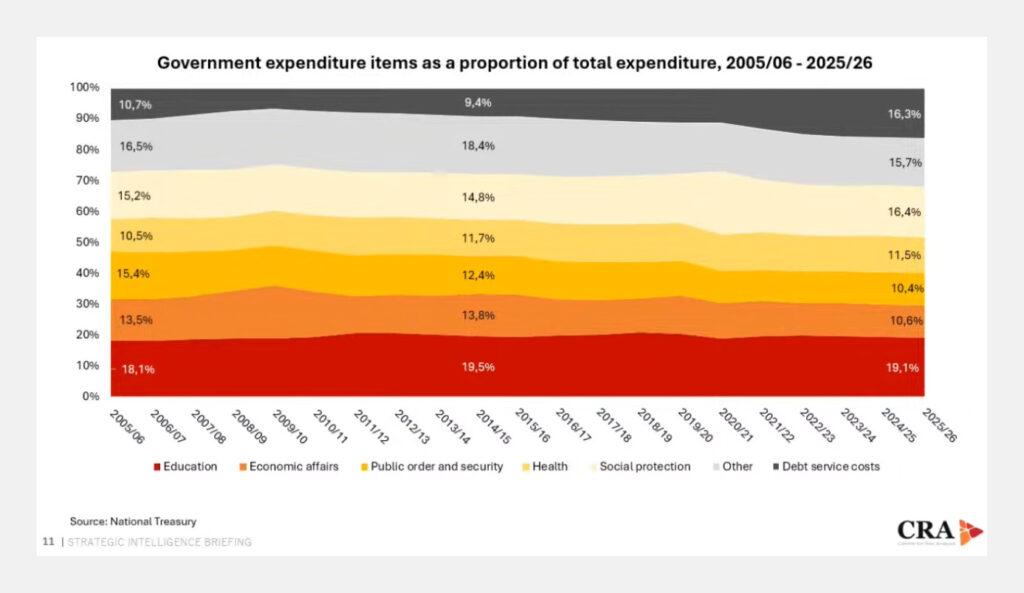
These interest payments have grown significantly over the past decade to consume over 16% of all government spending and remain the fastest-growing expenditure item in the budget.
If the growth in debt-servicing costs continues at its current rate, the government will end up spending more on interest payments than on healthcare and education in the next three years.
Economic policy analyst at the Centre for Risk Analysis, Anlu Keeve, explained that this is what makes the Finance Minister’s policy of fiscal consolidation so important.
The policy of fiscal consolidation is beginning to bear fruit in South Africa, with the government posting consecutive primary budget surpluses for the first time since the late 2000s.
These primary surpluses are key as they mean the government is bringing in more tax revenue than it is spending, excluding debt-servicing costs.
Over time, this will slow the growth in the government’s debt and enable it to begin paying down its liabilities and reduce the burden.
However, this is based on the assumption that the government will continue posting primary budget surpluses, which is not guaranteed.
To this end, the National Treasury wants Parliament to impose a fiscal anchor, which is a binding set of legislation that does not allow the government to break certain fiscal rules.
This may take the form of a debt ceiling, as it does in the United States, or limit the government’s deficit to below a certain percentage of GDP.
The National Treasury is currently working with the implicit anchor of a primary budget surplus, which informs the entire budgetary process.
Despite this, South Africa remains on a very difficult trajectory, with the interest rate it pays on its debt being higher than nominal economic growth.
This means its debt-servicing costs are compounding at a faster rate than the economy, which is unsustainable.
South Africa’s government has also repeatedly targeted a stabilisation in the debt burden since 2009, which it has not achieved. Saying that, Keeve said the government is closer than ever to achieving this goal.
“Dead money”
Government spending on debt-servicing costs has risen steadily over the past decade to take up 16.3% of all expenditure. This is vastly higher than the 9.4% seen a decade earlier.
This rapid growth means that spending on interest payments is crowding out expenditure in other areas of the economy, which are far more productive.
In the coming years, at the current trajectory, spending on interest payments will even begin to crowd out education expenditure and healthcare spending.
“Of course, notice here that the line is grey. This is not by accident. This is essentially dead money. It is money that cannot be spent productively anywhere else,” Keeve said.
“This is important because, if we are not careful, there is still a risk of debt running away from us. We are still in very high-risk territory.”
This trajectory has even raised the alarm from the Reserve Bank, which has warned that South Africa is still on the edge of a debt trap.
As a share of GDP, South Africa has experienced one of the fastest increases in government debt in history, from 24% in 2008/09 to over 76% at the end of the 2025 financial year.
This is far faster than South Africa’s emerging market peers over the same period and has resulted in the risk premium the country pays skyrocketing.
As South Africa’s credit rating deteriorated, the premium the country pays to entice investors to hold its debt has risen strongly.
The Reserve Bank said the government has little control over bond yields, but it can manage the perception of risk through credible financial management and resilience.
Over the past 15 years, the government has failed to show enhanced financial management, but it has slowly begun to turn the tide.
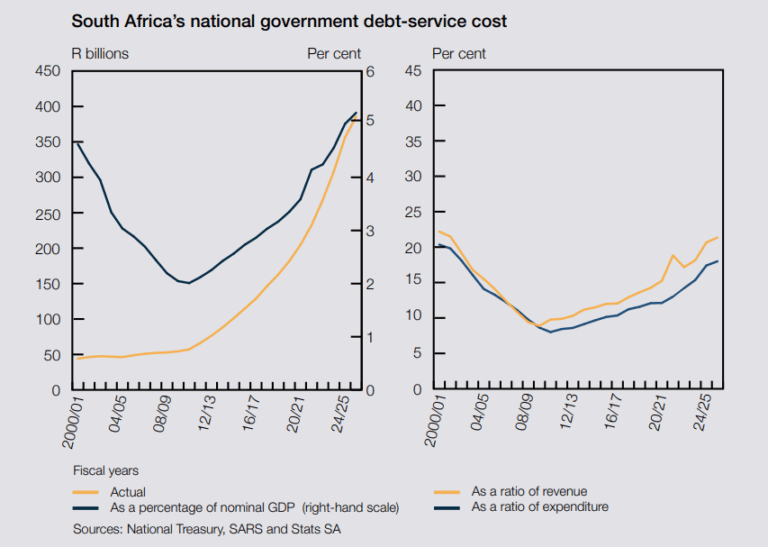
This combination has resulted in the country’s debt-servicing costs skyrocketing over the past 15 years from R54.3 billion in 2008/09 to over R424 billion in the current financial year.
This is a compound annual growth rate of 13.1%, making debt-servicing costs the fastest-growing expenditure item in the national budget.
The increase reflects the combined impact of rising debt and elevated borrowing costs, both of which present significant fiscal constraints, the Reserve Bank said.
It warned that South Africa’s finances risk becoming unsustainable, with higher debt-servicing costs resulting in wider budget deficits, increasing the risk of falling into a debt trap.





Comments