Only 1.5% of South Africans pay 60% of all personal income tax


South Africa’s tax base is highly concentrated, with 978,140 individuals paying 60.6% of all personal income tax in the country.
This means that around 1.5% of the country’s population is responsible for just over 60% of all personal income tax revenue.
The highly concentrated nature of South Africa‘s tax base limits the government’s ability to raise tax revenue by increasing rates, while also ensuring its revenue sources are vulnerable to any kind of shock.
This is feedback from the Centre for Risk Analysis’ (CRA) economic policy analyst, Anlu Keeve, who outlined where the government’s tax revenue comes from.
In an analysis after the Finance Minister’s Medium-Term Budget Policy Statement, Keeve explained that while there are key improvements in the country’s finances, there are still major challenges.
Keeve explained that SARS is doing an exceptional job in collecting additional tax revenue in a stagnant economy, with tax buoyancy increasing.
For every 1% of economic growth, South Africa collects over 1.5% more in tax. This has largely been done by narrowing the country’s estimated R800 billion tax gap.
However, the sources of this tax revenue remain highly concentrated, with a small minority paying the majority of taxes in South Africa.
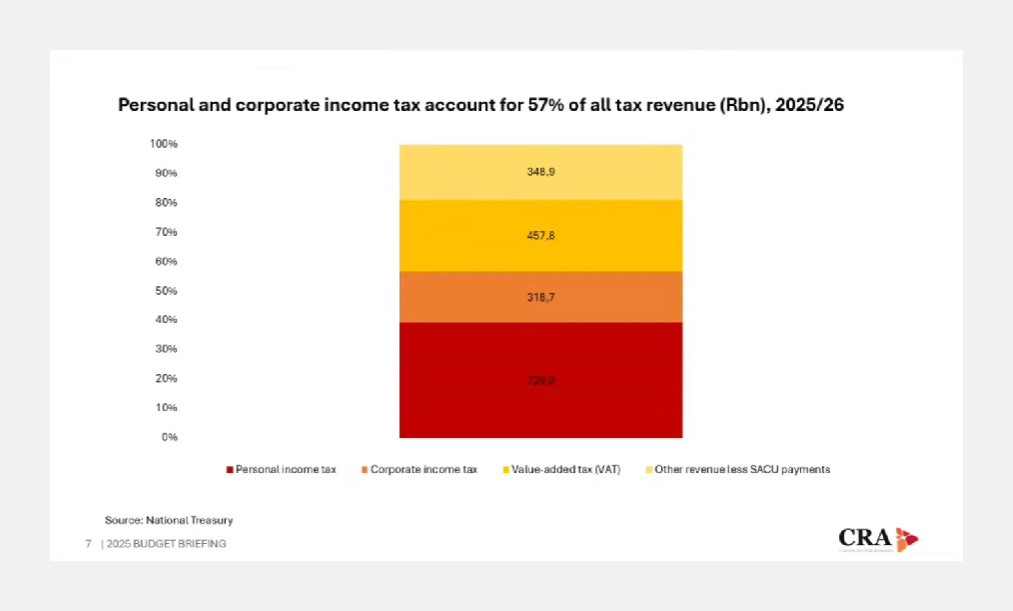
Keeve explained that personal and corporate income tax accounts for 57% of all government revenue, contributing over R1 trillion.
Breaking this down further, personal income tax is the largest source of government revenue, with it making up nearly 40% of the state’s tax base at R729.9 billion a year.
“It is important to understand where the government’s tax revenue comes from, because it tells us that the state relies heavily on individuals and companies to fund its operations,” Keeve said.
“So, increasing taxes means that a certain group will carry a disproportionately heavier burden. It also emphasises the point that the government is reliant on private individuals and businesses to deliver on its promises.”
The graph below, courtesy of Keeve, shows the various sources of the government’s tax revenue.
978,000 people bear the brunt
In analysing where personal income tax comes from, the picture becomes increasingly worrying as the tax base shrinks further.
The vast majority of South Africans start at zero, with elevated unemployment and many earning below the personal income tax threshold.
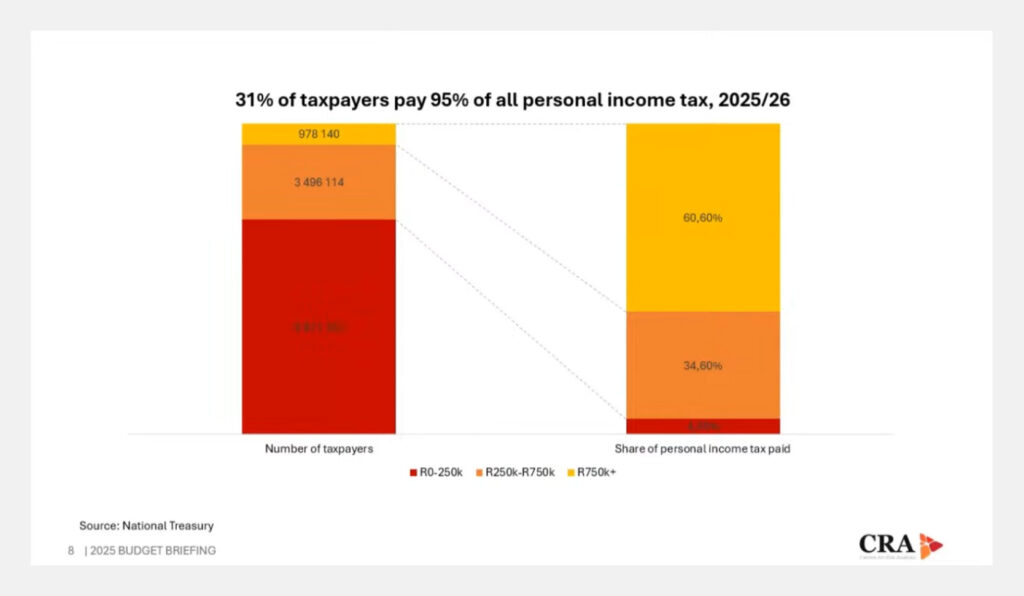
Around 10 million taxpayers contribute just 4.9% of personal income tax revenue in South Africa. These people earn between R0 and R250,000 per year.
Keeve explained that this is indicative of broader economic trends, with low growth and rising unemployment contributing to a large share of people not earning enough money to pay tax in South Africa.
The next cohort is made up of 3.5 million taxpayers who earn between R250,000 and R750,000 per year and contribute significantly more.
These 3.5 million taxpayers make up just less than 35% of all personal income tax revenue, contributing R254 billion to the fiscus.
This means that the vast majority of personal income tax, the largest source of government revenue, comes from a tiny proportion of the population.
The top cohort, which earns more than R750,000 per year, pays 60.60% of all personal income tax in South Africa.
This means that 978,140 people pay R442.3 billion in personal income tax, funding a significant portion of government expenditure.
“If we take a step back and look at the breakdown of personal income tax, the top two groups pay 95% of all personal income tax revenue,” Keeve said.
“This emphasises the point that South Africa has a very narrow tax base and it is problematic for various reasons.”
Efficient Group chief economist Dawie Roodt previously said that this shows South Africa has gone over the edge with regard to its tax rates.
Roodt said the government is over the Laffer Curve with its personal income tax collection and corporate income tax, with any increases to tax rates likely to result in less revenue for the state.




Comments