Spur burger for 30 cents


In the 1970s, South Africans were able to enjoy a Spur burger for 30 cents. Fifty years later, the same burger costs R119.90.
A similar story has played out with the price of many of South Africa’s favourite foods, pastimes, cars, and houses.
This is due to the pernicious effect of elevated inflation, which erodes purchasing power and savings to consistently make South Africans poorer in relative terms.
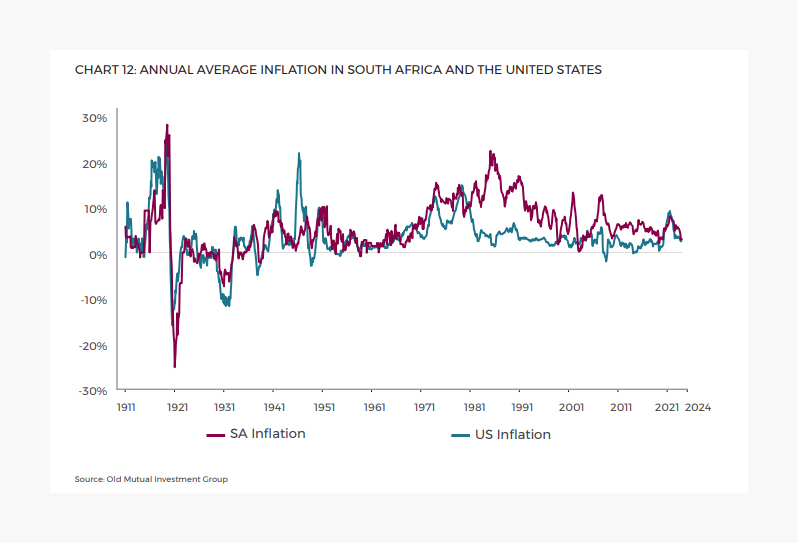
According to an Old Mutual Investment Group’s (OMIG) Long-Term Perspectives report, inflation has averaged 5.4% a year since 1911. This is significantly higher than the 3.3% in the United States, for example.
This has a myriad of negative effects, with income and spending power eroding at a relatively quick rate in South Africa over the past 100 years.
The elevated rate of inflation pushes investors to beat a higher threshold to earn real returns to avoid their savings losing their purchasing power, discouraging fixed investment.
This also results in elevated yields on government bonds, which makes it more expensive for the government to borrow money to fund service delivery.
The same effect impacts individuals through home loans, car loans, and personal loans, among other forms of debt. In effect, compound interest is working against the government and citizens.
While the difference in inflation between South Africa and developed economies may seem small, over decades of compound interest, the impact is severe.
In the recent Medium-Term Budget Policy Statement, Finance Minister Enoch Godongwana explained this phenomenon and how elevated inflation substantially erodes savings and purchasing power.
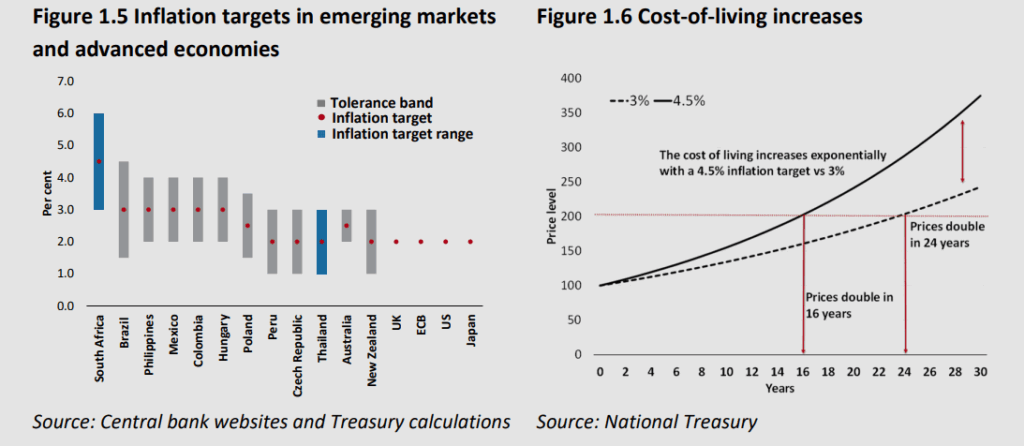
To explain why the government has decided to lower the inflation target to 3%, the National Treasury produced a simple graph showing the difference in the long-term effects of a 3% inflation rate versus 4.5%.
At a 4.5% inflation rate, prices double every 16 years. In comparison, prices only double every 24 years at a 3% inflation rate.
This gap widens over time, with the cost of living increasing at an exponential rate. Over 100 years, at a 3% inflation rate, prices would double just over four times. At a 4.5% inflation rate, prices would double more than six times.
South Africa’s elevated inflation rate is why the price of a Spur burger has risen from 30 cents in the 1970s to R119.90 in 2025.
The graph below shows the pernicious effect of elevated inflation over 30 years, courtesy of the National Treasury. It is followed by a table from OMIG portfolio manager John Orford’s data on the effect of inflation on common foodstuffs in South Africa.
| Product | Price in 1970s | Price in 2025 |
| Spur Burger | R0.30 | R119.90 |
| Cheddamelt Steak (300g) | R0.50 | R249.90 |
| Ricoffy (750g tin) | R0.25 | R169.90 |
| Condensed Milk | R0.10 | R38.99 |
South Africa’s inflation history
South Africa has had a relatively elevated inflation rate compared to developed economies over the past century, with the gap widening in recent decades.
Orford explained that many people suffer from ‘inflation illusion’, as they do not notice how steady price increases erode their purchasing power over time.
This particularly impacts investors and those saving for retirement. Unless your investments consistently outpace inflation, you will face a lower standard of living at maturity.
South Africa’s inflation rate was not always so elevated compared to other economies, with it largely matching the United States before 1980.
The country’s 3.6% annual inflation rate was only marginally higher than the 3.4% yearly average in the United States from 1911 to 1980.
However, this all began to change in the 1970s after the energy crisis, with demand far outstripping artificially subdued supply. South Africa’s inflation surged higher, as did the United States’.
However, the US government encouraged significant investment in its own oil industry to minimise the impact of supply disruptions on its economy.
In the early 1980s, US Federal Reserve Governor Paul Volcker began taking decisive action against inflation, which began a sustained decline in America’s inflation rate.
South Africa almost did the opposite, with expansionary government spending, rapid wage growth, and economic isolation keeping inflation elevated throughout the 1980s.
Only a recession and elevated rates in the 1990s began to bring inflation under control. This was boosted further by the adoption of inflation targeting in 2000.
From 2000 onwards, inflation averaged 5.5% per year in South Africa, compared to a 12.3% average in the two decades preceding the turn of the century.
Globally, the battle against inflation appeared to have been won in the two decades leading into the Covid-19 pandemic. Globalisation and China’s entry into the global economy anchored inflation at low levels.
The pandemic saw inflation skyrocket around the world. In the US, consumer prices rose by an average of 5% in 2021 and by a multidecade high of 8% in 2022.
This prompted an aggressive, if belated, response from central bankers, with the US Federal Reserve leading the charge to higher interest rates.
Several factors, including ageing populations, the retreat from globalisation and the high cost of the green transition, mean that inflation is likely to remain higher, on average, over the next decade than it did in the period since the 2008 financial crisis.
The Reserve Bank has stood out as a bastion of orthodoxy among global central banks, remaining committed to forward-looking inflation targeting, which is the best guard against inflation and its corrosive impact on living standards, Orford said.






Comments