South Africa leaves billions on the table


South Africa’s government has consistently underspent its infrastructure budget over the past four financial years, as it pledges to ramp up investment to revive the local economy.
Infrastructure investment has been declining as a share of GDP over the past 15 years, limiting South Africa’s economic growth.
This decline has been broad-based, with private companies reducing investment alongside the government and public corporations.
A result of this decline is that infrastructure investment has to occur now, with it no longer being a question of “if” but “when”.
Melville Douglas senior domestic equity analyst Kgosi Rahube said the time is now, with South Africa’s economy hobbled by a lack of fixed investment.
Rahube explained that the government has repeatedly reiterated its commitment to infrastructure-led growth in recent years.
This commitment was repeated by President Cyril Ramaphosa and Finance Minister Enoch Godongwana earlier this year, with both pledging R1 trillion in infrastructure investment over the next three years.
Rahube said this signals a strategic shift to use infrastructure as a foundation for economic development, job creation, and improved service delivery in the same fashion as other emerging markets.
However, South Africa’s fixed investment remains dismally low compared to its emerging market peers, with it being half of India’s as a share of GDP.
This is not good news for the local economy, with fixed investment in land, machinery, equipment, and infrastructure being a major driver of long-term growth.
Its decline in South Africa, from around 30% as a share of GDP in 1976 to 15% in 2024, has resulted in poor economic growth of less than 1% per year over the past decade.
The government’s plan to invest heavily in energy, water, and logistics infrastructure is positive news for the local economy, with deteriorating infrastructure increasingly limiting economic activity.
However, the government’s intentions are not always matched by its actions, with ambitious plans often not backed up in reality.
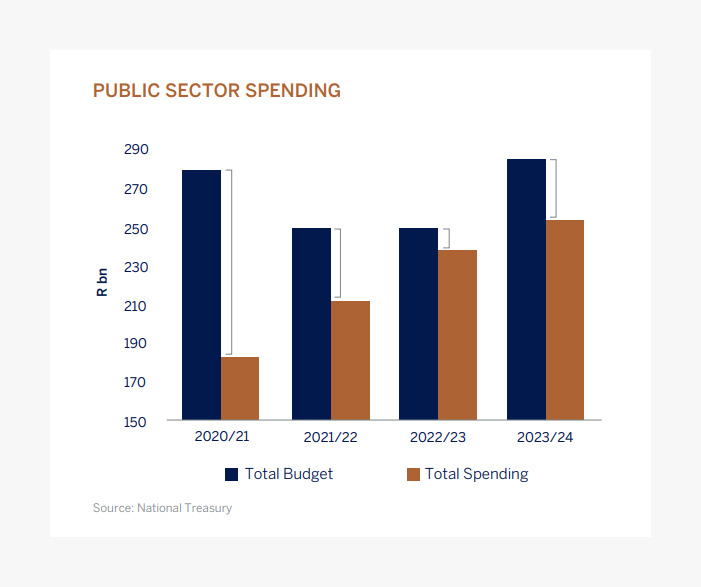
This can be seen in the graph below, which shows how the government has underspent its budget on infrastructure by over R100 billion in the past four financial years.
Out of options
One major difference in the coming years is that the government has simply run out of options – it has to invest in maintaining and upgrading infrastructure, or the local economy will continue to underperform.
Rahube explained that Melville Douglas continues to believe the current environment presents a pipeline of opportunities because of the reforms the government has implemented in recent years.
In particular, the government has reformed key regulatory frameworks to attract private investment in South Africa’s network industries.
This has been seen most clearly in the electricity sector, with the private sector pumping billions into renewable energy generation after reforms lifted limitations on the size of projects and began creating a competitive energy sector.
Reform in the logistics sector has been much slower but is following the same trend, with private players set to operate key rail corridors and port terminals.
Crucially, this means the private sector will play a greater role in South Africa’s economy than before, improving outcomes and increasing investment.
This is coupled with the government’s efforts to encourage public-private partnerships, which have had a positive impact in key areas of the economy.
Examples include the Gautrain, South Africa’s only world-class piece of infrastructure, and the rapid buildout of renewable energy contracted to Eskom.
The country has also run out of options in another sense – the government has run out of money and does not have the balance sheet to invest enough on its own.
Stanlib chief economist Kevin Lings explained that the mismanagement of government finances over the past decade has significantly weakened the state’s balance sheet.
“I would say that deregulation is your only option now. It is your only choice, and while you may not like it ideologically, it is your only option,” Lings said.
“You are out of options, and those options have been taken away because you took government debt from 26% to 76% of GDP. That increase meant you have taken away your option to use your own balance sheet.”
Lings said it would have been ideal for South Africa for the government to use its own balance sheet for infrastructure investment. However, this option is no longer available.