South African rand goes from zero to hero


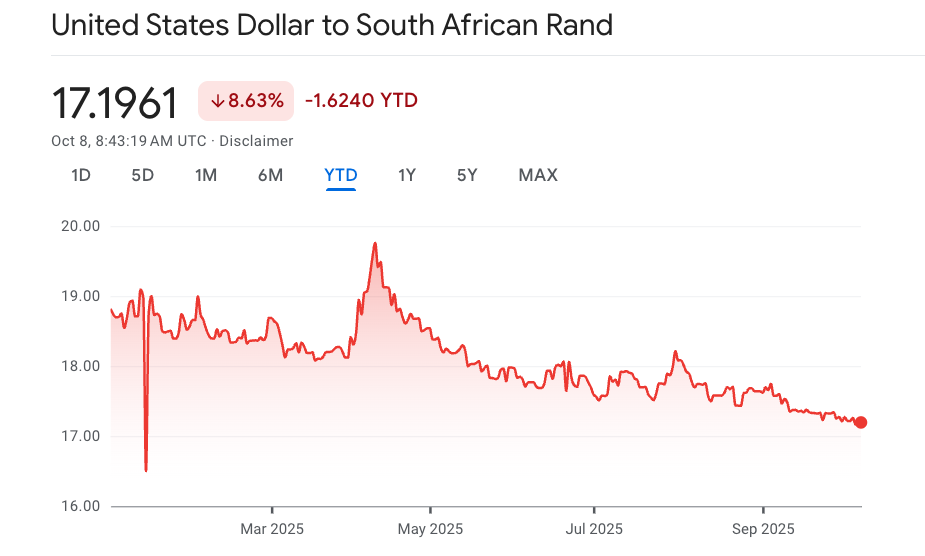
South Africa’s rand has shown significant resilience in 2025 so far, starting the year at R18.82/USD and now standing strong at around R17.21/USD.
This reflects an 8.68% appreciation against the United States dollar in the year to date, with many experts believing this is set to continue in the rest of 2025.
This is a far cry from the rand’s performance in 2024, when election uncertainty kept the local currency relatively weak.
Aluma Capital chief economist Frederick Mitchell explained that the rand has been appreciating against the US dollar since the general elections in May 2024.
Financial markets broadly welcomed the outcome of South Africa’s 2024 national elections, which led to the formation of the Government of National Unity (GNU). This outcome was considered very market- and business-friendly, leading to a boost for the rand.
Going into 2025, Mitchell told Daily Investor that the rand saw some blowouts when billionaire Elon Musk and US President Donald Trump turned up the heat on South Africa’s government.
This tension was related to Musk’s Starlink and other US businesses operating in the South African market, coupled with diplomatic tensions and 30% trade tariffs imposed on South African products exported to the US.
Mitchell explained that these developments caused the rand to “spike” against the dollar, but since then, the local currency has steadily gained value as the rand moved back to around the R17.50 mark.
Following this, the rand has continued to appreciate, seeing a significant boost in the past few weeks in light of the United States’ government shutdown and some dollar weakness.
The rand’s recent strength has also been boosted by the United States and the United Kingdom reducing their interest rates while South Africa’s was kept unchanged at the last Monetary Policy Committee meeting.
“Keeping the South African interest rate unchanged is currently supporting the rand for at least the short run, but we will have to see how long it lasts,” Mitchell said.
He warned that the trade tariffs placed on South African goods are likely to influence the country’s economic growth, output and employment levels, which will ultimately influence the value of the rand against the dollar going forward.
The graph below shows the rand’s performance against the United States dollar in 2025 to date.
Softer dollar, stronger rand
TreasuryONE head of execution Andre Botha told Daily Investor that a significant tailwind for the rand in 2025 has been the pronounced weakening of the US dollar.
He explained that the dollar has depreciated by nearly 10% this year, primarily due to softer US economic data, moderating inflation, and the US Federal Reserve’s decisive shift toward monetary easing.
He noted that the Fed’s September rate cut, in particular, signalled a clear pivot away from its previously restrictive stance, prompting investors to seek higher-yielding opportunities in emerging markets.
“The weaker dollar has also eased import costs for South Africa, as oil is one of our biggest import components, helping to stabilise,” he said.
“In essence, the dollar’s decline has not only directly boosted the rand’s value but also enhanced South Africa’s overall macroeconomic resilience, thereby amplifying the rand’s appeal as both a trade and carry currency in global markets.”
Mitchell explained that the rand has seen a similar pattern against the British pound in the last year as it has seen against the US dollar.
The rand has appreciated since the formation of the GNU from R23.94 against the pound to around R23.00 to R23.10.
He said this signals some small step in the right direction by South Africa’s government from a currency perspective.
This, coupled with the fact that South Africa kept its interest rates unchanged while the UK lowered its lending rates, supported the rand’s value against the pound, at least in the short term.
He noted that the rand’s value against the euro has remained relatively stable since the formation of the GNU, as Europe also “struggles” with US trade tariffs and the continent’s ongoing and uncomfortable energy dependence on Russian natural gas.
The graphs below show the rand’s performance against the British pound and the euro, respectively, in 2025 to date.


Rand on a roll
Botha explained that, from a carry trade perspective, South Africa remains one of the most attractive yield options in emerging markets.
“With policy rates well above those in advanced economies and inflation under control, the real yield differential remains compelling for global investors seeking higher returns,” he said.
He noted that this “carry attractiveness” is magnified by the rand’s improved stability and the Reserve Bank’s credibility, making it a favoured destination for yield-seeking capital amid softer US rates.
“This is where we have seen the rand perform better against other major currencies like the EUR, GBP, and AUD, etc,” he explained.
“While external risks persist, the combination of robust reserves, disciplined policy, and elevated carry potential positions the rand as a standout performer heading into the final stretch of 2025.”
Mitchell added that, because South Africa is a small, open economy, currency volatility is expected for a country of its size.
This is because South Africa, and therefore the rand, is often at the mercy of trade wars, tariffs and geopolitical movements across the globe.
He noted that South Africa also plays a role in this, as how the country chooses to position itself in the middle of these “storms” has an impact.






Comments