South Africa’s R1.8 trillion untapped goldmine


South African companies are sitting on a R1.8 trillion cash pile, which they are waiting to deploy in the country when economic conditions improve.
However, prevailing uncertainty, South Africa’s continued low economic growth and a lack of business confidence discourage corporations from using this stockpile to invest in the country.
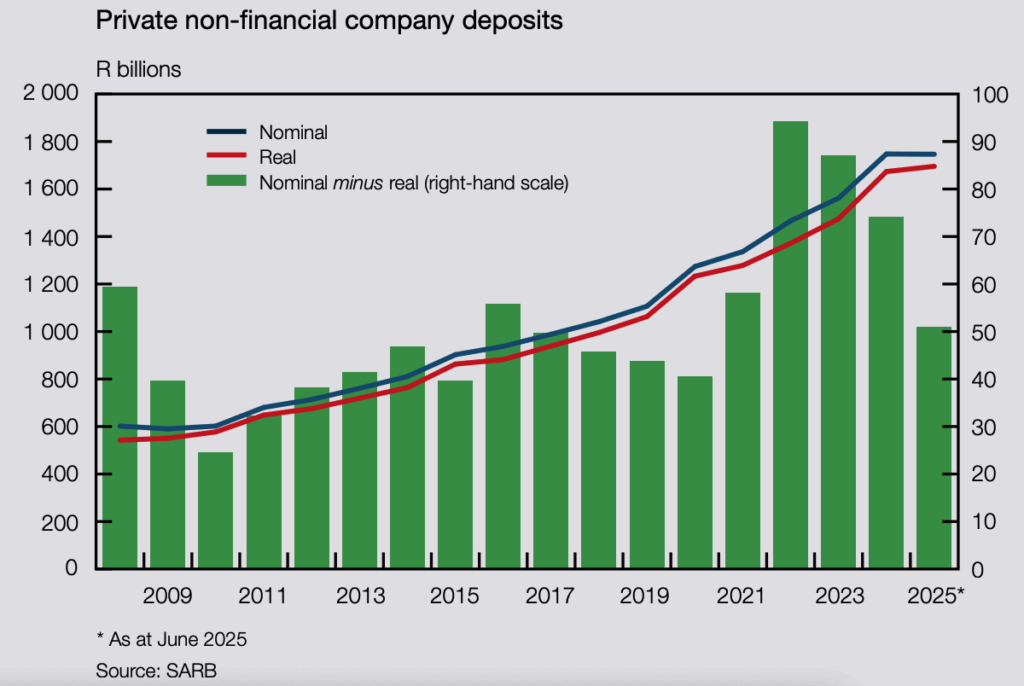
This was revealed in the Reserve Bank’s latest quarterly bulletin, released in September 2025, which showed that South Africa’s non-financial companies (NFC) now hold more money than they did before the pandemic.
The report explained that this trend began after the pandemic hit in 2020 and companies boosted their deposits by R166.9 billion.
In 2024, they added another R186.1 billion, marking the biggest annual increase to date. Some of this growth was due to inflation, but a large portion signalled cautious spending amid South Africa’s low economic growth.
The latest quarterly bulletin showed that South Africa’s non-financial companies held a record R1.8 trillion in their bank accounts in July 2025.
The Reserve Bank attributed this excessive stockpiling to increased uncertainty during the Covid-19 pandemic, which has continued into 2025.
“When the economy came to a standstill during the pandemic, companies protected their balance sheets amid higher uncertainty,” it explained.
“Cash holding thus increased significantly during the pandemic and the subsequent high-inflation period, and again when economic growth moderated from 2023 amid increased global and domestic uncertainty.”
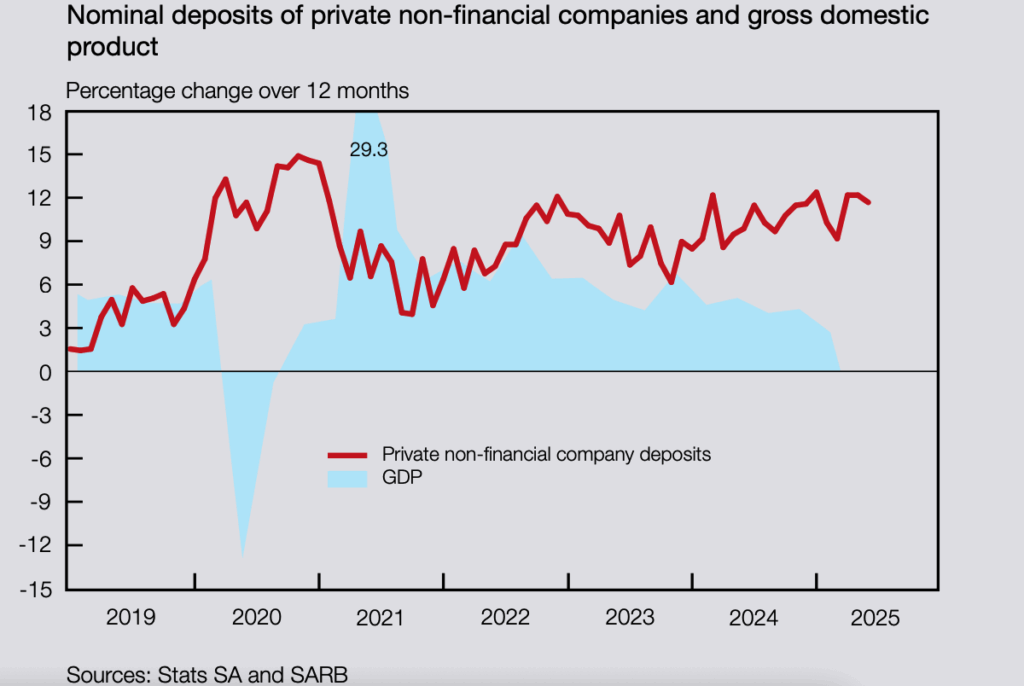
Positively, investment picked up in 2021, when it briefly pushed nominal GDP growth higher than deposit growth.
However, since mid-2022, deposit growth has outpaced South Africa’s GDP growth. The Reserve Bank said this is a sign that businesses are still keeping extra cash as a safety measure.
South African businesses lean towards these safety measures amid heightened uncertainty and limited investment opportunities in the country’s low-growth environment.
Therefore, from late 2023, the gap between deposits and investment widened due to heightened uncertainty, subdued business confidence and South Africa’s low economic growth.
The graphs below show the growth in private NFC deposits and the widening gap between South Africa’s GDP growth and deposit growth.
South Africa must create investment opportunities
Despite the significant growth in corporate cash piles, the Reserve Bank noted that the continued rise in deposits shows that companies are not merely stockpiling cash.
Rather, “they are responding to economic conditions and balancing risk with readiness to invest when confidence returns”, the Reserve Bank said.
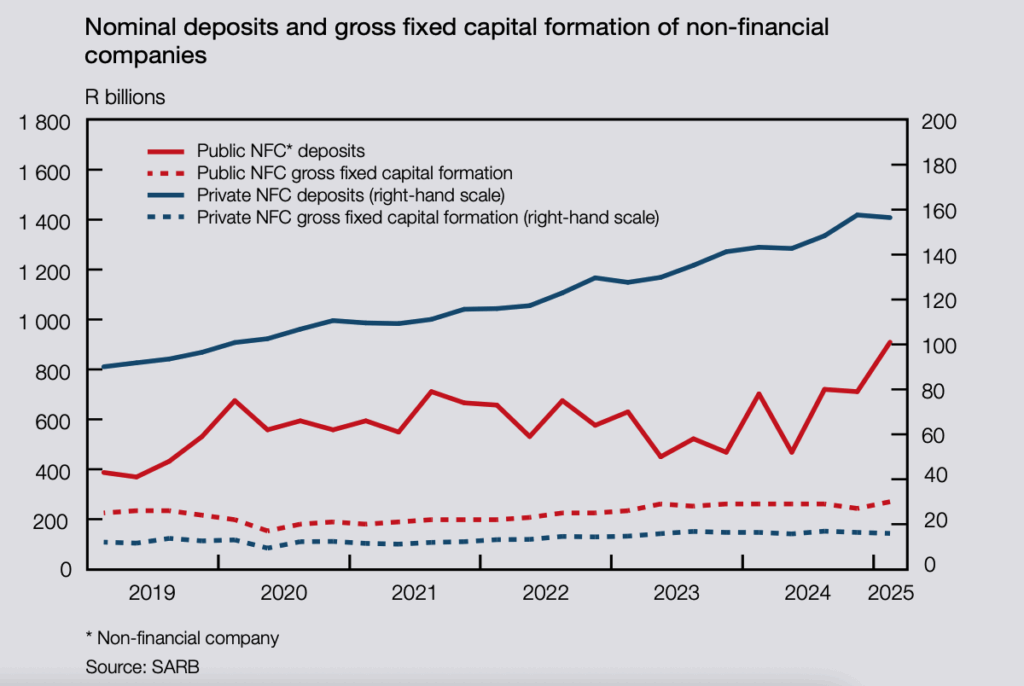
South Africa’s levels of fixed capital formation have been lacklustre for years, as local companies lack the confidence or opportunities to deploy cash into productive assets.
Fixed capital formation refers to business spending on tangible assets that are expected to remain in use for a relatively long period.
South Africa’s real gross fixed capital spending level in the first half of 2025 was 3.1% lower than in the corresponding period of 2024.
These low levels of investment are one of the main reasons for South Africa’s subdued economic growth, as neither the government nor the public sector have invested sufficiently to help the economy grow.
Stanlib chief economist Kevin Lings has attributed the private sector’s hesitance to deploy its cash pile to a lack of confidence in the local economy.
He said the government has to create an enabling environment to foster confidence in the local economy if it wants to encourage businesses to invest in fixed assets.
“I would say that deregulation is your only option now. It is your only choice, and while you may not like it ideologically, it is your only option,” Lings said.
“You are out of options, and those options have been taken away because you took government debt from 26% to 76% of GDP. That increase meant you have taken away your option to use your own balance sheet.”
The graph below shows the significant gap between NFC deposits and fixed capital formation.
 Loading ...





Comments