One thing South Africa can do to avoid financial disaster


The implementation of a new fiscal anchor, such as a debt or deficit ceiling, could significantly improve the government’s financial discipline.
This would have the ultimate benefit of putting South Africa’s government on a more sustainable financial footing, improving the country’s outlook from credit agencies and boosting investment.
However, there are concerns that such a fiscal anchor would limit the government’s flexibility in addressing external shocks and stimulating the local economy.
Investec chief economist Annabel Bishop outlined the government’s declining financial health and what a new fiscal anchor to address this deterioration could look like.
Amidst South Africa’s Budget Speech debacle earlier this year, the National Treasury published a discussion document on fiscal anchors.
This is part of its efforts to curb South Africa’s growing debt burden by setting clear, and potentially unbreachable, targets for debts, deficits, or government spending.
The National Treasury’s policy of fiscal consolidation is beginning to bear fruit, but a fiscal anchor would create greater certainty for investors by effectively ensuring the government’s financial sustainability.
Credit ratings represent the perceived creditworthiness of countries’ debt, that is, their ability to repay, and South Africa’s is seen to have deteriorated, Bishop explained.
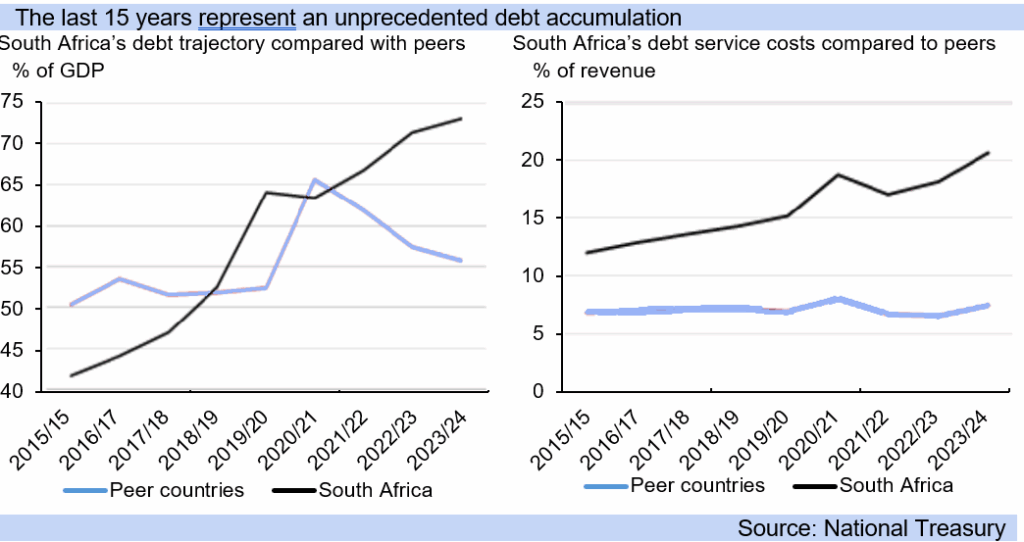
The country’s investing rating gradually slid into junk status in the 2010s as gross debt escalated from 23.6% as a share of GDP in 2008/2009 to 76.9% at the end of the 2024 financial year.
The escalation in borrowing has resulted in debt service costs jumping from 9% to 21% of government revenue, further weakening the country’s finances.
Higher debt-servicing costs raise the total debt burden, creating a self-reinforcing cycle of higher interest costs and a systemic “deficit bias”, Bishop explained.
It is the strongest evidence for why a more formal, credible fiscal anchor is now necessary to bind policy to a sustainable path.
“The long-term goal is to reduce the debt ratio towards a more sustainable range,” the National Treasury said in its discussion document.
“The budget process is being reformed to improve the efficiency and impact of every rand spent. A fiscal anchor is being considered to ensure long-term fiscal discipline.”
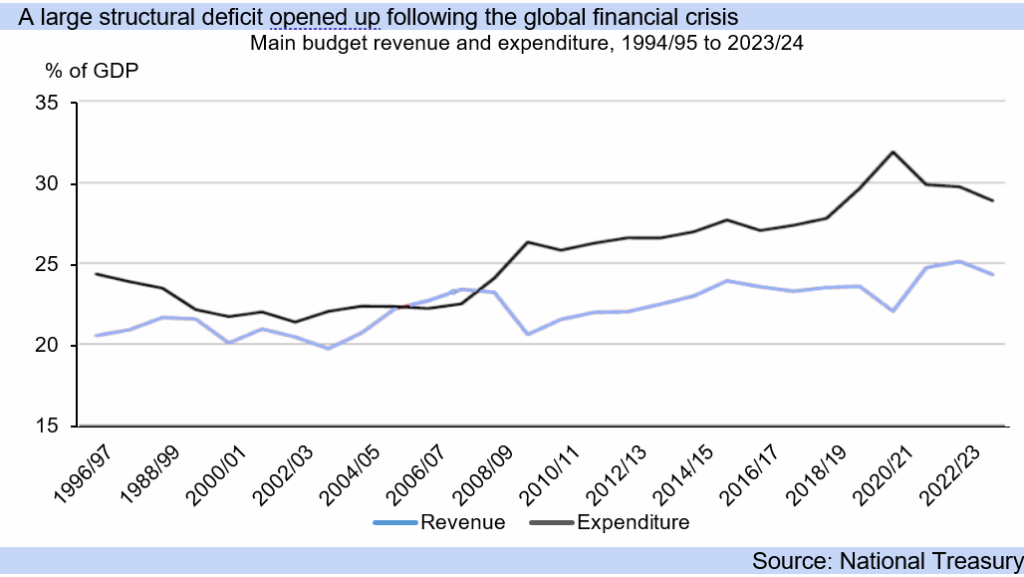
The growth in South Africa’s debt burden, debt-servicing costs, and persistent deficits can be seen in the graphs below, courtesy of Bishop.
A new fiscal anchor
Fiscal anchors seek to promote overall fiscal sustainability, with an emerging market’s debt being seen as sustainable at, or below 60% as a share of GDP. An emerging market’s deficit is seen as sustainable when at or below 3% of GDP.
South Africa’s financial health is far worse on these metrics than what is deemed sustainable, with debt rising above 76% as a share of GDP, and its deficit has consistently been above 4% of GDP.
This is despite the efforts of the National Treasury to rein in government spending, which has led to calls for a new, unbreachable fiscal anchor.
Fiscal anchors can be flexible or inflexible, and numerical, such as a debt or deficit ceiling, Bishop explained. Typically, they are unbreachable.
This is the case with the United States, for example, which famously has a debt ceiling that cannot be breached. In most cases, Congress votes to raise the ceiling to keep the government operational.
In other cases, such as Germany, there is a limit on borrowing, with the central state limited to taking on new debt worth only 0.35% of GDP in a year.
There can also be a parliamentary procedural model with medium-term fiscal plans demonstrating compliance with a set of predefined sustainability standards.
In this case, the Treasury’s fiscal plans would be used as a standard against which its own future budgets would be measured, ensuring greater accountability and oversight.
A well-designed fiscal anchor must strike a balance between discipline and flexibility, ensuring that fiscal policies remain sustainable while allowing necessary adjustments in response to economic fluctuations.
Bishop explained that the key area that needs to be addressed is the supply of government debt, which has been the main reason why debt-servicing costs have risen and why South Africa lost its investment grade status.
This is naturally linked to government spending, which has consistently grown at a faster rate than revenue over the past 15 years.
Fiscal sustainability reduces the need for large-scale borrowing by ensuring that public debt is not growing faster than the economy’s capacity to service it indefinitely.
It would, therefore, require a credible plan to stabilise South Africa’s debt burden and begin reducing it over time.
Instituting a credible fiscal anchor is key to improving the governance of state finances, which have also been eroded by the pressure of state capture.
Reducing the debt and deficit as a share of GDP is key to strengthening the bond market, reducing debt-servicing costs and putting South Africa on a more sustainable financial footing.





Comments