From zero to R15 billion in 25 years


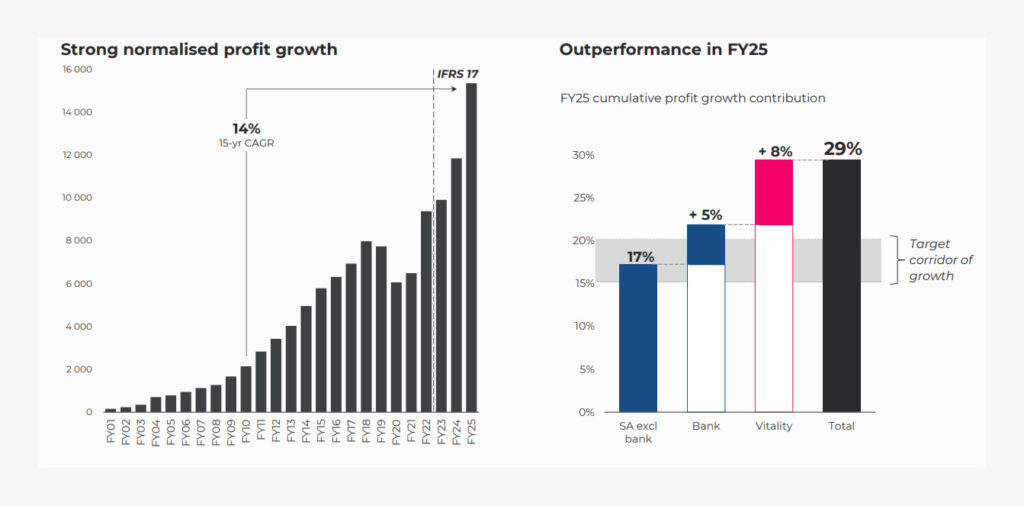
Discovery has grown its normalised profit from close to zero in 2000 to over R15 billion in its most recent financial year, with the company having plans to double this number by the end of 2029.
This doubling of profit will occur if Discovery meets the ambitious targets laid out as part of its new scaled growth era.
The new era is vastly different from the two that came before it, when the company first grew rapidly throughout the 2000s and then began to invest heavily in its new businesses, such as its bank, in the 2010s.
These eras mark significant milestones for the company, with Discovery looking to avoid falling into what some refer to as the ‘Valley of Death’ for a company.
This is when the first operating model or business units begin to flatline, with growth stagnating and the company effectively being outcompeted.
While some sort of slowing of growth occurs in every business, the crucial thing is for a company to avoid stagnation.
This is something Discovery CEO Adrian Gore was deeply concerned about and sought to address through either buying up companies or growing organically.
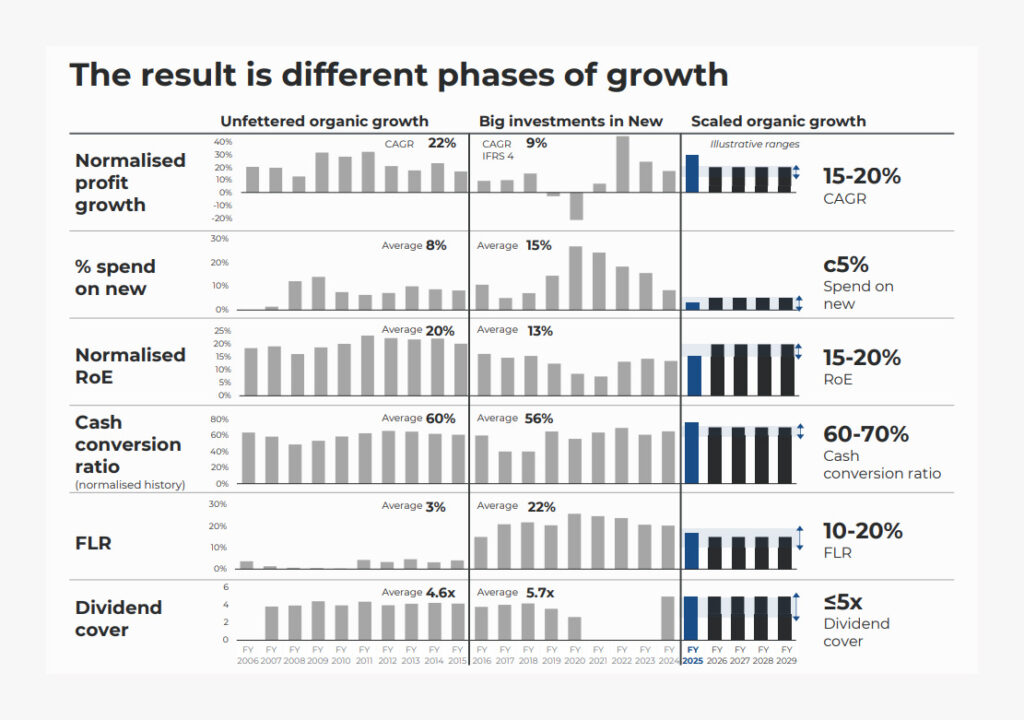
The company’s first period of “unfettered organic growth” saw it grow its profits by a compounded annual growth rate of 22%. Discovery’s return on equity throughout this period was 20%, with a cash conversion ratio of 60%.
Towards the end of this era for Discovery, the company’s growth naturally began to slow as it was expanding off a much larger base.
Gore explained to Daily Investor that this phase requires plenty of hard work to break out of, with companies either growing through acquisitions or organically by expanding their products and services.
Discovery chose to invest heavily in developing its own offerings, pumping R14.5 billion into its bank and some into its global businesses.
During this period, Discovery steadily built out its banking capability, enhanced its Vitality models, and began licensing its technology and models to global insurers.
These big investments impacted the company’s financial performance, with profit growth slowing to 9% per annum, its return on equity falling to 13%, and cash conversion slipping to 56%.
The percentage of its revenue spent on new businesses climbed from 8% in the first era to an average of 15% per annum in the second phase.
These two phases effectively got the company to where it is today, with it generating R15.2 billion in normalised profit for the 2025 financial year.
This growth can be seen in the graph below, alongside one showing the differences between the three phases of Discovery’s business growth.
Discovery doubling up
The period of intense investment in new businesses has set up Discovery well for future growth, with it setting ambitious targets for the coming financial years.
It expects to grow normalised profit at between 15% and 20% through 2029, with its expenditure on new businesses declining to 5% per annum as they become profitable and generate cash.
Crucial to this is the profitability of its bank, which has absorbed the most investment and is expected to be key in achieving this faster growth.
For the second half of the 2025 financial year, the bank was profitable and began contributing towards Discovery’s group-level profit.
Gore said even with the bank shooting the lights out, it will be difficult to achieve this faster level of growth due to the size of Discovery’s existing business.
“To be fair, 15% to 20% growth compounded over the next four years will result in the company doubling in size,” Gore explained.
“I am saying that achieving this is an aspiration. Not to say that we couldn’t, but I am just trying to make the point that we popped over the upper end of this target range and are likely to settle back into it.”
Discovery grew its profit by 29% in the past financial year, above its target range, due to strong performances from its short-term insurance, investment, and global businesses. Its bank also achieved profitability ahead of target.
“If you can grow at 15% per annum for five years, that is remarkable. If you look at our peer group globally and locally, no one is growing at that rate,” Gore said.
Gore explained that a few areas are crucial to achieving these targets, including the core businesses continuing to grow and the bank continuing to scale rapidly.
“I think the core businesses have to perform well and robustly. Scaling the bank is a key issue, and I think breaking through globally in some kind of our Vitality network is important,” Gore said.
This breakthrough is likely to come from the United States and Europe, which Gore identified as key markets to grow its Vitality offering through partnerships.






Comments