Eskom still falling short


While Eskom has made considerable progress in reforming its operations and staving off load-shedding, the utility’s performance remains far below levels seen in 2019 and 2021, as well as its own targets.
In addition, the utility is relying heavily on its diesel-powered open-cycle gas turbines (OCGTs) to manage peak demand in the 2025 Winter season.
This was revealed by a recent analysis from the Minerals Council of South Africa, which outlined Eskom’s performance between June and July 2025.
Minerals Council South Africa economist Andre Lourens explained that Eskom’s energy availability factor (EAF) improved in July 2025 and is now tracking more closely with the 2024 trend.
However, Lourens noted that the utility’s EAF typically declines after the winter period as electricity demand decreases, allowing Eskom to ramp up its planned maintenance activities.
EAF is a crucial metric to track Eskom’s generation performance, as it measures the percentage of time that the utility’s power plants are available to generate electricity.
Therefore, a higher EAF points to better power plant performance and reliability, while a lower EAF could lead to load-shedding.
Eskom’s turnaround since March 2023 has been impressive, with significant gains made in improving the utility’s EAF.
In early 2023, the utility recorded an EAF of 48%. Just over two years later, Eskom’s EAF has reached 69% across its fleet, with most of its power stations exceeding the utility’s target of 70%.
This improvement is one of the major reasons why load-shedding has become significantly less severe in South Africa.
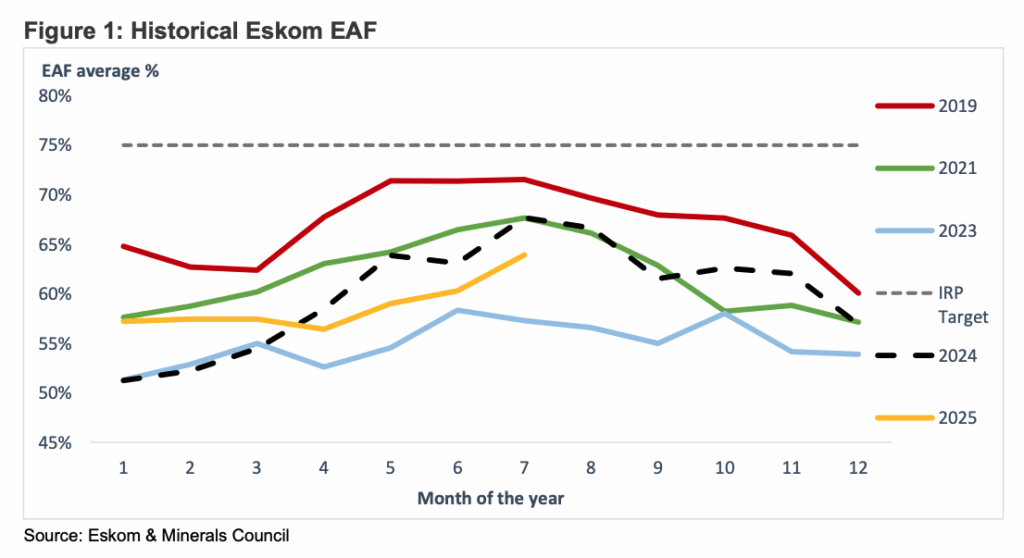
However, a historic view of Eskom’s EAF shows that the utility’s performance in 2025 to date remains below the levels seen in 2019 and 2021.
In addition, over the past four or so months, Eskom’s 2025 EAF has been below 2024 levels.
Lourens’ analysis further showed that, since 2019, Eskom has failed to meet its Integrated Resource Plan target of reaching an EAF of 75%.
These trends over the past few years can be seen in the graph below, courtesy of the Minerals Council of South Africa.
Missed targets
In a recent media briefing, Electricity Minister Kgosientsho Ramokgopa confirmed that Eskom is aiming to reach an EAF of about 70%, adding that the utility has seen some green shoots in this regard.
He said that over the past two weeks, the utility has breached the 70% mark, showing that this target is attainable.
“The EAF for the period from 1 April to 8 August was sitting at 60.14%. And of course, this is major progress that we’re making,” he said.
“If you look at what the performance was if we were to go back to 2023 when we initiated these interventions, it was substantially lower than this amount.”
“So, I think it’s important that there’s a greater level of appreciation. We are coming from the low of lows of about 49% and thanks to the men and women at Eskom. We are making that tremendous progress.”
It should be noted that Eskom’s diesel-powered OCGTS were part of the reason it was able to meet peak demand in the 2025 Winter season.
Lourens explained that Eskom’s ability to maintain supply is partly dependent on its continued use of OCGTs to manage peak demand.
He said that between 1 April and 24 July, Eskom spent R5.62 billion on fuel for its OCGT plants, reflecting a higher reliance on OCGTs than last year.
For context, Eskom’s total OCGT fuel expenditure for the previous financial year was R11.43 billion. Therefore, four months into the current financial year, Eskom has already reached nearly 50% of last year’s diesel spend.
Ramokgopa also addressed this at this briefing, explaining that the OCGTs are merely being used in the way they are intended to be used.
“It is not a secret that we experienced significant challenges at the beginning of the financial year in April,” he said.
“We relied more and more on the diesel to be able to support us, and this diesel was able to support us because it’s meant to support us during those periods of difficulty.”
The minister explained that Eskom’s diesel budget for the current financial year, which started on 1 April 2025, is about R12 billion, with the utility already having spent around R5 billion.
Addressing concerns that Eskom had already used over 40% of its diesel budget in the first four months of the year, Ramokgopa said this was necessary to meet Winter demand.
“It is because it is during winter when the intensity of the demand reaches the peak, and that’s when we are likely going to experience challenges if some units fail because we don’t have the headroom for us to be able to absorb those failures of the units,” he said.
“What do we do? We then call on our ace card, which is the peakers, to come and help us. So, they’re designed to do that.”





Comments