Eskom is being replaced


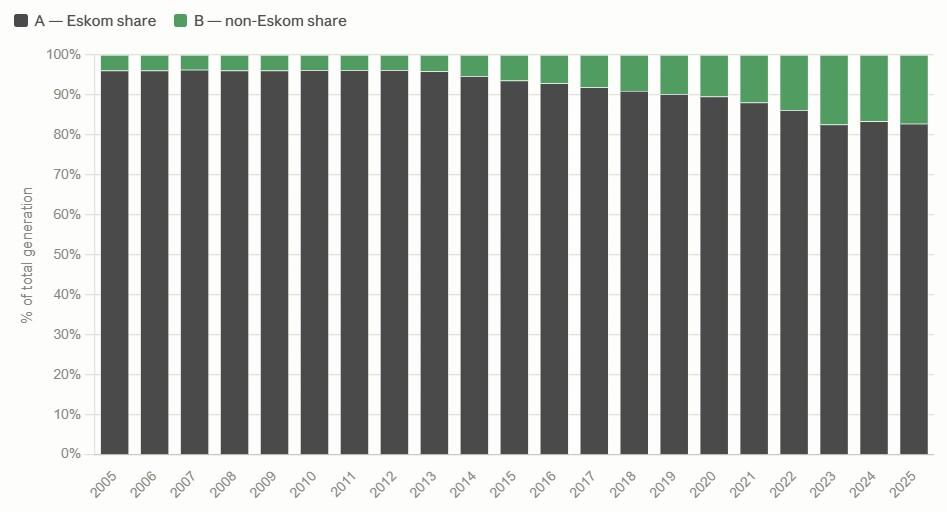
New data shows that Eskom’s share of electricity generation in South Africa has declined significantly over the past decade.
This data was shared by EE Business Intelligence managing director and energy expert Chris Yelland in a social media post as part of the company’s analysis of South Africa’s electricity market.
It showed an acceleration in non-Eskom energy generation since 2015, as load-shedding became more severe.
The state-owned utility is now producing less than 90% of South Africa’s electricity, and its share is heading towards 80% and lower.
This significant change has occurred before South Africa fully liberalises its electricity market, which is set to break Eskom’s monopoly.
A fully liberalised electricity market will mean households and businesses can choose their electricity supplier, with Eskom among many players.
This is likely to result in huge new investments into electricity generation by private companies, as it will ensure a return on investment.
Many households and businesses have already invested in rooftop solar to reduce their reliance on Eskom and their exposure to its price hikes.
This has significantly reduced Eskom’s electricity sales, with the latest Weekly Systems Status report showing contracted energy demand is down 8.17% year-on-year.
The same report also showed that Eskom estimates that there is 9,107 MW of rooftop solar generation capacity in South Africa. This is equivalent to 20% of the utility’s entire capacity.
At the same time, Eskom lacks the ability to invest heavily in expanding its own generation capacity and in new technologies to drive down its production costs.
This is due to the utility’s historic financial mismanagement, which has left it with R360 billion in debt after several government bailouts.
The utility’s balance sheet is too weak to invest in new coal-fired plants and, importantly, in adding renewable generation to its existing fleet.
Renewable energy is significantly cheaper to generate than other forms of generation. Adding it to Eskom’s fleet would enable it to reduce its average cost of producing electricity.
The utility aims to do this through its Eskom Green business unit, which will invest in utility-scale renewable energy generation in South Africa.
Eskom’s declining share of South Africa’s electricity market is shown in the graph below, courtesy of Yelland and EE Business Intelligence.
Eskom being privatised
The rise of private energy generation has led to fears that Eskom is being privatised through the back door, as some other state-owned companies have been.
Efficient Group chief economist Dawie Roodt explained that Eskom finds itself in this situation because of its historic mismanagement.
This mismanagement has left it unable to provide basic services to its customers, pushing them towards private alternatives.
Roodt pointed to the examples of the Post Office and South African Airways (SAA) of what happens when this cycle plays out.
In the case of the Post Office, it has been effectively replaced by private couriers like PostNet and Aramex. SAA has been replaced by FlySafair and international carriers.
“Because they are so destructive, incompetent, and often corrupt, things started falling apart. The more the ANC centralised things, the worse they got,” Roodt explained.
“The ANC’s centralisation of power resulted in things breaking and becoming more fragmented. Eskom is a very good example of that.”
As Eskom’s service levels declined, households and businesses invested in private alternatives. This created competition for the utility for the first time.
It has also created a death spiral, where its best-paying customers are reducing their usage of Eskom-generated electricity.
This leaves it with non-paying or very small customers, forcing it to raise prices to cover its cost of producing electricity. This accelerates the shift to private alternatives.
Private players can generate electricity for their operations without ever having to purchase power from Eskom. They can also wheel it through the grid to other companies, effectively replacing Eskom as the energy generator.
“This is a good news story. The bad news is that these things had to be destroyed in the first place, which hurt the economy,” Roodt said.
“The good news story is that the ANC is being forced to do the right thing by increasing private participation in the economy.”





Comments