Standard Bank customers take a R890 million chunk out of Eskom’s sales


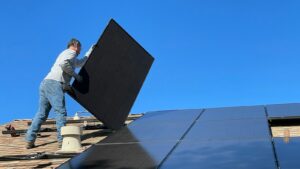
Standard Bank homeowners have reduced their reliance on electricity from the grid through solar installations and increased energy efficiency.
These efforts translate into an estimated saving of R890 million in home-ownership costs across their lifetimes, according to the bank.
The number is likely to only grow further as the bank, along with its competitors, ramps up lending related to sustainability measures.
Standard Bank is the largest provider of home loans in South Africa, with it facilitating one-third of all home financing in the country. This is partly boosted by its 50% ownership stake in SA Home Loans.
In late April 2026, it revealed the scale of the shift towards increased energy efficiency and rooftop solar across its client base.
The bank said the value of “green-aligned financing” to homeowners amounted to R4.7 billion in 2025 and translated into 43,000 tonnes of carbon emissions being prevented.
More importantly for homeowners, they are estimated to save R890 million across their lifetimes from their investments in sustainable alternatives.
“The emissions reduction and estimated savings have been achieved through a combination of residential solar installations, energy-efficient home upgrades and preferential home loan pricing for properties in certified green developments,” the bank said.
“These interventions have allowed homeowners to reduce their reliance on the electricity grid, lower monthly utility bills and cut their long-term carbon footprint, while strengthening household financial resilience.”
The bank’s LookSee unit has been the main driver of increased lending in support of energy efficiency and alternatives to Eskom-generated electricity.
Its head, Marc du Plessis, said thousands of homes across South Africa have added solar panels, converted electric geysers to solar, and increased their energy efficiency in recent years.
Partial conversions, such as converting an electric geyser to a solar panel-powered system, can reduce a household’s electricity bill by as much as 40%.
All of this comes out of Eskom’s overall sales, and while the number may appear insignificant now, as investment in alternatives scales across households and companies, the utility’s revenue base is being eroded.
Not about load-shedding anymore

LookSee has previously noted that despite load-shedding coming to an end, demand for alternatives to Eskom has continued to grow amid sustained above-inflation electricity price hikes.
For example, when Eskom announced in mid-2025 that it would continue asking for significant increases in electricity tariffs, visits to the LookSee platform tripled.
This is in stark contrast to expectations, with many forecasting a slowdown in demand for solar and other alternatives when load-shedding came to an end.
However, the rising price of electricity has made alternatives increasingly financially viable and even profitable investments for households and companies.
“The past year marked a deliberate drive to scale solutions that make sustainable living accessible and affordable,” Du Plessis said.
“Homeowners are under increasing financial pressure as electricity and living costs rise. Electricity costs have seen a compounded increase of 64% since April 2022 and are set to continue outpacing inflation in the coming years.”
Du Plessis explained that while the price of electricity from Eskom is rising, the price of installing a solar system is coming down in some cases.
Lower component prices and enhanced finance options have improved the affordability – and thereby accessibility – of residential solar installations, driving increased demand.
“With demand at more manageable levels, we have seen the cost of components dropping by up to as much as 30% since the beginning of the year,” Du Plessis said.
Stanlib chief economist Kevin Lings said the rise in private electricity generation has been the biggest success story of South Africa’s current reform agenda.
“The biggest success story of this is obviously if we look at our electricity development. When they deregulated the sector, the private sector stepped in and has built a huge amount of energy infrastructure,” Lings said.
“It demonstrates that if you deregulate, the private sector will step in and invest. The argument is to do that for all the infrastructure where we have a major backlog.”
“The private sector has the balance sheet, and it wants to invest. If the government stepped away and deregulated sectors to allow the private sector more, we are convinced that we will get the investment needed to lift the growth rate.”



Comments