Eskom is in serious trouble


Despite making significant progress in effectively bringing load-shedding to an end, Eskom still faces a serious threat from declining demand for its product.
Declining demand, from a stagnant economy and businesses increasingly using alternatives, means that Eskom has a smaller sales base from which it can recoup the cost of producing electricity.
This means that if it cannot find a way to produce electricity much more efficiently, it will have to raise prices. This has the potential to create a downward spiral for the utility, where increased prices result in lower demand, forcing prices to rise.
There is evidence that such a spiral is already taking hold, with South African households and businesses increasingly turning to alternative energy sources to reduce their exposure to Eskom’s elevated prices.
This is feedback from EE Business Intelligence managing director Chris Yelland, who explained to 702 that despite Eskom’s progress, the utility is not in a healthy position.
Eskom and Electricity Minister Kgosientsho Ramokgopa have said their attention has shifted towards reducing electricity prices in South Africa, after the load-shedding crisis has been effectively resolved.
Yelland said this will prove to be challenging, with the current environment of rising costs and falling demand putting Eskom in a tricky situation.
“To talk about saving money and bringing prices down for customers in an environment where you are selling less because demand is declining is extremely difficult,” Yelland said.
Yelland explained that South Africans are turning to alternative energy sources for affordability, not only for security of supply, as was the case during load-shedding.
This has been coupled with industrial demand declining significantly amid a stagnant economy and smelters being effectively priced out of operation.
“Declining demand actually pushes the price up because you are trying to recover a certain cost base off a declining sales base,” Yelland said.
“Whilst there has been a dramatic improvement in the reduction of load-shedding, one has to be concerned about the decline in demand.”
“What is really going on with the decline in demand and the rise in alternative energy sources does not paint a healthy picture for a monopoly utility. In fact, it indicates just the opposite.”
Eskom under pressure

Declining demand is only one of the issues Eskom faces, with it also having to contend with rising municipal debt and the increased cost of environmental compliance.
These factors put the utility in a very difficult position if the current reform agenda takes its course and South Africa gets a competitive electricity market.
In this market, Eskom will have to compete against other generators of electricity for the first time in its history. These private companies are unlikely to have the significant environmental compliance burden of Eskom, nor do they have to deal with billions in municipal debt.
“I would be very worried about demand, which is putting upward pressure on prices. This is one of many issues Eskom faces,” Yelland said.
“There are a number of environmental issues and a rising environmental compliance burden for Eskom to contend with in the coming years.”
While these environmental costs may be significant, Eskom’s chief challenge is dealing with municipal debt, which has skyrocketed in recent years.
Eskom itself has described this as an existential threat to the utility, with CFO Calib Cassim forecasting it to reach R300 billion by 2030.
What makes this even more challenging for Eskom is that the crisis appears to be out of its control, with the utility unable to engage in typical credit control practices given the essential service it provides.
As a result, the utility is heavily dependent on the government, particularly the National Treasury, in finding a solution.
So far, efforts from the National Treasury have been largely unsuccessful, with the rate of growth in debt owed to Eskom increasing in the 2025 financial year.
CEO Dan Marokane explained that Eskom is limited in what it can do to address this crisis, with it being unable to force an end to non-payment by municipalities, as this would crush the economy.
“Let me tell you what drawing the line means. In any other business, you start exercising your credit control. In our case, this means we have to stop the supply of electricity,” Marokane explained.
“If we stop the supply of electricity ourselves, for example, to the City of Johannesburg, the City of Tshwane, and the City of Ekurhuleni and other municipalities, they will be non-functional.”
“So, our credit control options are not as available to us as they are to many other businesses.” Marokane warned that this rise in municipal debt owed to Eskom could result in the utility entering a financial crisis.
Yelland said that, in this regard, rising electricity prices threaten the utility further, with elevated prices resulting in an increase in non-payment and theft from customers.
In turn, this means that municipalities cannot collect sufficient revenue to pay Eskom for the electricity they use, resulting in an increase to municipal debt.
 Loading ...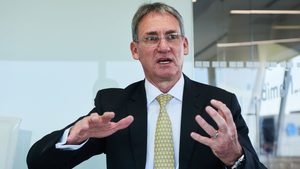




Comments