R1.74 petrol price relief for South African motorists


Inland petrol prices in South Africa are R1.74 per litre lower in January 2026 than they were a year ago, as international oil prices came under pressure throughout 2025 and the dollar had one of its worst years on record.
From 7 January 2026, the price of 95-octane petrol will decrease to R20.75 per litre in Gauteng, compared to a price of R22.49 a year earlier.
This will translate into substantial relief for motorists while also supporting the Reserve Bank’s efforts to keep inflation near its new 3% target point.
In time, this should result in lower interest rates in South Africa, bringing further relief to households and boosting consumer spending.
The outlook for petrol prices for 2026 is cloudy, with significant uncertainty surrounding the economic growth of major economies and potential disruptions to oil supply.
Oil remains on track for a record surplus in 2026, according to the International Energy Agency (IEA). This surplus may be widened by the US operation of Venezuelan oil fields.
Analysts at Goldman Sachs expect output from the South American country to rise after the United States said it was going to “run” Venezuela after capturing its leader, Nicolás Maduro.
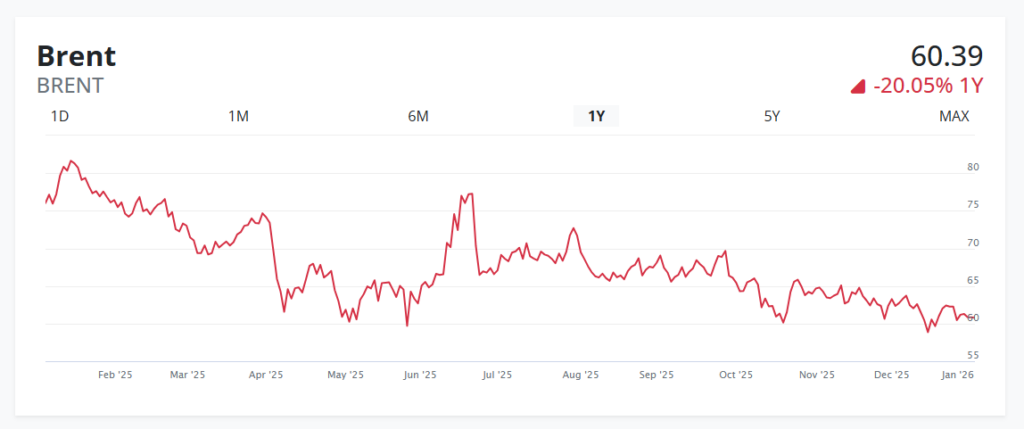
This will put further downward pressure on global oil prices, which have fallen by over 20% in the past year to trade at $60 per barrel.
Increased output from Venezuela will add to strong production from members of the Organisation for Petroleum Exporting Countries (OPEC).
OPEC lifted the production caps on its members in 2025 to prevent them from losing market share, as its bid to keep prices stable failed.
Even if output from Venezuela does not increase, the oil supply in 2026 is still on track to significantly exceed demand.
Venezuela, despite having the largest untapped oil reserves in the world, only represents 1% of global supplies after decades of mismanagement and sanctions.
OPEC has paused supply hikes in the first quarter of 2026 as demand continues to soften, as economic growth slows in Europe and China.
The fall in international oil prices over the past year can be seen in the graph below.
Rand holding its own
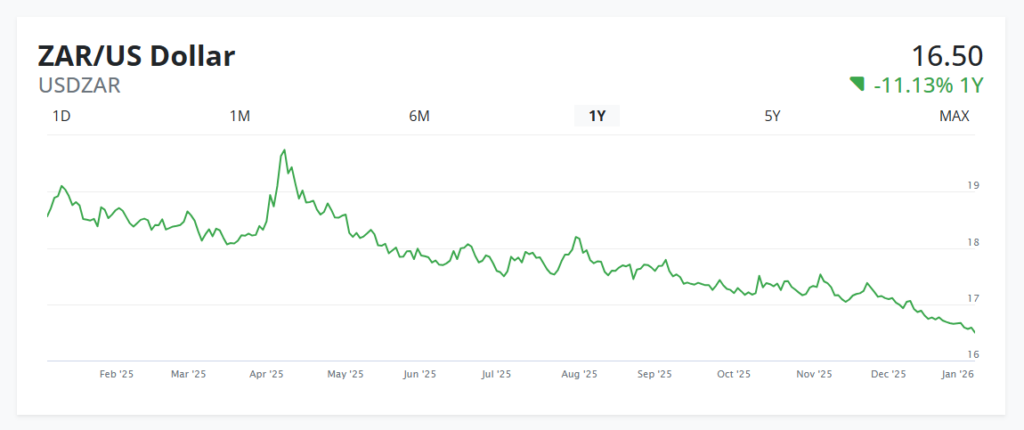
The other half of the equation for South African motorists is the strength of the rand versus the dollar throughout 2025.
While this is largely a function of dollar weakness and soaring commodity prices, not necessarily stronger South African fundamentals, it does make it significantly cheaper to import goods into the country.
The local currency weakened against other major currencies, such as the British pound and euro, indicating that the overall story is one of dollar weakness.
Investec chief economist Annabel Bishop noted that the South African rand gained only 1.1% year-over-year on a nominal trade-weighted basis, mainly due to the dollar’s weakness against the rand.
The greenback’s weakness led to a 2.5% strengthening of the South African rand versus the US dollar exchange rate.
However, the US dollar weakened by 3.3% year-over-year in 2025, while the rand gained only 2.5% against the US dollar for the year.
This means that, in actual terms, the South African rand lost ground against the US dollar over the last year.
However, South Africans will still reap the rewards of a weaker dollar in the form of cheaper imports, lower inflation, and faster economic growth.
The dollar is expected to weaken further in the future, as the fundamentals underpinning a strong greenback have been steadily eroded in recent years.
Historically, shifts from investors out of the US dollar have been short-term cyclical rotations as commodity prices soared and emerging markets generated strong returns.
What makes this time different, according to Old Mutual portfolio manager Zain Wilson, is that the dollar’s weakness has been driven by changes in US fundamentals.
The fundamentals underpinning US exceptionalism are slowly fading, Wilson explained, bringing the dollar down with them.
Wilson explained that the US financial markets have sucked up global liquidity over the past 15 years, driven by four key factors –
- Security of capital: Policy certainty, strong private property rights, and a tight lid on inflation assured investors that their capital was safe in the United States.
- Growth and interest rates: The United States economy outperformed global peers, and relatively elevated interest rates attracted capital to American assets.
- Valuations: The soaring United States stock market was driven largely by earnings growth from American companies and not valuation expansion.
- Returns: US assets, particularly equities, produced exceptionally high returns for investors, creating a feedback loop which attracted investors.
One of the side effects of these factors was a much stronger dollar as money flowed into US assets. This was boosted by the lack of alternatives, as the American economy and financial markets dominated.
In many cases, these factors are still apparent, Wilson said. However, they are slowly being eroded by factors well within the United States’ control.
Wilson explained that security of capital and strong economic growth are the most important factors and that these are being eroded at the fastest pace.
In particular, unconventional policy and increased uncertainty are making investors increasingly question the security of their capital in the United States.
Investors are also increasingly concerned about America’s financial health, with the Federal government running record deficits outside of wartime.
The US government is now sitting on a debt pile worth more than $38 trillion, increasing fears of a financial cliff and concerns that it will look to inflate away this debt, thereby making capital less secure.





Comments