Big turn for petrol prices in South Africa


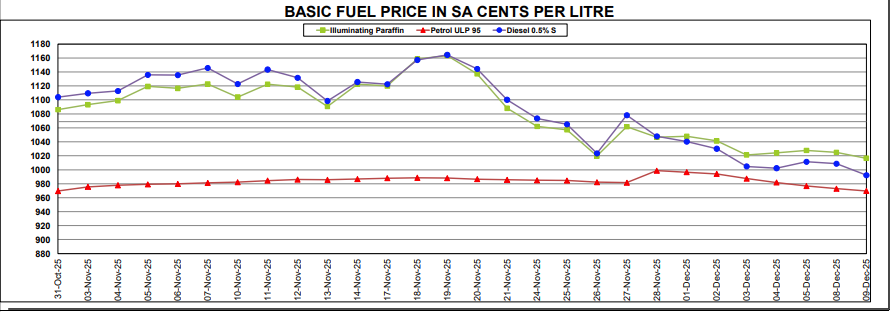
Forecasted price increases for petrol and diesel in January have narrowed dramatically as the month has progressed, with some grades of fuel likely to see a reduction in prices.
This shift has been driven by a rapidly falling oil price, as tensions between the United States and Venezuela eased after the South American country’s airspace was closed at the end of November.
There has also been renewed hope of a peace deal between Russia and Ukraine, which would potentially add significant supply to the global market.
The International Energy Agency (IEA) still predicts a record oil surplus in 2026, which has resulted in prices steadily declining throughout 2025.
A strong rand has ensured that a declining oil price is likely to result in some relief for motorists in January, if current trends hold.
The latest data from the Central Energy Fund (CEF) indicates the following changes to the prices of fuel in South Africa may be made in January –
- Petrol 93 – increase of 4 cents per litre
- Petrol 95 – increase of 2 cents per litre
- Diesel 0.05% – decrease of 70 cents per litre
- Diesel 0.005% – decrease of 73 cents per litre
The large difference between petrol and diesel is due to the easing of capacity constraints at various refineries in Europe and the United States, which are vital for diesel production globally.
These changes compare to significant increases in petrol prices for January projected by the CEF at the beginning of December.
An elevated oil price at that point indicated that petrol prices would rise by around 40 cents per litre and diesel prices would be flat in January.
Brent Crude oil prices have declined by over 3% during the second week of December, as the United States indicated domestic production would hit a record 13.6 million barrels by the end of the year.
This adds to the flood of supply hitting the global oil market, with the Organisation for Petroleum Exporting Countries (OPEC) lifting production caps on its members.
One of the world’s largest oil traders, Trafigura, has said it would be hard to avoid the potential glut, with the only question being the size of the surplus.
The IEA predicts a record oil surplus next year, and the volume of crude crossing oceans is rising. The only reason this has not translated into even lower oil prices so far is because of US sanctions on Russia’s two largest oil companies, Rosneft and Lukoil.
Declining oil prices have been coupled with a strong rand, which is being driven by improving domestic macroeconomic fundamentals.
In particular, stronger-than-expected economic growth and improving government finances have resulted in investor interest in South African assets picking up.
In the first week of December, the government raised $3.5 billion in a sale of dollar bonds that attracted demand for almost four times that amount.
This auction saw the rand trade at its strongest level in three years, hovering just below R17 to the US dollar. It has since been pushed back over the R17 marker.
Improved sentiment towards South African assets is most notable in the country’s 10-year bond yield, which has declined to its lowest level in eight years.
This makes borrowing cheaper for the government and ultimately all participants in the economy, boosting borrowing and growth.





Comments