One mistake made putting South Africa on the edge of another load-shedding crisis


South Africa’s failure to tie its new renewable generation capacity around the country to battery storage is a mistake that could result in the country experiencing load-shedding in the future.
As Eskom steadily retires some of its coal-fired power plants over the next decade, South Africa is going to become increasingly reliant on other sources of energy.
In particular, it will rely on renewable energy generated by a mix of the state, through Eskom, and private players in a competitive electricity market.
However, this renewable capacity has historically not been tied to battery storage, resulting in its effectiveness in replacing coal power being limited.
Eskom chairman Mteto Nyati explained the consequences of this mistake at Old Mutual Investment Group’s Tomorrow Investment Conference.
Nyati explained that investment in storage technologies is booming around the world, with large battery systems being installed in countries from the United States to Australia.
Given South Africa’s expected increase in reliance on renewable energy, it should also be investing heavily in storage.
Nyati explained that the best time to invest in this storage was when the projects are built, particularly those that are intended to be utility-scale on their own.
This is something that South Africa has not done well in recent years, with most independent power producers in the country not having sufficient storage.
Investing in increased battery storage capacity will result in South Africa being able to significantly reduce its usage of coal.
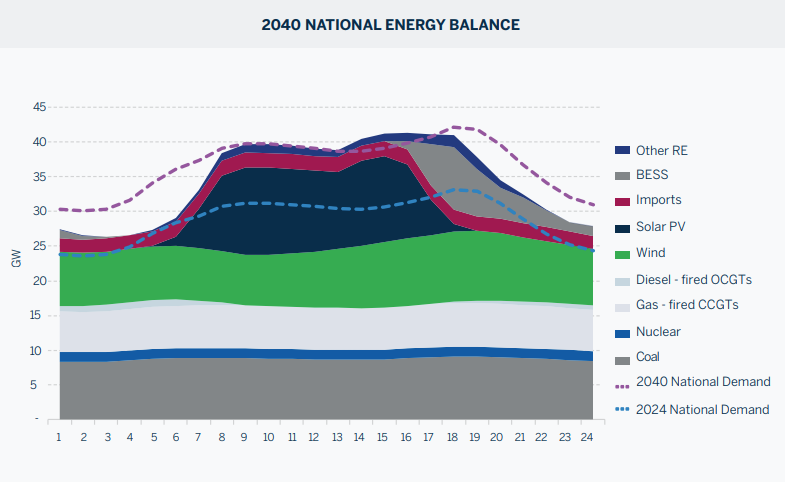
This is because it will enable renewable energy to be dispatched to manage peak demand in the evenings and mornings, when its yield is typically low.
In effect, battery storage enables renewable energy capacity to be shaped to match the country’s demand curve and limit ‘wasted’ generation during the middle of the day when demand is low.
Nyati said that investment in storage is happening in South Africa, but it is relatively slow and is not quick enough to make a meaningful difference in the short term.
He also made it clear to attendees that this does not mean South Africa will dump coal, with it being one of the country’s key advantages that has historically been used to drive industrialisation through cheap electricity.
Load-shedding looms

South Africa is also not adding enough new energy generation capacity fast enough to prevent another severe electricity crisis in the country.
When Eskom begins decommissioning its coal-fired power plants later in the decade, the country is likely to run into significant electricity supply challenges.
This is despite significant investment by the private sector in new generation capacity over the past few years, with thousands of megawatts added to the grid.
Research from Standard Bank’s corporate and investment banking division and Cresco shows that the country desperately needs more generation capacity.
New capacity is needed from various forms, including renewables, gas, storage, and potentially nuclear in the long run.
The report highlighted that the IRP 2024’s most significant shift is the Cabinet’s decision to keep Camden, Grootvlei and Hendrina power stations running until 2030.
The move, designed to stabilise the grid while new capacity comes online, highlights the challenge of maintaining a reliable power supply while meeting environmental goals.
Data indicates that there will be substantial shortfalls in energy supply during parts of the day, requiring ‘top-ups’ with gas, nuclear, or other types of generation.
Energy expert and managing director of EE Business Intelligence, Chris Yelland, highlighted that Eskom’s own Medium-Term System Adequacy Outlook shows a strong likelihood of insufficient supply in the coming years.
The outlook is for 2026 to 2030, and models expected electricity demand based on varying levels of economic growth in South Africa.
Under the moderate scenario – adopted for the base case – electricity demand rises from 243 TWh in 2024 to 264 TWh in 2030, an annual growth of 1.4%.
The outlook identifies a looming base-supply cliff – 8.4 GW of Eskom coal capacity is scheduled for retirement in 2029 and 2030, and the 1.15 GW Cahora Bassa import from Mozambique expires simultaneously, creating a potential loss of 9.5 GW of firm supply.
While Eskom’s review of its coal-fired power shutdown schedule has postponed closures to 2029, the decline remains inevitable.
Koeberg’s life extension to 2044 partly offsets this, but the fleet’s Energy Availability Factor (EAF) remains critical.
Under the moderate-case average of 60% EAF, adequacy is maintained – a fall to 55% EAF reintroduces risks of load-shedding.




Comments